
A safe Kubernetes rollout is a contract between replacement capacity, meaningful readiness checks and graceful shutdown. RollingUpdate creates the overlap; the application must finish accepted work before exiting. This guide shows backend and platform engineers how to design that contract, test it under traffic and distinguish deployment controls from PodDisruptionBudget protection. It is a practical explanation, not an announcement of a new Kubernetes release.
Start with a user operation, not a green Pod
Consider a checkout API with three replicas. A request can already have charged a card when its Pod starts terminating. If the connection disappears before the response arrives, a customer may retry an operation that succeeded. A rollout that keeps three Pods available can still harm that customer. Define the outcome as completed operations, bounded latency and safe retries, rather than merely a successful kubectl command.
Our example assumes a stateless HTTP API, durable transaction records and idempotency keys for writes. These are design assumptions, not measurements from Noor Yasser's production systems. Long-running exports, streaming responses and queue workers need different completion policies. Choose one representative operation and document when ownership of its side effects becomes durable.
Separate deployment controls from disruption budgets
The Deployment documentation explains maxUnavailable and maxSurge. For a three-replica service, maxUnavailable: 0 and maxSurge: 1 provide an illustrative starting point: retain the desired available replica count while allowing a replacement to start. minReadySeconds adds a stability interval before a new Pod counts as available. These controls manage availability, not business correctness.
The disruption documentation draws an important boundary. A PodDisruptionBudget constrains voluntary evictions through the Eviction API, such as a compliant node drain. It does not constrain Deployment rolling upgrades, even though unavailable Pods can count against its budget. Direct deletion and involuntary failures are different again. A PDB is useful for maintenance; it cannot repair a weak rollout strategy.
Before choosing zero unavailability, ensure the cluster can schedule the surge Pod. Account for resource requests, affinity, topology constraints and quota. Terminating Pods can still consume resources. If spare capacity is unavailable, the rollout may stall safely instead of progressing. Increasing allowed unavailability to bypass that stall is a capacity decision with a user-facing consequence.
Give startup, readiness and liveness different jobs
According to the probe configuration guide, startup probes protect initialization, readiness determines participation in Service traffic and liveness can trigger a restart. A successful startup probe allows the other probes to run. Use separate endpoints so their semantics remain understandable during an incident.
A suggested contract is /startup for completed initialization, /ready for the ability to accept the supported operation, and /live for a process condition that restarting can plausibly recover. Do not restart every replica because a shared database is briefly unavailable. Do not report readiness solely because an HTTP listener opened. Conversely, checking every optional dependency on every readiness request can remove otherwise useful capacity. Define which dependencies the operation truly requires, and keep checks cheap and bounded.
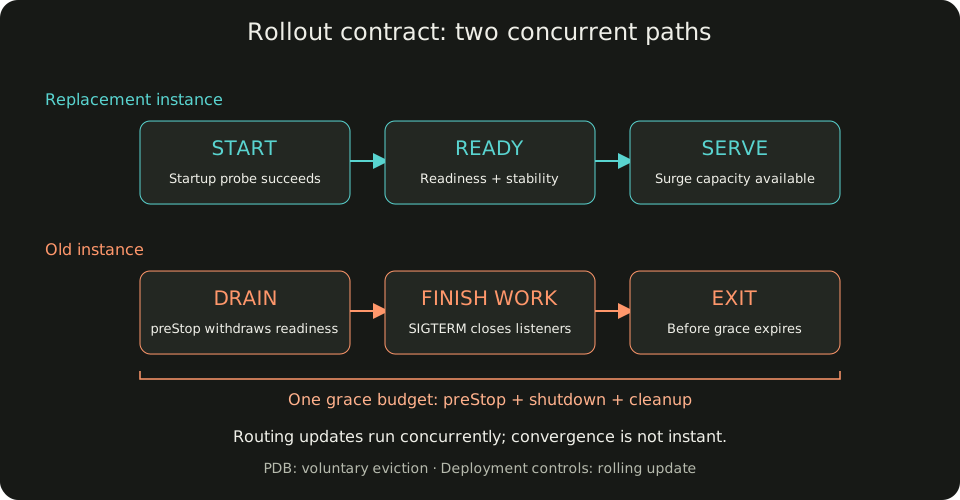
Understand the two concurrent termination paths
The Pod lifecycle reference describes local container shutdown and control-plane endpoint updates occurring concurrently. The kubelet runs preStop when configured, then signals the container's main process. The grace countdown already includes the hook. At the deadline, unfinished processes can be killed. There is no universal interval that makes all traffic paths converge instantly.
At the same time, routing information changes. The EndpointSlice reference distinguishes ready, serving and terminating. Consumers can treat these conditions differently, including fallback behavior when every endpoint is terminating. An ingress, external load balancer or service mesh adds its own behavior. Failing readiness changes eligibility; it does not complete an existing request or revoke every established connection.
Design a bounded handoff: enter a draining state, withdraw readiness, allow a measured routing-convergence interval where the process can still handle late arrivals, then stop accepting new connections and complete admitted work. This is an engineering pattern to validate in your own network, not a Kubernetes guarantee. Immediate rejection during propagation can itself create rollout errors.
Use a manifest fragment with an explicit shutdown contract
The following fragment belongs inside an existing Deployment spec. Values are examples to replace with measured budgets. The application must implement these endpoints; /internal/drain is an idempotent administrative operation, not a public API. Use an isolated management listener and restrict access. A GET is shown only because the lifecycle HTTP handler uses it; do not expose that state-changing route through public ingress.
replicas: 3
minReadySeconds: 10
progressDeadlineSeconds: 300
strategy:
  type: RollingUpdate
  rollingUpdate:
    maxUnavailable: 0
    maxSurge: 1
template:
  spec:
    terminationGracePeriodSeconds: 60
    containers:
      - name: api
        # Keep the existing immutable image, resources and ports.
        startupProbe:
          httpGet: {path: /startup, port: 8080}
          periodSeconds: 2
          failureThreshold: 30
        readinessProbe:
          httpGet: {path: /ready, port: 8080}
          periodSeconds: 2
          failureThreshold: 2
        livenessProbe:
          httpGet: {path: /live, port: 8080}
          periodSeconds: 10
          failureThreshold: 3
        lifecycle:
          preStop:
            httpGet: {path: /internal/drain, port: 9090}
The drain handler first flips readiness to false, then waits for the configured convergence window before returning. It continues serving bounded late arrivals during that window. On the subsequent stop signal, the main process closes listeners and waits for admitted operations. Make both transitions idempotent: the lifecycle hook reference describes at-least-once delivery intent, so hook repetition must not duplicate side effects.
Use this planning inequality: grace period must cover preStop work, the remaining admitted-operation deadline, cleanup and a safety margin. Do not give the hook the entire grace period and then expect another full interval after SIGTERM. Startup timing, request timing and shutdown timing are separate budgets. In a Node HTTP implementation, server.close() stops new connections and closes idle connections; force-closing all connections would also cut active responses. WebSockets require separate tracking and closure handling.
Prove the handoff under continuous traffic
Use a staging environment with the real ingress and relevant mesh configuration. Generate reads, idempotent writes and deliberately slow requests. Attach operation identifiers to logs and traces. During a rollout, record readiness transitions, endpoint conditions, stop-signal receipt, active-request counts and process exit. The official termination-flow tutorial is useful for observing endpoint behavior; add your own application-level assertions.
Run four distinct scenarios: a normal rollout; a replacement that never becomes ready; a maintenance drain that respects the PDB; and a shutdown exceeding the grace budget. Check client-visible outcomes and persisted side effects, not just HTTP response counts. A bad rollout should be detected and stopped by delivery automation. progressDeadlineSeconds reports failed progress; it is not an automatic application rollback mechanism. Verify that your pipeline handles that condition deliberately.
Treat connection resets, duplicate writes, abandoned jobs and unexplained latency spikes as separate failures. Establish acceptance criteria against the service's own baseline; this article does not prescribe a fabricated universal error threshold. Trace the product outcome using a user-journey SLO and connect logs across services through backend observability.
Best uses, limits and patterns to avoid
This pattern fits replicated HTTP services whose work can finish inside a bounded deadline. It also benefits inference APIs with finite request limits, provided cancellation and resource cleanup are explicit. It is insufficient for an hours-long stream, an unbounded task or an application that keeps essential state only in Pod memory. Move durable work ownership outside the Pod, or build a resumable protocol, instead of stretching a shutdown timer indefinitely.
Avoid a fixed sleep copied from another cluster, a liveness check that restarts the fleet during a shared dependency outage, a public drain endpoint and an immediate process.exit() on SIGTERM. Avoid assuming that maxUnavailable: 0 promises zero errors. Concurrent old and new versions must also understand each other's data: use additive schema changes and compatible message contracts before removing old fields. A feature-flag product contract can separate release exposure from deployment, but it does not replace shutdown correctness.
An execution plan for the next release
First document one important operation's timeout, durable side effect and retry behavior. Then implement the probe semantics and an idempotent drain transition. Reserve surge capacity, choose a grace budget from observed behavior and exercise the four scenarios before production. Roll out with user-operation signals visible, and retain a tested recovery path. For a broader implementation, connect this contract to cloud and delivery engineering. The goal is a repeatable, observable handoff that preserves customer work, not an unqualified promise of zero downtime.
Official references
These references document the tools discussed. Examples and design decisions are illustrative and should be adapted to the project and its versions.
- Kubernetes — Deployments
- Kubernetes — Disruptions and PodDisruptionBudgets
- Kubernetes — Startup, readiness and liveness probes
- Kubernetes — Pod lifecycle and termination
- Kubernetes — EndpointSlice conditions
- Kubernetes — Container lifecycle hooks
- Node.js — HTTP server shutdown
- Kubernetes — Pod and endpoint termination tutorial
Prepared by: Noor Yasser
Working through a similar engineering challenge?
I help teams turn architecture decisions into a clear scope and dependable, reviewable implementation.