
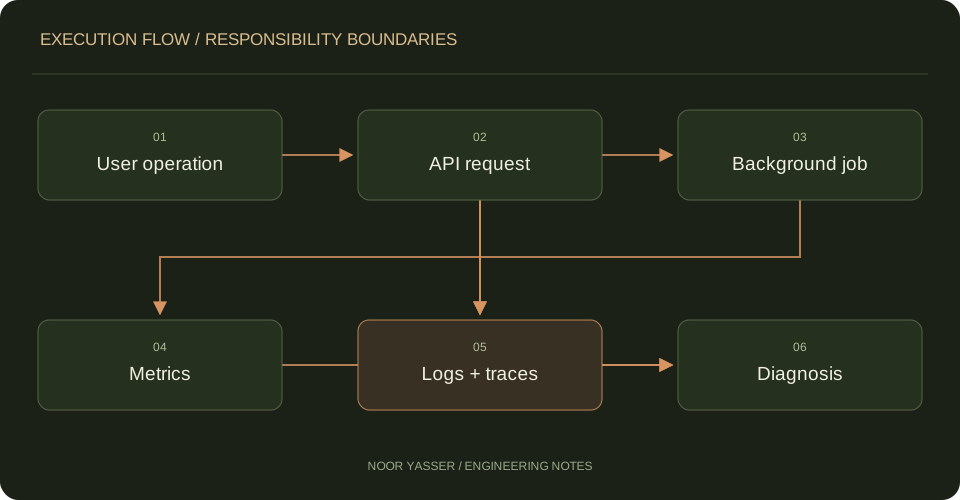
Every server can be running while a user’s order remains unfinished. Uptime does not explain whether a payment event arrived, a job ran or a membership became active. Useful observability begins with a user operation and follows it across HTTP, storage, queues and external services.
Define success in product terms
Choose a path such as order creation or subscription activation. Record its beginning, completion and failure outcomes. A fast 202 response measures acceptance, not background completion. Track both request latency and time to the business result.
Give signals distinct roles
Metrics reveal changes in rates and timing. Structured logs describe specific events. Traces connect the segments involved in execution. OpenTelemetry’s context propagation supports correlation across components. The goal is not to record everything, but to move from an aggregate symptom to the affected operation.
Add context without leaking data
Propagate trace context to downstream requests and messages where supported. Include internal operation identifiers, component names and outcomes in structured records. Do not log access tokens or complete customer messages by default. Define redaction, access and retention because telemetry aggregates information from many product boundaries.
{
  "event": "membership.activation",
  "operation_id": "op_example_123",
  "status": "retry_scheduled",
  "attempt": 2,
  "duration_ms": 480
}
Control metric cardinality
Attaching a unique user or order identifier to every metric can create excessive time series. Prefer bounded dimensions such as operation type, provider and outcome class. Keep detailed identifiers in appropriately controlled logs or traces. Sampling reduces storage cost, but an unconsidered strategy can conceal rare failures.
Alert on actionable impact
High CPU can provide context. An oldest payment event exceeding the service’s processing target is more directly connected to user impact. Give each alert an owner and a diagnostic path, with thresholds that limit noise. Test whether it reveals a problem before a customer report, not merely whether a test email arrives.
Rehearse a bounded failure
In a test environment, delay an external service or interrupt a worker. Follow one operation end to end. Can you identify waiting time, distinguish a retry and determine the deployed version? Improve missing context before adding another dashboard. Observability earns its value by shortening diagnosis and recovery.
Scenario: a fast API and a late business result
A report endpoint responds almost immediately, yet the user waits minutes without receiving a file. Separate acceptance latency from queue waiting, execution and upload time. Correlate them through the same operation and expose meaningful progress states. This distinguishes worker capacity problems from expensive queries or slow external storage.
Check alert quality
Introduce a known failure and record when it began, when the alert arrived and what information the operator needed. If diagnosis requires searching many systems without a shared identifier, the issue is correlation rather than missing dashboards. Review repeated alerts that never lead to action; persistent noise makes the important alert easier to overlook.
Official references
These references document the tools discussed. Examples and design decisions are illustrative and should be adapted to the project and its versions.
Prepared by: Noor Yasser
Working through a similar engineering challenge?
I help teams turn architecture decisions into a clear scope and dependable, reviewable implementation.