
A feature flag is easy to add and surprisingly difficult to finish. The first pull request introduces a conditional branch and a remote switch. The hard work begins after that: deciding who should be evaluated, proving who actually experienced the feature, watching user and system outcomes, recovering when the flag provider is unhealthy, and deleting the branch when the decision is over.
Treating the flag as a toggle solves deployment coordination. Treating it as temporary product infrastructure solves a larger problem: how to release a change to real users without confusing assignment, measurement, safety and cleanup. The flag needs a contract that product, design, engineering, data and operations can all inspect.
This explainer uses current OpenFeature, Unleash and LaunchDarkly documentation verified on 29 September 2026. The operating model and examples are recommendations. They are not a claim that one provider automatically enforces every control described here.
Classify the flag before writing the branch
Not every flag has the same job. A release flag gradually moves a feature from hidden to broadly available. An experiment flag compares variants to answer a product question. An operational flag is a circuit breaker or load-shedding control. An entitlement flag represents an enduring commercial or permission boundary. Mixing these types creates unsafe expectations.
A temporary release flag should have an owner, expected lifetime and removal condition. A permanent operational flag needs tested emergency behavior and a review cadence. An entitlement must be enforced at an authoritative server boundary; a client-side flag is not authorization. An experiment needs stable assignment, exposure evidence and a decision rule, not only a percentage slider.
Write the type into the flag record. It determines the safe default, who may change it, which metrics matter, whether a user should remain in one variant and what “done” means. If the team cannot name the type, it probably cannot define the failure behavior.
Give every flag a product-and-engineering contract
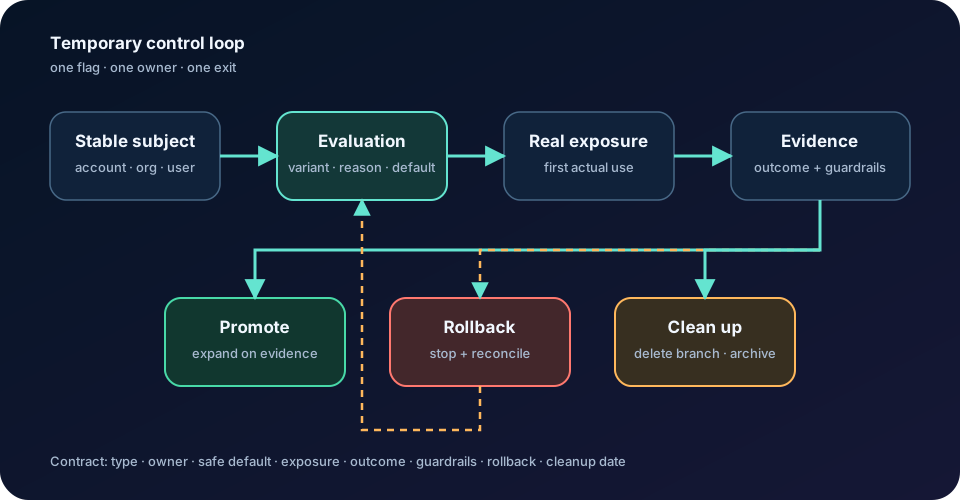
The contract should exist before production exposure. Record the flag key, type, owner, affected user journey, intended outcome, evaluation boundary, targeting attributes, safe default, rollout stages, product metric, operational guardrails, rollback authority, expected expiry and cleanup work. Link the implementation and runbook.
A compact record is enough:
flag: catalog_import_validator_v2
type: temporary release
owner: catalog-experience
subject: organization_id
exposure: first validation executed by v2
outcome: valid import completed within 24h
guardrails: false_rejection_rate, api_error_rate, p95_latency
fallback: v1 validator
rollback: on-call may set 0%
cleanup_by: 2026-10-20
The dates and values above are hypothetical. The important part is that the record connects a technical branch to a user behavior and an exit. This complements the earlier product experiment decision contract: the product decision says what evidence changes the roadmap; the flag contract says how code will create trustworthy exposure and a reversible delivery path.
Make evaluation stable and inspectable
OpenFeature defines an evaluation context that can carry request, application or end-user attributes, with documented precedence across global, transaction, client, invocation and hook levels. Use that flexibility deliberately. Pick one stable subject key at the product boundary—often an account, organization or user—and keep it consistent for the lifetime of the rollout.
If an organization-level workflow is assigned by user ID, two colleagues may see incompatible states in the same shared process. If the subject key changes between web, worker and API calls, one operation may cross variants halfway through. Propagate the smallest stable context needed for the decision, and document where it originates. Do not copy arbitrary personal or high-cardinality data into every evaluation merely because the SDK accepts it.
Use detailed evaluation when the reason and variant matter. OpenFeature's detailed API can return the value, variant, reason and error information, while abnormal evaluation returns the caller-supplied default instead of terminating the application. Store bounded diagnostics for troubleshooting, but do not emit one unbounded log line for every hot-path evaluation.
Separate assignment, exposure and outcome
An evaluation is not proof that a user experienced a feature. Code may evaluate a flag before rendering, then exit through another path. A background prefetch may evaluate a variant that never becomes visible. Counting every evaluation as exposure dilutes the cohort and can make a weak feature look neutral.
Define exposure at the first irreversible or perceivable use of the variant: when the new validator actually evaluates a file, when the new checkout step renders, or when the new ranking result is shown. Record the stable subject, flag key, variant, evaluation reason, exposure time and release version. Emit it once per analysis unit and agreed window, not on every component render.
Then record outcome events separately. OpenFeature's tracking API is designed to associate flag evaluations with later actions or application states, and hooks can report evaluation details to telemetry. This separation lets the team ask whether exposed subjects completed the intended job while retaining the variant and evaluation evidence. It also prevents a business metric from becoming a side effect of the flag call itself.
Design failure semantics before the provider fails
A feature-flag system is another dependency. The application must know what to do when the provider is unavailable, stale or misconfigured. OpenFeature requires evaluation calls to return a supplied default during abnormal execution and defines provider events including ready, error, stale and reconciling. Those mechanisms expose state; the team still chooses the product-safe behavior.
The old path is often, but not always, the safe default for a release flag. A fraud check, privacy control or entitlement cannot silently fail open. A new recommendation panel may safely disappear, while a new write format may require fail-closed behavior or a compatibility layer because switching readers back cannot undo data already written. Decide per flag, not per SDK.
Test startup without the provider, loss of connectivity after warm-up, stale cached rules, missing keys, wrong value types and a context without its expected subject. Surface provider health as a bounded operational signal. The user-facing journey should degrade predictably rather than wait indefinitely for a remote flag decision.
Ramp on evidence, not on the calendar
A progressive rollout is a sequence of decisions, not 5%, 25%, 50% and 100% on fixed dates. Each stage needs a minimum observation window, enough exposed subjects for the intended inference, operational guardrails and an explicit promote, hold or rollback rule. Preserve cohort assignment between stages unless the question requires a new population.
For the hypothetical catalog validator, start with internal organizations and replayed fixtures, then a small production cohort that can fall back to the old validator. Compare valid-import completion, correction loops and support contacts while guarding API errors, latency and false rejections. Segment by file size and integration source if those dimensions were predeclared and actionable. Do not hunt across dozens of slices until one looks favorable.
Connect release telemetry to the actual journey. The checkout recovery design shows why a low raw error count can hide abandonment; the same principle applies here. Pair system metrics with user outcomes. A faster validator that rejects valid catalogs is not an improvement, and a conversion lift that doubles incident load may not be a sustainable release.
Make rollback a product state
“Turn the flag off” is incomplete. State what happens to users who already created data, started a workflow or received a durable artifact under the new path. A rollback may need dual readers, schema compatibility, a queue drain, user messaging or a repair job. The flag only controls future routing.
Build the rollback path before expanding exposure. Exercise it in a non-production environment and during a small cohort. Keep the control plane available to the authorized responder, but do not make a flag change the only incident action: link dashboards, decision thresholds and data-repair steps. Record who changed the flag, from which state to which state and why.
For high-impact changes, use a two-part response: reduce or stop new exposure, then reconcile work already admitted. Backend observability helps follow affected operations across services; the flag's variant and exposure identity should be searchable evidence, not a high-cardinality metric label.
Delete the branch after the decision
Temporary flags accumulate technical debt when code and configuration outlive their purpose. Unleash marks flags potentially stale after an expected lifetime, and LaunchDarkly's release guidance calls for monitoring during rollout and removal of temporary flags once the feature is stable. A dashboard warning helps, but the code still needs a deliberate cleanup change.
When the decision is final, freeze the winning behavior, remove the losing branch and its tests, simplify the data model where compatibility allows, deploy the unconditional path, verify that no evaluations remain, then archive the flag while preserving appropriate history. Delete targeting attributes and telemetry that existed only for the rollout.
Cleanup is not a cosmetic task. Each stale branch multiplies the state space future engineers must test and can preserve a path whose assumptions are no longer valid. Put cleanup in the feature's definition of done, reserve capacity for it, and escalate expired flags to the owning team. A release is complete when the product behavior is stable and the temporary control is gone.
Review the full lifecycle in one test matrix
Test both values and every planned targeting boundary. Add missing context, provider unavailable, cached stale configuration, process restart, concurrent requests, user migration between segments, rollback during an active workflow and removal of the flag after the winning branch is deployed. Verify exposure deduplication and outcome joins with synthetic identities.
Keep product and operational assertions together. Did the intended cohort receive one stable variant? Did only real use create exposure? Did the outcome event join to that exposure? Did guardrails trip before unacceptable harm? Did rollback stop new exposure and preserve existing data? Could the team remove the flag without changing unrelated behavior?
The useful mental model is a temporary control loop: evaluate a stable subject, observe actual use, measure the user and system consequences, promote or reverse on pre-agreed evidence, then erase the branch. A flag without exposure evidence is guesswork; a flag without failure semantics is a dependency risk; and a flag without an exit plan is permanent complexity disguised as delivery safety.
Official references
These references document the tools discussed. Examples and design decisions are illustrative and should be adapted to the project and its versions.
- OpenFeature Specification — Flag Evaluation API, verified 29 September 2026
- OpenFeature Specification — Evaluation Context, verified 29 September 2026
- OpenFeature Specification — Hooks, verified 29 September 2026
- OpenFeature Specification — Tracking, verified 29 September 2026
- OpenFeature Specification — Events, verified 29 September 2026
- Unleash Documentation — Technical debt, verified 29 September 2026
- LaunchDarkly Documentation — Deployment and release strategies, verified 29 September 2026
Prepared by: Noor Yasser
Working through a similar engineering challenge?
I help teams turn architecture decisions into a clear scope and dependable, reviewable implementation.