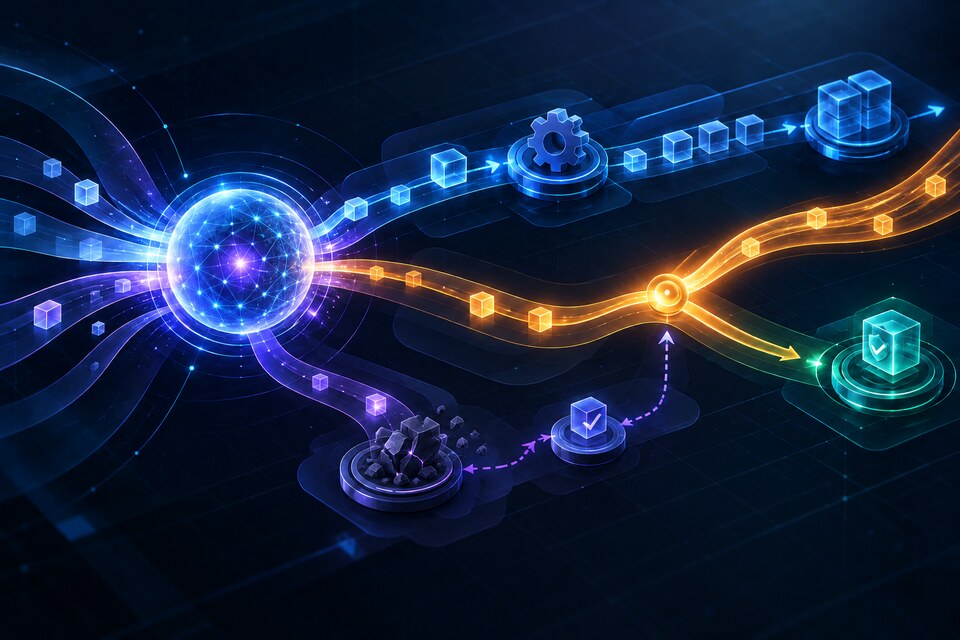
The difficult part of connecting an AI agent to a database is not generating SQL. It is letting unpredictable, parallel and sometimes long-running reasoning tasks inspect current business data without taking CPU, memory or I/O away from checkout, payments or other production transactions. On 24 September 2026, Google Cloud announced a preview of PostgreSQL for agents in AlloyDB built around that boundary: share an up-to-the-second view of the data, but not the database compute serving the application.
This is a preview, not a generally available guarantee. Access requires a request, and Google documents it under Pre-GA terms with limited support. The architecture is nevertheless worth studying because it addresses a real distributed-systems problem that conventional read replicas, shared block servers and object-store exports solve only partially.
What Google actually introduced
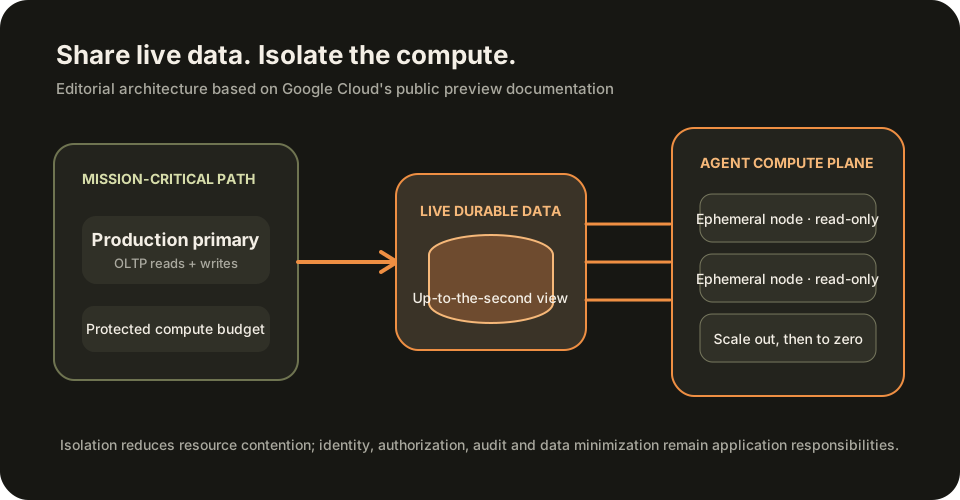
The new unit is an AlloyDB agent node: an independent, ephemeral microVM running a full PostgreSQL engine. Google says the node can use PostgreSQL indexes, extensions and query features, including vector, full-text and spatial search, against a current read-only view of production data. The node can also participate in queries that reach BigQuery or Spark through the documented federation paths.
The important word is independent. According to Google's architecture explanation, agent nodes do not share database compute, memory or network components with the production primary. Their storage access uses dedicated Colossus segments rather than the production server's storage path. A burst of agent queries can therefore consume its own node fleet instead of competing for the primary's execution slots.
Nodes are disposable. An application can create them for a task, fan out work across many nodes and release them afterward. Google describes scaling from zero to thousands and billing for the seconds in which nodes are active. The announcement does not, however, publish a complete price table for every configuration; teams should model cost from their preview agreement rather than infer it from the phrase “scale to zero.”
Why a normal read replica is not the same boundary
A read replica is often the first answer to analytical or agent traffic. It is familiar and preserves PostgreSQL behavior, but it is a provisioned server with finite capacity. If hundreds of agents arrive at once, they queue behind the same replica resources unless the fleet is overprovisioned or actively rescaled. Replica lag and promotion responsibilities also become part of the operating model.
A shared disaggregated database can attach many workers to common storage, but noisy-neighbor protection depends on how much of the I/O, cache, metadata and network path remains shared. Exporting snapshots to an object store isolates production better and can scale cheaply, yet the agent sees stale data and may lose relational execution, indexes or transactional semantics.
AlloyDB's proposed trade is different: retain PostgreSQL execution close to live data, then create a separate compute-and-storage access path for each agent workload. Read-only access sharply narrows the blast radius, but also means an agent cannot complete a write-heavy workflow inside that node. Production changes should pass through a separately authorized service or command path with validation, idempotency and human approval where the risk requires it.
Read-only isolation is not authorization
The feature separates resources; it does not decide which rows an agent should see. A node with access to a current production view can still expose personal, financial or tenant data if credentials are too broad. Treat the node as a database client with a new failure domain, not as an automatic security sandbox.
Create a dedicated database role for each agent class. Grant only the schemas, views and functions it needs. Apply row-level security where tenant boundaries require it, keep secrets out of prompts, and audit both the database identity and the end-user or service identity that initiated the task. A read-only query can still create harm through data disclosure or excessive retrieval.
Data minimization matters to RAG and tool use alike. Prefer purpose-built views that exclude sensitive columns over telling a model not to select them. Cap statement time, result size and concurrency at the agent gateway. Log the query fingerprint, role, node, latency, rows returned and task identifier without copying sensitive result data into a less protected observability system. These controls complement the design in PostgreSQL tenant isolation and the retrieval boundaries in RAG quality engineering.
Reading the benchmark without turning it into a promise
Google reports that one to ten agent nodes increased a benchmark from about 3,900 to 41,000 queries per second, and that a larger test reached roughly three million queries per second at 1,000 nodes—described as a 773× increase. The company also reports more than eight million IOPS, over one terabit per second in a 2,100-node scan test, and no measurable impact on the primary during those experiments.
Those figures are vendor-reported engineering results, not independent measurements or an SLA. Their value is evidence that the architecture was exercised at unusual fan-out, not a forecast for an application's latency or bill. Query shape, cache warmth, index design, result size, dataset layout, concurrency and region can all change the outcome. A 773× throughput increase also does not imply a 773× reduction in end-to-end agent time: model inference, tool orchestration and serialization may dominate the critical path.
A useful evaluation therefore reports both database and task metrics. At the database layer, measure node startup time, p50/p95/p99 query latency, cache behavior, I/O, failed queries and total active node-seconds. At the application layer, measure completed tasks, time to first useful result, total tool calls, retries, answer quality and cost per successful task. Compare these with a fixed replica and a snapshot-based path under the same query corpus.
A safe pilot design
Start with one read-only workload whose source of truth already lives in AlloyDB and whose answers benefit from fresh data: operational support search, fraud investigation or a catalog assistant are better candidates than an autonomous refund executor. Build the pilot as an explicit control plane rather than letting a model create arbitrary infrastructure.
user task -> policy gateway -> node lease -> scoped SQL tool
                 |                |              |
                 v                v              v
          identity + limits   create/expire   query + audit
                                  |
                                  v
                         isolated agent node
The gateway should bind a task to a database role, maximum node count, time budget and query policy. A lease controller creates or reuses nodes within that boundary and guarantees expiration after success, cancellation or timeout. The SQL tool uses prepared operations where possible and rejects writes. A separate command service handles any proposed mutation only after business validation.
Run failure tests before a demo: a malformed query loop, a thousand simultaneous tasks, cancellation during node startup, an unavailable federation target, a tenant-boundary probe and a task that exceeds its budget. Confirm that production latency stays inside its objective and that orphan nodes are reclaimed. Feed node lifecycle and query signals into the same incident model used by backend observability.
Where the preview fits—and where it does not
The design is compelling when the data is already in AlloyDB, freshness matters, workloads arrive in large bursts, and SQL or PostgreSQL extensions are a better retrieval layer than a separate index. It may also simplify experiments that would otherwise require a large standing replica fleet.
It is less attractive when the workload needs frequent writes, the authoritative data spans many systems without a clean federation boundary, or a small fixed replica already meets latency and cost goals. Teams committed to another database should compare the migration cost with adding an isolated query service, CDC-fed analytical store or purpose-built vector system. Architectural novelty is not a reason to move the source of truth.
The practical conclusion is narrower than the marketing headline: AlloyDB now previews a new compute boundary for read-only AI-agent access to current PostgreSQL data. If Google’s isolation claims hold under a team's own workload, that boundary can protect production from agent fan-out. It does not replace least privilege, data governance, query budgets, observability or an independently authorized write path. Those remain the parts that make an agent safe to operate.
Official references
These references document the tools discussed. Examples and design decisions are illustrative and should be adapted to the project and its versions.
Prepared by: Noor Yasser
Working through a similar engineering challenge?
I help teams turn architecture decisions into a clear scope and dependable, reviewable implementation.