
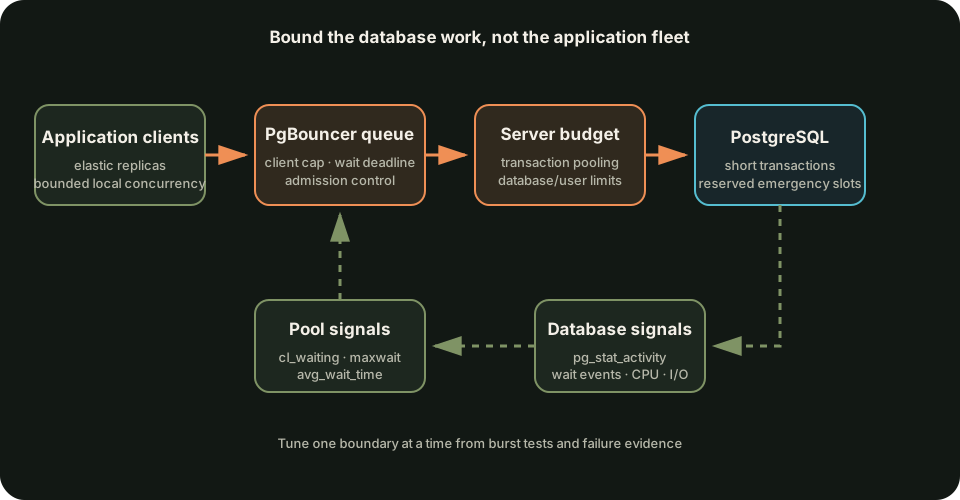
PostgreSQL connection pooling is safest when it acts as admission control, not as permission to open more database sessions. Put PgBouncer between elastic application workers and PostgreSQL, cap the real server connections below the database's operational limit, allow only a bounded client queue, and reject work before its caller's deadline expires. Transaction pooling usually gives the highest reuse for short web requests, but only after the application proves it does not depend on session-scoped state.
This guide is based on the official PgBouncer and PostgreSQL 18 documentation, reviewed on 5 October 2026. The example values are illustrative, not universal sizing advice. Derive the final numbers from transaction duration, database saturation signals, workload priority and a controlled burst test.
`max_connections` is a ceiling, not a throughput target
PostgreSQL creates a backend process for each accepted connection. Its documentation also states that some resources are sized directly from `max_connections`, so increasing the setting increases allocations including shared memory. A larger limit can stop an immediate “too many connections” error while giving the database more concurrent work than CPU, storage or lock paths can complete.
Start with the database's safe active concurrency, not the replica count of the application. A service with 40 containers and a local pool of 20 can theoretically request 800 connections. That arithmetic says nothing about whether PostgreSQL can run 800 queries usefully. The capacity budget belongs to the database failure domain and should include headroom for migrations, monitoring, administration, replication and incident recovery.
Preserve PostgreSQL's emergency slots. The server supports `reserved_connections` for roles granted `pg_use_reserved_connections` and `superuser_reserved_connections` as a final reserve. Do not point ordinary application traffic at those roles. A pool that consumes every normal slot makes the database hardest to inspect exactly when it is failing.
Choose the pooling boundary before tuning numbers
PgBouncer offers three reuse boundaries. Session pooling holds one server connection for the whole client connection and supports all PostgreSQL features. Transaction pooling releases the server connection after each transaction. Statement pooling releases it after every statement and disallows multi-statement transactions.
For HTTP APIs, workers and serverless tasks with short transactions, transaction pooling is often the useful starting hypothesis. A thousand mostly idle application connections can share a much smaller set of busy database connections. It is not transparent, however. PgBouncer documents that transaction pooling does not preserve ordinary `SET`/`RESET`, `LISTEN`, SQL-level `PREPARE`, session-level advisory locks or temporary tables configured to preserve rows across transactions.
Use session pooling for a workload that genuinely requires those semantics, or separate it onto a dedicated PgBouncer database entry and budget. Do not weaken the main API pool because one background process uses `LISTEN`. A direct PostgreSQL connection can also be reasonable for a small number of known, long-lived administrative workers when their capacity is reserved explicitly.
Build a connection budget, not one global pool size
PgBouncer creates a distinct pool for each `(database, user)` pair. That detail changes the arithmetic. A `default_pool_size` of 30 is not necessarily 30 server connections for the whole PgBouncer process; several databases and users can each receive a pool. Use `max_db_connections` and `max_user_connections` to enforce the larger failure-domain budget rather than relying only on the per-pool default.
An illustrative configuration might look like this:
[databases]
app = host=postgres.internal dbname=app \
      pool_mode=transaction \
      pool_size=32 \
      max_db_connections=40 \
      max_db_client_connections=240 \
      query_wait_timeout=3

[pgbouncer]
listen_port=6432
max_client_conn=600
default_pool_size=20
reserve_pool_size=0
max_prepared_statements=100
server_idle_timeout=600
These are demonstration values. Here, the database cap protects PostgreSQL across user-specific pools, while the client cap bounds how much work can wait for that database. PgBouncer describes the difference between `max_db_client_connections` and `max_db_connections` as a conceptual queue size. The process-level `max_client_conn` is another guard, not a substitute for per-database and per-user limits.
File descriptors need their own calculation. PgBouncer warns that potential descriptors include both accepted clients and server pools, and the theoretical count grows with databases and users. A high client limit with an unchanged operating-system limit can move the failure from PostgreSQL to the pooler.
Queue intentionally and fail before the deadline
Queueing absorbs a short burst; it does not create database capacity. When every server connection is busy, new transactions wait in PgBouncer. If arrival remains above completion rate, the queue grows, latency rises and upstream requests may time out while the query is still waiting to begin.
Set the application's pool-acquisition or request deadline deliberately, then keep `query_wait_timeout` inside that budget. PgBouncer disconnects a client whose query cannot acquire a server before this timeout; setting it to zero allows indefinite waiting. A bounded failure is easier to retry, shed or surface than a request that occupies an application worker until an unrelated proxy closes it.
Do not use `reserve_pool_size` as permanent capacity. A reserve can help a brief exceptional burst after `reserve_pool_timeout`, but if it is active continuously, the normal budget is wrong or the database is overloaded. Keep the reserve small or disabled, and measure why it activates.
Backpressure should continue upward. Limit concurrent database operations in each application instance, use jittered retries only for safe reads or idempotent writes, and stop accepting low-priority batch work when pool wait time breaches its objective. A queue at every layer hides overload and multiplies tail latency.
Make transactions short enough to return the connection
Transaction pooling can only reuse a server after the transaction ends. An `idle in transaction` client holds scarce capacity without doing useful work and can also retain locks or an old snapshot. Open the transaction immediately before the related statements, commit before external HTTP calls, and never wait for user input while holding it.
An ORM request transaction that wraps rendering, API calls and message publication defeats the pool even if each SQL statement is fast. Split the workflow: validate first, run the smallest atomic database change, commit, then execute retry-safe external work through an outbox or durable job. Measure transaction duration separately from individual query duration.
Set timeouts according to semantics rather than copying one number everywhere. PostgreSQL `statement_timeout` limits a statement; `lock_timeout` limits lock acquisition; PgBouncer `query_wait_timeout` limits waiting for a server connection. An upstream HTTP deadline covers the whole request. Each protects a different phase.
Test prepared statements and session state explicitly
Modern PgBouncer can track protocol-level named prepared statements in transaction pooling when `max_prepared_statements` is non-zero. It maps client names to internal statements and prepares them on whichever server connection is assigned. SQL commands such as `PREPARE`, `EXECUTE` and `DEALLOCATE` do not receive the same transparent treatment.
This feature has memory and compatibility trade-offs. The configured value controls an LRU cache per server connection; increasing it keeps more prepared statements resident. Run the real driver and ORM through PgBouncer in transaction mode, exercise schema changes and reconnects, and verify that prepared-plan errors do not appear during a rolling deployment.
PHP deserves a deliberate check. PgBouncer's FAQ says PHP/PDO compatibility with its prepared-statement tracking depends on PHP 8.4+ with libpq 17; for older combinations it recommends upgrading or disabling server-side prepared statements. Emulated prepares change where parsing and binding occur, so treat the driver choice as a tested compatibility decision, not a hidden environment toggle.
Also audit session dependencies. Search for `SET`, `LISTEN`, advisory locks, temporary tables and SQL-level prepared statements. Add a contract test that performs consecutive transactions likely to land on different server connections. A passing happy-path query does not prove transaction pooling is safe.
Observe PgBouncer and PostgreSQL as two systems
Pooler health and database health answer different questions. `SHOW POOLS` exposes `cl_waiting`, active and idle server counts, and `maxwait`, the age of the oldest waiting client. `SHOW STATS` exposes transaction and query rates, durations and `avg_wait_time`, the average time assigned clients waited for a server during the statistics period.
On PostgreSQL, inspect `pg_stat_activity` by application, state, transaction age and wait event. The official monitoring guide shows how `wait_event_type` and `wait_event` identify sessions blocked on locks, I/O and internal synchronization. Keep application names bounded and useful so the server view can distinguish API, workers, migrations and administration.
Interpret the layers together:
- Rising `cl_waiting` and `maxwait` with PostgreSQL CPU or I/O already saturated means the pool is protecting an overloaded database. More server connections may make it worse. - Rising pool wait with idle PostgreSQL capacity can indicate a pool budget that is too small, fragmented `(database, user)` pools, long transactions or a connection-path problem. - Many PostgreSQL backends `idle in transaction` indicate an application lifecycle defect, not a reason to raise the pool size. - Low average wait with a bad p99 application latency can hide a hot endpoint or tenant; preserve endpoint and workload-class context outside high-cardinality metric labels.
Alert on sustained queue age, not merely client count. Hundreds of idle clients may be harmless in transaction pooling, while five waiting clients with a deadline of one second are already an incident.
Validate with burst and failure tests
Reproduce the connection topology in staging: the same application replica count, driver pool behavior, PgBouncer mode and PostgreSQL limits. Run a steady baseline, a short arrival burst and a sustained overload. Record completed transactions, PgBouncer wait distribution, PostgreSQL active sessions, wait events, CPU, I/O, lock waits and application error classes.
Then inject failures. Pause PostgreSQL briefly, restart PgBouncer safely, exhaust one tenant or workload budget, hold a transaction open and deploy a schema change while prepared statements are active. Confirm that queues remain bounded, callers receive classifiable failures, retries do not duplicate effects, and emergency access remains available.
Tune one boundary at a time. Increasing `pool_size`, application concurrency and retry count together makes the result impossible to explain. The release gate should state a maximum queue age and error budget under the target burst, plus a rollback configuration.
Know when PgBouncer is not the answer
PgBouncer cannot repair slow queries, missing indexes, lock contention, storage saturation or an ORM that opens oversized transactions. Fix the expensive work first. For a low-connection service on a managed database that already provides a compatible pooler, another proxy may add operational cost without meaningful protection.
Transaction pooling is also the wrong default for workloads built around session semantics. Keep those on session pooling or direct reserved connections. Conversely, session pooling provides little multiplexing when serverless or autoscaled clients create many long-lived connections; in that case the application behavior and pool mode must change together.
The production invariant is simple: PostgreSQL sees a bounded number of purposeful sessions, excess demand waits only within an explicit deadline, and every queue and transaction is observable. That makes PgBouncer a capacity firewall rather than a place where connection pressure disappears. For related safeguards, see PostgreSQL tenant isolation, logical-replication drift monitoring and backend observability.
Official references
These references document the tools discussed. Examples and design decisions are illustrative and should be adapted to the project and its versions.
Prepared by: Noor Yasser
Working through a similar engineering challenge?
I help teams turn architecture decisions into a clear scope and dependable, reviewable implementation.