
A reliable Shopify bundle is not merely several SKUs shown as one card. It is a commerce contract that must define component identity, quantity, price allocation, inventory eligibility, cart presentation, order representation and failure behavior. Use Shopify's fixed bundle model when composition is known before the cart. Use a customized bundle with a Cart Transform Function when the buyer assembles components dynamically. Do not choose the implementation from the storefront appearance alone.
This guide uses Shopify's official developer documentation, verified on 5 October 2026. Shopify documents the platform behavior and limits; the versioning, fallback, testing and observability patterns below are engineering recommendations. It is an explainer, not a Shopify feature announcement.
Choose fixed or customized from the invariant
Shopify's bundle overview separates fixed bundles from customized bundles. A fixed bundle models a product or variant with predefined component relationships. It fits standard sets and multipacks whose combinations stay within the platform's variant model. A customized bundle uses the Cart Transform path for cases such as mix-and-match, where composition is selected at runtime.
The decision question is: when does the sellable composition become true? If the merchant publishes a stable set—one camera, one battery and one case—the relationship belongs in the product model. If the buyer chooses any three flavors from a larger collection, composition becomes true in the cart and needs a transform plus a storefront selection experience.
Do not use a customized function merely because it feels more flexible. The app then owns the picker, configuration, stock presentation, function runtime, migration and failure path. Conversely, do not manufacture hundreds of fixed variants to represent a combinatorial builder. That creates catalog and operational complexity before checkout begins.
Define one versioned bundle contract
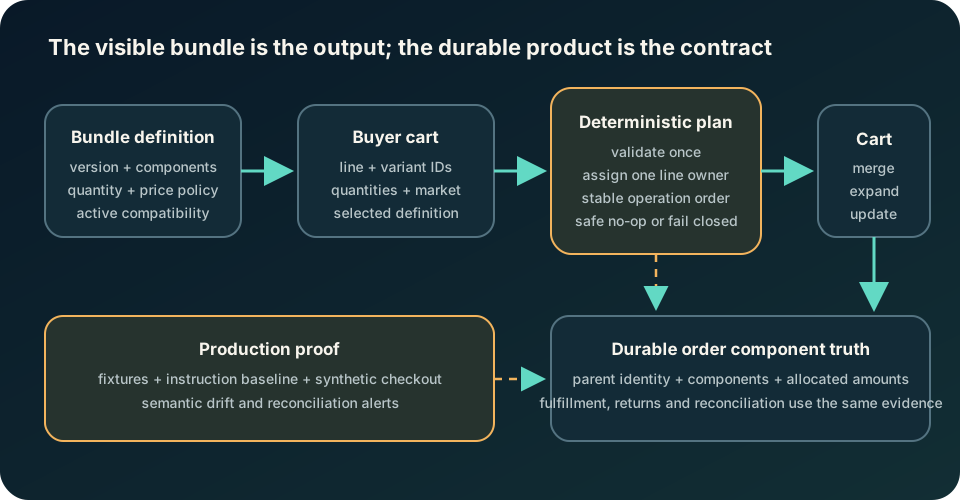
Store a bundle definition with a stable identifier and explicit schema version. Include the parent variant, allowed component variants, required quantities, option rules, pricing policy, market or currency scope, effective window and publication state. Treat merchant configuration as untrusted input: validate referenced variants, ownership, duplicates, maximum component count and impossible quantities before activating it.
The Shopify comparison makes the pricing and inventory differences important. Fixed-bundle price comes from the parent and Shopify allocates it across components. For customized bundles, expand derives price from the parent, while merge derives it from components with a function-supplied adjustment. Fixed bundles receive platform-maintained sellable quantity from components; customized storefronts must present availability themselves, although Shopify checks components again in cart and checkout.
Keep the published definition immutable. A merchant edit creates version 8 while carts already containing version 7 retain evidence of what the buyer selected. If the function reads only the newest mutable metafield, a price or component can change beneath an open cart. Carry a bounded configuration key or version in cart attributes and resolve only active, compatible definitions.
Keep the Function input small and deterministic
The Cart Transform Function API runs inside cart and checkout. Query only the fields required to reach a decision: line ID, variant ID, quantity, the minimum configuration reference and perhaps market context. Avoid network-dependent truth or a large remote rules engine on this path. The same validated input and definition should produce the same ordered operations.
Build maps in one pass instead of comparing every cart line with every other line. Reject invalid configuration early and return no operations when no bundle candidate exists. Shopify's instruction-count guidance says a Function can execute up to 11 million instructions for carts with up to 200 lines and that the limit scales for larger carts. Shopify also stresses that merely staying below the ceiling is not the goal because each instruction adds latency in a critical buyer flow.
Rust gives the most headroom for complex or large-cart logic; JavaScript can still suit bounded contracts if measured with production-shaped fixtures. Record instruction count, input size, output size and bundle count for every regression fixture. A one-line demo proves syntax, not checkout capacity.
Treat operations as an ordered plan
A transform returns ordered operations. Use merge when separate component lines should appear as a grouped parent. Use expand when one parent line must become component lines. Use update only for supported presentation changes such as title, image or price, and verify store eligibility before depending on an operation. Never target the same line twice accidentally.
type Plan = {
  definitionVersion: string;
  consumedLineIds: string[];
  operation: 'linesMerge' | 'lineExpand';
  parentVariantId: string;
  componentFingerprint: string;
};

const plan = validateAndPlan(cart, activeDefinitions);
if (!plan.ok) return { operations: [] };
return { operations: renderOrderedOperations(plan.value) };
The planning phase is application architecture, not a Shopify SDK example. It prevents validation, selection and rendering from being intertwined. Give each input line one owner, sort candidates by a stable key and calculate a component fingerprint from normalized variant IDs and quantities. The output should never depend on map iteration order or wall-clock time.
When multiple apps install cart transforms, Shopify runs them and resolves operation collisions according to documented rules. Your app cannot assume it is the only modifier of a cart. Test coexistence with discounts, selling policies and other cart transforms, and make an untouched cart a safe outcome.
Make inventory and price promises explicit
For a fixed bundle, platform sellable quantity provides a strong starting point, but downstream systems still need component-level fulfillment truth. For a customized bundle, the selector can offer a fast availability hint, not a reservation. Cart and checkout validation remains authoritative. Tell the buyer when a component becomes unavailable and preserve the selection so recovery does not require rebuilding the bundle.
Define the pricing owner. A fixed parent price and a component-derived customized price are different accounting models. Specify how discounts allocate, how rounding is handled per currency, whether a price adjustment may make a line negative and what happens when a component price changes while a cart is open. Recompute from authoritative cart inputs; do not trust a browser-submitted total.
Shopify computes taxes on components and represents components in orders. ERP, warehouse and analytics adapters should therefore ingest the component relationship, not reconstruct it from a title. Keep parent identity for merchandising and component identity for stock, tax, fulfillment and returns.
Design the failure policy before launch
Choose whether checkout should continue with unmodified lines or stop when transformation fails. The right policy depends on the product promise. If components are independently valid at their normal prices, a graceful ungrouped cart may be acceptable. If the parent cannot be purchased without components, mark it with the documented requiresComponents behavior and fail closed against incomplete composition.
Do not silently continue after partial interpretation. An invalid definition should produce a clear safe outcome, telemetry and a merchant-facing configuration error. A runtime exception is different from a valid no-op; monitor them separately. Shopify's production error guide exposes runtime, instruction, stack and output problems. Copy representative inputs into a compliant test corpus instead of relying on logs, which are intentionally limited.
Create a rollback unit containing Function binary, input query, configuration schema, storefront block and order parser. Releasing only a previous WebAssembly module while leaving a newer metafield schema active is not a rollback.
Preserve component truth after checkout
The order is the durable evidence of what was bought. Persist Shopify order line and component references, parent merchandising identity, definition version, quantities, allocated amounts and fulfillment state. Do not depend on the current product catalog to explain an old order; products, titles and compositions can change.
Returns need an explicit policy. Can one component be returned alone? Does a bundle discount need proportional reversal? Can a warranty parent remain valid after one item is refunded? Represent these as policy decisions and ledger adjustments rather than editing the historical bundle. Reconciliation should compare order components with ERP or warehouse records and surface missing or duplicated fulfillment lines.
For event delivery and recovery, pair this design with the durable Shopify webhook architecture. If the integration spans merchants, propagate tenant context as described in tenant-safe SaaS architecture, and use checkout recovery paths for buyer-facing failures.
Test the contract, not only the happy path
Build fixtures for one valid fixed bundle, one valid customized bundle, incomplete components, duplicate lines, quantity splits, a component removed after selection, stale configuration, multiple currencies, discount interaction, a very large cart and another transform touching the same line. Assert exact ordered operations and the untouched fallback.
Replay production-shaped inputs locally and set instruction baselines. Canary a new definition version to selected development or internal stores before broad release. Monitor transform execution errors, no-op rate by reason, instruction distribution, cart-to-checkout conversion, component-unavailable recovery, price mismatch, order-to-component reconciliation and merchant configuration failures. Conversion alone cannot distinguish a faster flow from an incorrectly cheap bundle.
Use synthetic checkout probes for a known bundle and verify both cart presentation and order component structure. Alert on semantic drift, not only HTTP availability. A Function can execute successfully while a catalog edit makes every intended bundle a no-op.
When Shopify bundles are the wrong tool
Do not use a bundle to model a subscription or preorder: Shopify's bundle overview states that bundles cannot be sold with selling plans. Do not use nested bundles; Shopify documents that a bundle cannot both contain components and be a component of another bundle. Do not encode an external configurator with thousands of unconstrained choices into one giant metafield and function loop.
Use ordinary variants when the choice is one product option, a discount when products remain independent and only price changes, or separate cart lines when grouping adds no fulfillment or customer value. For rules that require remote credit, inventory or compliance decisions, perform the authoritative check in a dedicated validation or backend workflow rather than pretending a presentation transform owns the external system.
Production decision
Choose fixed bundles for stable compositions that benefit from Shopify-managed product relationships and sellable quantity. Choose a customized Cart Transform bundle for runtime composition when the app can own the selector, availability experience, deterministic operation plan and recovery path.
Whichever model you choose, version the bundle definition, minimize Function input, measure instruction counts, make price and inventory ownership explicit, preserve component truth in orders and define a safe no-op or fail-closed policy. The visible bundle card is the last step. The real product is the contract that remains correct from selection through fulfillment and return.
Official references
These references document the tools discussed. Examples and design decisions are illustrative and should be adapted to the project and its versions.
Prepared by: Noor Yasser
Working through a similar engineering challenge?
I help teams turn architecture decisions into a clear scope and dependable, reviewable implementation.