
Secure SaaS tenant-context propagation means deriving the active tenant from verified identity and membership—not from a client-supplied `tenant_id`—then carrying a minimal, immutable context through APIs, services and jobs while every resource boundary authorizes it again. It matters because a valid login does not prove that a user may access a specific tenant's object. Product and platform teams need both request-level authorization and hard isolation in queries, queues, caches, storage and observability to prevent cross-tenant data exposure.
This guide is based on the AWS SaaS architecture and authorization guidance, the OAuth JWT profiles in RFC 9068 and RFC 8725, OWASP API Security, PostgreSQL row security and OpenTelemetry documentation reviewed on 5 October 2026. The examples are an architecture pattern, not a claim that one token shape or one policy engine fits every system.
Tenant context is a derived security fact
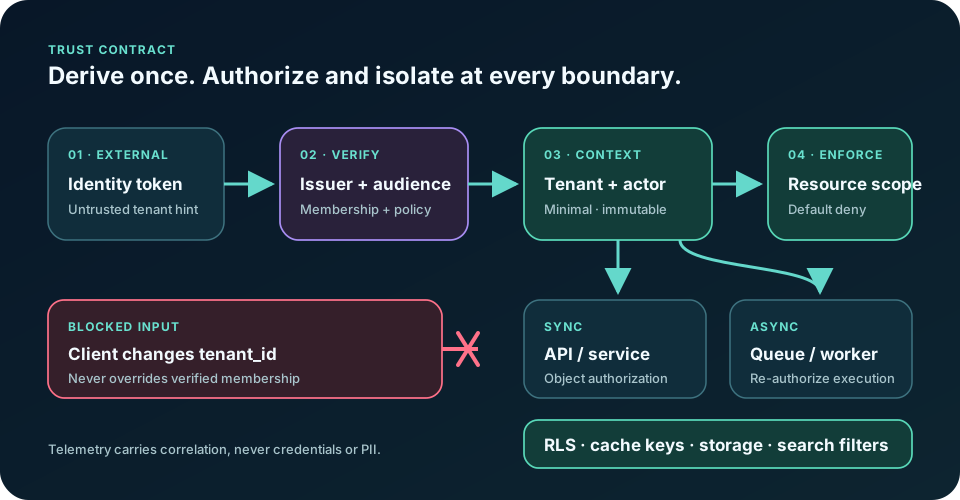
A browser can send a workspace slug, account ID or store ID to express navigation intent. That value is not proof. At the first trusted boundary, validate the access token's signature and allowed algorithm, exact issuer, intended audience, expiry and other required claims. Then resolve the `(issuer, subject)` pair to an active membership for the requested tenant. RFC 8725 specifically warns that deployments with multiple issuers or recipients must validate issuer and audience to prevent token substitution; RFC 9068 requires a resource server to reject a JWT access token whose audience does not identify that resource.
The result should be an internal context produced by trusted code, not a renamed public header. A useful context can include `tenantId`, `actorId`, actor type, granted scopes or role references, authentication strength, policy version, request ID and the identity event used for audit. Include only what downstream services need. Freeze the object for the lifetime of the operation so middleware cannot silently replace the tenant halfway through a request.
AWS describes SaaS identity as the connection of user identity with tenant identity and explains that this context must flow through the architecture. The important engineering interpretation is that propagation is not authorization. It supplies trusted inputs to each policy decision; the service that owns a resource still decides whether the actor may perform the requested action inside that tenant.
Reject public tenant headers as authority
A public `X-Tenant-ID` header is convenient for routing but unsafe as the source of truth. An attacker can change it. If a route includes `/tenants/:tenantId`, compare that requested tenant with the membership resolved from the verified identity. In products where one user belongs to several tenants, switching tenants should be an explicit operation that issues or selects an authorized tenant context, not a free-form identifier passed deeper into the system.
The gateway may verify the external token once, but downstream services should receive a signed internal assertion, a workload-authenticated request with server-owned context, or a context reconstructed from trusted claims. Strip any client version of internal headers before adding the verified value. Do not forward the original user token indiscriminately to every service: audience-specific service tokens or workload identity reduce token replay and privilege spread. Preserve the human actor separately for audit and delegated authorization.
Treat context fields as versioned contracts. A service must fail closed if the tenant is absent, malformed or unsupported. Defaults such as `tenantId = public` turn propagation failures into data leaks. Health checks and truly tenantless control-plane routes should use distinct handlers rather than bypass flags hidden inside ordinary request middleware.
Authorize the object, not only the route
OWASP calls the failure to check whether the caller may act on a specific object Broken Object Level Authorization. Every endpoint that accepts an object identifier is a candidate. Random UUIDs reduce guessing; they do not grant permission. Prefer repository methods that require both tenant and object identifiers, such as `findInvoice(tenantId, invoiceId)`, so the unsafe one-argument query is difficult to call.
Query scoping is stronger than loading an object globally and comparing tenants later. The latter can leak existence through different errors, timing, logs or side effects. Use the same external response for not-found and not-authorized where the product permits, and keep the precise reason in restricted audit data. Authorization must cover writes, exports, search, file downloads, bulk endpoints and indirect relationships—not only read-by-ID routes.
A policy-enforcement point at the API or service boundary can ask a central or embedded policy decision point about actor, tenant, action, resource and relevant attributes. AWS guidance distinguishes multi-tenant authorization from tenant isolation: a user can be authenticated and apparently authorized while the system still reads the wrong tenant's resource. Enforce both.
Carry context safely through asynchronous work
Queues break the lifetime of the original request. The producer should enqueue the verified tenant and actor references, operation purpose, authorization or policy version, trace correlation and an idempotency key scoped to the tenant. Never put access tokens, refresh tokens, cookies or reusable credentials in the event. The consumer authenticates the producer or queue, validates the envelope schema, reconstructs a server-owned context and rechecks mutable facts such as membership status, tenant suspension and current permissions when the action is sensitive.
Do not assume authorization at enqueue time remains valid forever. A user can be removed before a long-running export executes. Choose deliberately between execution-time authorization and an approved capability with a narrow action, resource, expiry and revocation model. Record that choice. Background maintenance acting as a service should use `actorType: service`, a named purpose and tightly scoped permissions instead of impersonating a user.
Tenant scope also belongs in deduplication and ordering. `idempotencyKey = tenantId + operation + externalId` prevents two tenants with the same merchant order number from suppressing each other's jobs. Partitioning by tenant can preserve local ordering, but avoid letting one large tenant starve others: apply per-tenant concurrency and fair scheduling where workload shape requires it. Quarantine messages with missing or contradictory tenant context rather than guessing.
Enforce isolation at the data boundary
Application filters are necessary but easy to omit. Add a second enforcement layer where the technology supports it. PostgreSQL Row-Level Security can restrict which rows normal queries may read or modify. Once RLS is enabled, the absence of an applicable policy produces default deny. Table owners and roles with `BYPASSRLS` normally bypass policies, so the application role must not own tenant tables or carry bypass privileges; use `FORCE ROW LEVEL SECURITY` when the ownership model requires it.
With connection pools, bind tenant context transaction-locally and clear it automatically at transaction end. A persistent session setting can leak into the next borrower. The following pattern is illustrative; the real policy must cover `USING` and `WITH CHECK`, privileged maintenance roles, migrations and failure behavior.
BEGIN;
SELECT set_config('app.tenant_id', $1, true); -- transaction-local

ALTER TABLE invoices ENABLE ROW LEVEL SECURITY;
ALTER TABLE invoices FORCE ROW LEVEL SECURITY;

CREATE POLICY tenant_invoices ON invoices
  USING (tenant_id = current_setting('app.tenant_id', true)::uuid)
  WITH CHECK (tenant_id = current_setting('app.tenant_id', true)::uuid);

SELECT * FROM invoices WHERE id = $2;
COMMIT;
The same invariant extends beyond SQL. Cache keys need a tenant prefix and authorization-aware variation. Blob paths and signed URLs must bind tenant ownership. Search and vector queries need mandatory tenant filters. Analytics exports need tenant predicates applied before aggregation. A shared backing service does not remove the application team's isolation responsibility.
Design a minimal context envelope
Keep transport and policy separate. An HTTP header, RPC metadata or event field is only a carrier. The service converts it into a typed internal object after authenticating its source. A compact envelope might look like this:
type TenantContext = Readonly<{
  tenantId: string;
  actor: { type: 'user' | 'service'; id: string };
  scopes: readonly string[];
  authn: { issuer: string; audience: string; strength?: string };
  policyVersion: string;
  requestId: string;
}>;

async function loadInvoice(ctx: TenantContext, invoiceId: string) {
  await authorize(ctx, 'invoice:read', { invoiceId });
  return invoices.findOne({ tenantId: ctx.tenantId, id: invoiceId });
}
Avoid copying complete JWTs or customer profiles into every hop. Tenant plan, feature flags and billing state may change; pass stable identifiers and load mutable data from an authoritative store or a bounded cache. Sign internal assertions when they cross trust zones, restrict their audience and lifetime, and rotate keys. Context authenticity, freshness and confidentiality are separate requirements.
Keep observability useful without creating a leak
Tenant-aware logs and traces help diagnose one customer's path through distributed services. They can also create a new shared data plane. OpenTelemetry warns that context propagation crosses service boundaries and that credentials, API keys and personally identifiable information should not be placed in baggage because they may be logged or sent to untrusted downstream services.
Use a controlled tenant identifier or irreversible operational surrogate, not tenant names, email addresses or secrets. Restrict who can query tenant-tagged telemetry, define retention, and audit support access. High-cardinality tenant labels can make metrics expensive; keep per-tenant analysis in logs or traces when the metrics backend cannot support that cardinality, while retaining aggregate SLO metrics. Never propagate authorization decisions as unverified baggage.
Trace context can follow HTTP and message carriers, but an asynchronous consumer should create or link a span according to the operation semantics. Telemetry correlation is not the mechanism that grants access. If baggage is stripped, the consumer must still receive authenticated tenant context through the job contract.
Test cross-tenant failures before production
Positive tests prove that a customer can use the product. Isolation requires negative tests that deliberately cross the boundary. Create two tenants with identical-looking object IDs and attempt reads, writes, deletes, exports and searches across them. Modify route tenant IDs and public headers. Present a valid token with the wrong audience. Replay a queued job after membership removal or tenant suspension. Reuse an idempotency key across tenants. Return a pooled database connection after an exception and verify the next request cannot inherit its context.
Test caches, object storage, search indexes and observability separately. Verify RLS using the actual application role, not the table owner. Add property-based or generative tests that vary actor, tenant, resource and action combinations. Run a lightweight cross-tenant suite on every authorization or data-access change and a broader adversarial suite before release. Monitor denied cross-tenant attempts, missing-context failures and policy-version mismatches without logging sensitive payloads.
A safe rollout starts in report-only mode only where denial can be observed without exposing data. Data-layer isolation should not be report-only: shadow the proposed policy against production-shaped fixtures, then enable it with explicit break-glass procedures and audited privileged paths.
When this pattern is not enough—or not needed
A single-tenant deployment may not need tenant context inside every domain operation, but it still needs clear workload identity and resource authorization. A silo-per-tenant model reduces some shared-data risk but still needs tenant-aware routing, billing, operations and protection against sending a request to the wrong silo. Conversely, adding tenant IDs to every header does not fix a system that lacks object-level checks or data-layer enforcement.
Use ordinary SQL or service queries instead of a distributed policy engine when the authorization rule is local, stable and easy to review. Introduce a policy decision point when many services must enforce consistent, attribute-rich rules and the organization can operate policy versioning, availability and audit. Do not centralize all data into the policy engine; pass the decision inputs needed for the request and keep sensitive tenant data in its authoritative store.
The core invariant is simple: no operation may select its tenant from untrusted input alone, and no resource access may omit tenant scope. The implementation must prove that invariant across synchronous calls, delayed jobs, databases, caches, files, search and support tooling.
Production checklist
Before launch, confirm that the edge validates signature, algorithm, issuer, audience and expiry; membership binds the actor to the selected tenant; client tenant headers are stripped; internal context is minimal and immutable; every object lookup includes tenant scope; sensitive consumers re-authorize at execution; events contain no credentials; idempotency is tenant-scoped; PostgreSQL policies fail closed under the application role; cache, storage and search keys include tenant ownership; telemetry carries no secrets or PII; and cross-tenant negative tests run continuously.
For deeper implementation detail, continue with PostgreSQL tenant isolation, reliable webhook processing, API contract design and backend observability. Together they cover the data, integration and operational boundaries around this context contract.
Official references
These references document the tools discussed. Examples and design decisions are illustrative and should be adapted to the project and its versions.
- AWS SaaS Architecture Fundamentals — SaaS Identity
- AWS Prescriptive Guidance — Multi-tenant SaaS authorization and API access control
- RFC 9068 — JWT Profile for OAuth 2.0 Access Tokens
- RFC 8725 — JSON Web Token Best Current Practices
- OWASP API1:2023 — Broken Object Level Authorization
- PostgreSQL — Row Security Policies
- OpenTelemetry — Context propagation
Prepared by: Noor Yasser
Working through a similar engineering challenge?
I help teams turn architecture decisions into a clear scope and dependable, reviewable implementation.