Saudi Arabia's AI Principles in Media define eight responsibilities across the media-content lifecycle: disclosure, accuracy, privacy, prevention of deception, accountability, integrity, public awareness and continuing impact assessment. The practical move for a newsroom, agency, creator platform or brand is to turn those principles into a release gate: record where AI was used, verify facts and rights independently, choose a proportionate visible disclosure, preserve provenance when useful, require accountable approval and retain evidence after publication.
The current event is an implementation push, not the first publication of the document. The principles were announced at the Saudi Media Forum in February 2026 and appear in SDAIA's publication catalog. On November 6, the Saudi Press Agency reported a renewed operational effort through the AI for Impact forum, held by SDAIA with the General Authority of Media Regulation, and the launch of the Impact Creators program. That distinction matters: do not label an established framework as a brand-new regulation.
Answer first
Build one policy-enforcing path for every publishable asset. The gate should answer six questions before release:
- What is the original asset, and who supplied it?
- Which AI systems created, transformed, translated or analyzed any part of it?
- Which factual claims were checked against authoritative sources?
- Which privacy, consent, likeness and licensing risks were reviewed?
- What must the audience be told, and where will the disclosure remain visible?
- Who approved release, and what evidence can an auditor reproduce later?
A watermark alone answers only part of question five. A detector score alone answers none of the other five. The gate must bind editorial, product, legal and engineering controls to a single release decision.
What the official sources establish
The November 6 SPA report describes eight principles: transparency and disclosure; factual accuracy and credibility; privacy and protection of public figures; prevention of misleading content; responsibility and accountability across the content lifecycle; impartiality and integrity; public empowerment and digital awareness; and impact assessment with regulatory compliance.
SPA also says the guidance calls for clear, proportionate disclosure of AI-assisted content, using mechanisms such as watermarks, notices or metadata labels, especially for news and high-impact public matters. It warns against treating generative AI as an authoritative factual source and emphasizes human verification, deepfake detection, awareness of algorithmic behavior and bias mitigation.
The report says the AI for Impact forum gathered more than 250 media professionals, influencers and creators and that the Impact Creators program was launched. Those are reported program facts. Claims that the program will improve trust or professional standards are program objectives, not independently measured outcomes.
The official SDAIA publication entry describes the document as guidance governing AI use throughout the media-content lifecycle. The underlying Arabic document is the controlling reference for the principles themselves.
Engineering analysis: the sources describe desired responsibilities and disclosure behaviors; they do not prescribe one required database schema, one vendor, or C2PA adoption. The architecture below is an implementation pattern, not an official Saudi technical mandate or legal opinion.
Decide disclosure from impact and AI contribution
Use a decision table rather than leaving labels to individual preference:
| Asset state | Minimum release decision | Additional controls |
|---|---|---|
| No generative model touched the published asset | Do not add an AI label merely because ordinary software was used | Preserve source and edit history |
| AI assisted research, transcription or translation but humans authored the final item | Disclose when the assistance is material to audience understanding or organizational policy requires it | Verify every claim from primary sources; preserve the AI-use record |
| AI materially generated or transformed text, image, audio or video | Use a clear, nearby and durable disclosure | Human review, source comparison, rights review and approval are mandatory gates |
| Synthetic depiction of a real person, event or public-interest claim | Use prominent disclosure before consumption, not only in metadata | Consent or documented authority, elevated verification, senior approval and abuse review |
| Provenance is missing or contradictory | Do not present the asset as verified | Quarantine, obtain the original or publish only with an explicit uncertainty statement approved by policy |
“Proportionate” should be made testable. Define label text, placement, persistence after reposting, supported languages and the approver for each risk tier. A tiny footer on a long video is not equivalent to a notice shown before a synthetic depiction begins.
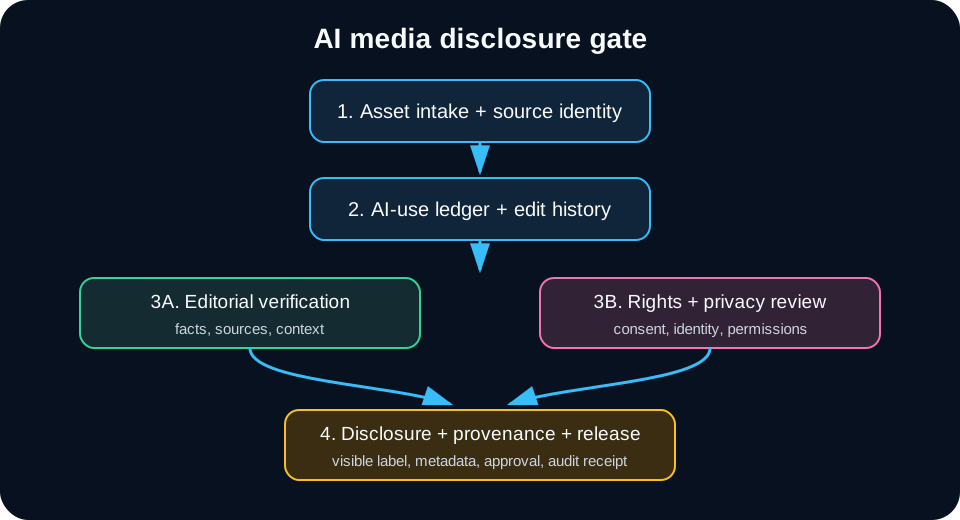
Architecture: a disclosure gate, not a badge service
The diagram shows five evidence-producing components:
- Asset intake: assign an immutable asset ID; hash the received file; record source, license, consent status and capture time.
- AI-use ledger: append every model operation with model identifier, purpose, operator, input references, output references and edit type. Do not store sensitive prompts by default; store only what policy and audit require.
- Editorial verification: map publishable claims to sources, record the verifier and block release when a high-impact claim lacks authoritative support.
- Rights and privacy review: evaluate personal data, likeness, confidential material, copyright and required permissions independently from factual accuracy.
- Release service: render the visible disclosure, attach machine-readable provenance when selected, verify the final derivative, capture accountable approval and issue an audit receipt.
The release service must inspect the final encoded asset, not only the editing project. Transcoding, cropping, screenshotting and social-platform processing can remove metadata or separate the disclosure from the content.
A minimal release contract
A versioned record can make the decision reproducible without locking the team to one tool:
{
  "asset_id": "media_01J...",
  "source_digest": "sha256:...",
  "ai_use": [
    {
      "purpose": "background removal",
      "model_identifier": "vendor/model/version",
      "material_to_meaning": false
    }
  ],
  "claims_review": "passed",
  "rights_review": "passed",
  "disclosure": {
    "tier": "material-ai-edit",
    "label": "AI-assisted visual; reviewed by the editorial team",
    "placement": ["opening-frame", "article-caption", "metadata"]
  },
  "approved_by": "editorial-role-id",
  "policy_version": "sa-media-ai-1.0",
  "released_digest": "sha256:..."
}
Use role or employee identifiers in audit storage, not names exposed to the public unless required. Sign or otherwise protect the receipt from silent alteration. Keep the source asset and released asset distinct: a correct review of one file does not authorize every later derivative.
Where C2PA helps—and where it does not
C2PA Content Credentials provide a standard way to bind signed provenance assertions to media. Version 2.5 supports records about creation and edits, including AI disclosure information. This can help downstream systems verify that a known signer attached a manifest and that the bound asset or manifest has not been silently altered.
However, the C2PA explainer is explicit about the boundary: provenance does not prove that the depicted claim is true. Metadata can also be removed, so durable discovery may require hard binding plus a soft binding such as watermarking or fingerprinting.
Therefore:
- use C2PA as a provenance transport, not as a fact-check;
- pair it with a visible disclosure because many consumers and platforms will not inspect manifests;
- verify the final asset after transformation;
- retain a server-side audit receipt even when embedded metadata is lost;
- do not call content “authentic” merely because a signature validates—validate the signer, policy, claims and context separately.
Adopting C2PA is an engineering choice that may support the Saudi transparency principle. The official Saudi sources cited here do not state that every publisher must implement C2PA.
End-to-end implementation
- Inventory workflows. List creation, translation, voice, image, video, personalization and distribution tools. Identify where AI can enter without an editor noticing.
- Define a contribution taxonomy. Separate assistive use, material transformation, fully synthetic media and prohibited uses. Version the definitions.
- Create the AI-use ledger. Integrate authoring tools where possible, but give editors a simple manual declaration path. A missing integration must not mean “no AI used.”
- Build claim verification. Require primary-source links and named review roles for high-impact facts. Model output may suggest a source; it cannot be the source.
- Build rights and privacy review. Check consent, personal data, public-figure context, licenses and confidential information before the asset reaches distribution.
- Render disclosure from policy. Generate human-readable labels in the publication language and machine-readable metadata from the same decision record.
- Approve the final derivative. Hash and inspect the exact image, audio, video or text package that will be published.
- Observe distribution. Sample the website, application, feed and social derivative to confirm that the disclosure remains clear.
- Support correction and withdrawal. Connect the audit receipt to corrections, takedowns and replacement assets without rewriting history.
Verification tests
| Test | Evidence of success | Failure signal |
|---|---|---|
| Undeclared model use | A material AI edit cannot reach release without a ledger entry | A rendered asset bypasses the gate |
| Claim sourcing | Every high-impact claim resolves to an approved source and reviewer | A model answer or dead link is treated as evidence |
| Disclosure rendering | The label is readable before or with the content on every supported channel | Metadata exists but the audience cannot see a notice |
| Provenance | The final asset verifies against the expected signer and release digest | The manifest belongs to an earlier derivative or unknown signer |
| Privacy and rights | Required consent and licenses are present and scoped to the release | Approval is inherited from an unrelated asset or campaign |
| Correction | A withdrawn asset is removed or marked across owned channels and a new receipt is issued | The website changes but feeds or cached derivatives remain misleading |
Test adversarial transformations too: screenshots, recompression, clips, translated captions, removed metadata and reposts. The desired result is not that every signal survives every transformation; it is that the system knows which controls survived and falls back to visible labels, server records and review.
Best practices and anti-patterns
Do: separate facts from company or program claims; keep one policy version on every release; require a source for each material claim; review privacy independently; show disclosure in the audience's language; protect audit receipts; and sample real distribution channels after publication.
Avoid: treating “human reviewed” as proof without naming the review scope; hiding disclosure in terms of service; relying on AI detectors as definitive evidence; storing every prompt and personal datum forever; calling C2PA a truth certificate; or allowing editors to erase an AI-use record after approval.
The hardest limit is organizational, not cryptographic. A perfect manifest cannot repair an unsupported claim, missing consent or a rushed approval. Conversely, a clear disclosure does not excuse false or harmful content. The controls reinforce one another.
Executive checklist
- [ ] The eight principles are mapped to owners, system controls and evidence.
- [ ] AI contribution tiers and disclosure language are versioned.
- [ ] Every asset has source identity, rights status and immutable digests.
- [ ] Material AI operations enter an append-only use ledger.
- [ ] High-impact claims have authoritative sources and accountable reviewers.
- [ ] Privacy, likeness and licensing are reviewed before release.
- [ ] Visible disclosure and optional provenance are generated from one decision.
- [ ] The exact final derivative is verified after encoding.
- [ ] Corrections and withdrawals preserve history and update owned channels.
- [ ] C2PA validation is never described as proof that a claim is true.
For adjacent implementation patterns, see the Saudi deepfake verification architecture, secure document-ingestion quarantine, and the agent action-contract guide. The services page connects these controls to product, AI and platform engineering work.
References
- Saudi Press Agency: Saudi Arabia Champions Responsible AI Use in Media Content Creation Through National Guiding Framework
- Saudi Press Agency: February announcement of the AI Principles in Media initiative
- SDAIA Publications: AI Principles in Media
- SDAIA: مبادئ الذكاء الاصطناعي في الإعلام (Arabic PDF)
- C2PA Content Credentials Technical Specification 2.5
- C2PA and Content Credentials Explainer
- Asterzenback, “Television News Control Room,” CC0 1.0, Wikimedia Commons
Prepared by: Noor Yasser
Official references
These references document the tools discussed. Examples and design decisions are illustrative and should be adapted to the project and its versions.
- Saudi Press Agency — Saudi Arabia Champions Responsible AI Use in Media Content Creation Through National Guiding Framework
- Saudi Press Agency — المملكة تعزّز الاستخدام الآمن والمسؤول للذكاء الاصطناعي في صناعة المحتوى الإعلامي
- SDAIA Publications — AI Principles in Media
- SDAIA — مبادئ الذكاء الاصطناعي في الإعلام (PDF)
- C2PA Content Credentials Technical Specification 2.5
- C2PA and Content Credentials Explainer
- Wikimedia Commons — Television News Control Room.png
Prepared by: Noor Yasser
Working through a similar engineering challenge?
I help teams turn architecture decisions into a clear scope and dependable, reviewable implementation.