OpenAI released GPT-6 Rosalind Research on October 30, 2026 for a limited set of approved life-sciences organizations. The model brings GPT-6 reasoning to multistep research across literature, biological data and scientific tools, but access is deliberately narrower than a normal model rollout. It is available to approved Research users in Work and Codex, and through the API where separately approved; it is not available in the Chat tab.
For engineering teams, the important question is not only what the model can do. It is how to place it inside an identity-aware, auditable research workflow where data access, scientific tools, human review and downstream actions are controlled outside the model. This article separates OpenAI's documented release facts from the production architecture recommended below. Documentation and the system-card addendum were checked on October 31, 2026.
Answer first
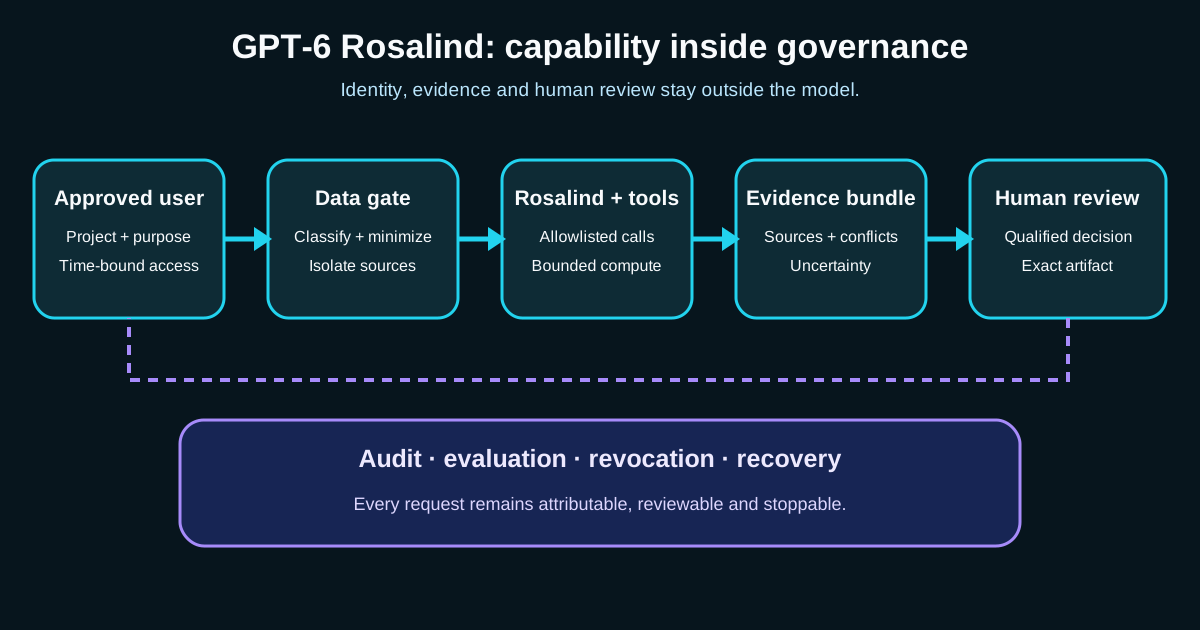
Treat GPT-6 Rosalind Research as a high-capability research component, not as an autonomous laboratory authority. Provision only approved users, isolate Research from Discovery access, classify every input, expose a narrow scientific-tool registry, require evidence and provenance in outputs, and place qualified human review before experiments, publications or consequential decisions.
approved researcher -> research request -> data and policy gate
                    -> GPT-6 Rosalind + approved tools
                    -> evidence bundle + uncertainty
                    -> qualified human review
                    -> approved downstream action

identity, access, audit, revocation and evaluation surround every stage
The model can synthesize and propose. Your organization remains responsible for authorization, data governance, scientific validation, execution and incident response.
What OpenAI actually announced
OpenAI's model release notes say GPT-6 Rosalind Research brings GPT-6 reasoning capabilities to multistep life-sciences research. The rollout is limited to approved Research customers in Work, Codex and the API. API users call the model as gpt-6-rosalind. It is not available in the Chat tab.
The GPT-Rosalind access guide makes several boundaries explicit:
- buying a subscription or joining a workspace does not automatically grant access;
- Research approval is separate from Discovery approval;
- API access can require separate approval from Work or Codex access;
- installing the Life Sciences Research plugin does not grant model access;
- Enterprise workspaces begin with a two-week Admin Preview in which the model is off by default;
- GPT-5.5 Rosalind Research remains selectable for existing workflows.
OpenAI says Rosalind workflows can support evidence synthesis, biological-data analysis, scientific tool use, target research, genomics, protein and sequence analysis, medicinal chemistry, wet-lab troubleshooting and experiment planning. These are vendor-described capabilities, not a guarantee that an output is scientifically correct or appropriate for a particular experiment.
Read the system card as an operating constraint
The GPT-Rosalind-6 system-card addendum says GPT-Rosalind-6 uses the same weights as GPT-6 Astra and did not add training data or additional post-training for this release. The deployment differs through access, policy and safeguard controls designed for advanced life-sciences work.
OpenAI describes four safeguard components: trusted access, model-level boundaries, monitoring and enforcement, and additional contractual requirements. The addendum says approved customers must apply qualified human review before outputs inform experiments, publications or consequential decisions. It also says customers need strong identity, least-privilege access, administrator controls and processes to remove access when it is no longer needed.
Under OpenAI's Preparedness Framework, the company treats the release as High capability in the Biological and Chemical domain, below its Critical threshold. The addendum also carries GPT-6 Astra's Critical cybersecurity classification. These are OpenAI's risk classifications. They do not replace an organization's own risk assessment, biosafety review, security program or legal obligations.
Separate eligibility, provisioning and runtime authorization
Access has three distinct layers:
| Layer | Question | Evidence to retain |
|---|---|---|
| Organizational eligibility | Is the institution approved for Research? | Approval scope, permitted surfaces and renewal date |
| User provisioning | Is this named researcher authorized? | Workspace group, role, training and manager approval |
| Runtime authorization | May this request use these data and tools now? | Policy decision, project, purpose and exact tool scope |
Do not collapse these layers into one API key. A generic shared credential destroys attribution and makes offboarding unreliable. Map each request to an approved organization, user, research project and purpose. Refuse execution when any binding is missing, expired or inconsistent.
Keep Discovery and Research entitlements explicit. A user who can access a Discovery workflow should not automatically inherit the higher-capability Research path. Likewise, enabling a Codex plugin does not prove the model or API project is approved.
Build a research request envelope
Before a prompt reaches the model, convert it into a policy-enforced request envelope:
{
  "request_id": "rr_2026_10_31_0142",
  "organization": "approved_lab",
  "researcher": "user_482",
  "project": "oncology-evidence-review",
  "purpose": "literature_synthesis",
  "data_classes": ["public_literature", "internal_nonclinical_notes"],
  "allowed_tools": ["literature.search", "sequence.read_only"],
  "forbidden_effects": ["run_experiment", "publish", "modify_registry"],
  "human_review": "required_before_external_use",
  "expires_at": "2026-10-31T15:00:00Z"
}
The example is an engineering pattern, not an OpenAI API schema. Sign or hash the accepted envelope and attach its identifier to every model call, tool invocation, review and downstream effect. The model must not be able to widen its own tool or data scope.
Classify data before retrieval
Life-sciences workflows often mix public papers, proprietary research, unpublished results, patient-linked information and third-party databases. Build a data gate before retrieval:
- identify the project and approved purpose;
- classify each source and its contractual restrictions;
- minimize or pseudonymize personal and sensitive fields;
- verify region, retention and logging requirements;
- enforce tenant and project isolation in retrieval;
- deny sources whose authorization cannot be proven;
- record source identifiers and policy decisions without copying unnecessary sensitive content into logs.
Do not assume that enterprise access settles every data-governance question. Confirm the actual data-processing, retention, residency, privacy and institutional-review requirements for your approved deployment. The model name is not a compliance certificate.
For RAG, preserve source identity, capture time, version, license and access decision through chunking, embedding, reranking and context construction. A relevant passage is not automatically current, authorized or experimentally reliable.
Put scientific tools behind a registry
Tool use is one of Rosalind's main value propositions and one of its largest control surfaces. Expose tools through a registry rather than handing the model arbitrary shell, database or laboratory access.
Each tool definition should include:
- owner and approved scientific purpose;
- input and output schema;
- read-only or side-effecting classification;
- permitted data classes and projects;
- credential and network boundaries;
- cost, rate and compute limits;
- required reviewer level;
- idempotency and rollback behavior;
- validation tests and last review date.
| Tool class | Example | Default control |
|---|---|---|
| Public evidence read | Search approved literature index | Allow within project and record sources |
| Internal read | Query a governed sequence repository | Project authorization and field minimization |
| Compute | Run a bounded analysis pipeline | Resource limit, immutable inputs and output checksum |
| External write | Update a shared research system | Exact-payload review and idempotency |
| Physical or experimental action | Submit a lab instruction | Qualified human approval and independent lab controls |
Model output is a proposal. A deterministic gateway decides whether the requested tool and arguments are allowed.
Require an evidence bundle, not a confident paragraph
For every material conclusion, return a structured evidence bundle:
{
  "claim": "The reviewed evidence supports hypothesis H within the stated cohort.",
  "sources": [
    {"id": "paper_17", "version": "2026-08-12", "location": "results:table-3"},
    {"id": "dataset_9", "snapshot": "sha256:...", "analysis": "run_204"}
  ],
  "assumptions": ["cohort labels are correct"],
  "conflicts": ["paper_22 reports a different effect direction"],
  "uncertainty": "moderate",
  "recommended_reviewers": ["computational_biologist", "domain_scientist"]
}
This is a product contract, not a claim that the model supplies calibrated scientific confidence. Validate citations against the actual source, preserve dataset and code versions, and separate source statements from the model's inference. If the evidence is missing or conflicting, the interface should make that visible rather than smoothing it into one fluent answer.
Define human-review gates by consequence
OpenAI's system card explicitly requires qualified human review before outputs inform experiments, publications or consequential decisions. Convert that into gates with named roles and exact review criteria.
| Output | Minimum review |
|---|---|
| Internal literature summary | Researcher verifies sources and scope |
| Analysis used for project prioritization | Domain scientist reviews methods, assumptions and alternatives |
| Experimental protocol proposal | Qualified scientist plus institutional safety process |
| Material for publication | Author verifies every citation, analysis and disclosure |
| Clinical or patient-related use | Independent clinical, legal, privacy and regulatory controls |
A reviewer should see the request, model and tool versions, source bundle, transformations, uncertainty, conflicts and proposed next action. A generic approve button is not meaningful scientific review.
The model should never mark its own work as independently reviewed. Store reviewer identity, timestamp, decision, required changes and the exact artifact digest.
Migrate without treating the model name as a drop-in replacement
Existing GPT-5.5 Rosalind Research workflows can continue. A controlled migration to GPT-6 Rosalind should use a shadow phase:
- freeze representative tasks and approved source snapshots;
- run both models with the same tool and data boundaries;
- compare factual traceability, scientific usefulness, refusal behavior, tool selection, latency and cost;
- have blinded experts review disagreements;
- investigate any increase in unsupported conclusions or unsafe tool proposals;
- canary a small set of approved users;
- retain a rollback target and model-specific audit field;
- expand only after acceptance criteria pass.
Do not rely on aggregate quality alone. Review high-consequence subgroups separately, including ambiguous literature, sparse evidence, sensitive data, dual-use questions and requests that should stop at a human gate.
Evaluate the whole workflow
Model-only benchmarks miss failures introduced by retrieval, tools and permissions. Test complete trajectories:
- an unapproved user attempts to call the Research model;
- a Discovery-approved user is routed into a Research project;
- retrieved text tries to expand tool permissions;
- a source is relevant but revoked or out of date;
- two papers conflict and the answer must preserve the disagreement;
- a tool returns success but its output checksum is missing;
- a proposed experiment reaches the human-review gate;
- a user loses access during a long-running job;
- a sensitive sequence appears in logs or cross-project retrieval;
- a model upgrade changes refusal or tool-selection behavior.
Score scientific correctness, evidence traceability, authorization accuracy, data isolation, uncertainty reporting, tool safety, reviewer usability and recovery. Track false allows and false denies separately.
Audit and incident response
Record enough to reconstruct a consequential run without logging hidden reasoning or unnecessary sensitive data:
- approved user, organization, project and purpose;
- model identifier and policy version;
- source IDs, versions and access decisions;
- tool names, normalized arguments digest and results digest;
- human-review receipt and artifact hash;
- downstream action, authoritative read-back and status;
- revocation and retention deadlines.
If access is revoked, stop new requests immediately, cancel queued jobs where safe, rotate project credentials, invalidate active sessions, preserve required audit evidence, and review outputs created after the last trusted checkpoint. Test this process before an incident.
Best practices
- Keep Research and Discovery access groups separate.
- Use named users and short-lived, least-privilege credentials.
- Bind every request to a project and approved purpose.
- Classify and minimize data before retrieval.
- Allowlist scientific tools and make side effects explicit.
- Preserve source, dataset, code and output versions.
- Require qualified human review at consequence boundaries.
- Use shadow evaluation and canaries for model migrations.
- Keep an auditable rollback and revocation path.
- Recheck OpenAI documentation and your approval scope before deployment changes.
Anti-patterns and limits
- Assuming a Business or Enterprise subscription grants Rosalind Research access.
- Treating Discovery approval, plugin installation or Workbench availability as Research authorization.
- Sharing one API key across a laboratory.
- Sending every internal dataset because the model is enterprise-gated.
- Giving the model direct write access to laboratory or registry systems.
- Presenting generated citations without source verification.
- Treating fluent output as calibrated scientific confidence.
- Letting the model approve its own experiment or publication.
- Migrating from GPT-5.5 without model-specific evaluation.
- Calling OpenAI's risk classification proof of institutional compliance.
GPT-6 Rosalind Research is intentionally limited and its safeguards can evolve. Availability, approved surfaces and contractual requirements depend on the organization's actual approval. The release does not remove the need for biosafety, security, privacy, research ethics, clinical governance or regulatory review.
Executive checklist
- Confirm organization, surface and user Research approval.
- Separate Discovery and Research entitlements.
- Bind requests to a project, purpose and expiry.
- Classify and minimize data before retrieval.
- Allowlist tools with resource and side-effect boundaries.
- Require evidence, conflicts and uncertainty in outputs.
- Gate experiments, publications and consequential decisions with qualified reviewers.
- Preserve model, source, dataset, code and artifact versions.
- Shadow-test migration from GPT-5.5 and retain rollback.
- Test revocation, audit and incident-response paths.
Related reading: OpenAI Model Spec action contracts, guarded computer use with GPT-6.1 Terra, secure RAG document ingestion, RAG citation provenance, and the AI, RAG and vector search hub.
Primary references
- OpenAI — Model release notes
- OpenAI — GPT-Rosalind for life sciences research
- OpenAI — GPT-Rosalind-6 System Card Addendum
- OpenAI — Introducing GPT-Rosalind
- Wikimedia Commons — Researcher at work in her laboratory
- Creative Commons — Attribution 4.0 International
Prepared by: Noor Yasser
Official references
These references document the tools discussed. Examples and design decisions are illustrative and should be adapted to the project and its versions.
Prepared by: Noor Yasser
Working through a similar engineering challenge?
I help teams turn architecture decisions into a clear scope and dependable, reviewable implementation.