Saudi Arabia's Data Regulatory Sandbox has opened its Personal Data Protection track for applications in October 2026. The official program lets eligible private entities test products or services that process personal data under regulatory supervision and assess whether their organizational, administrative and technical measures align with the Personal Data Protection Law (PDPL), its Implementing Regulations and other applicable requirements. Product, privacy and engineering teams should treat an application as an evidence-building exercise: map every data flow, state the lawful purpose, minimize fields, test data-subject rights, rehearse incident notification and preserve auditable results.
This analysis uses the official Saudi Data & AI Authority (SDAIA) National Data Governance Platform pages verified on 21 October 2026. The opening month and program scope are documented facts. The architecture and test pack below are engineering recommendations, not legal advice, certification criteria or a claim that participation equals compliance.
What opened, and what the sandbox does not promise
The official sandbox page says the Personal Data Protection track opens for applications in October 2026. It targets private entities testing products or services that involve processing personal data. Its stated purpose is to assess the effectiveness of implemented organizational, administrative and technical measures and their alignment with the PDPL, the Implementing Regulations and other relevant rules.
Eligibility is broader than a product being incorporated in the Kingdom: the page includes Saudi private entities and entities outside Saudi Arabia that process the personal data of residents of Saudi Arabia. The application path runs through the National Data Governance Platform, with authorization for the entity representative through the Saudi Business Center among the listed steps.
The sandbox is a supervised, time-bounded testing environment. It should not be described as a production licence, blanket exemption, security certification or guarantee that a later commercial launch is compliant. A useful application narrows the product, population, data categories, processing purposes and tests. An application that says “our whole platform uses AI” is too vague to produce meaningful evidence.
Start with a processing inventory, not a policy document
The PDPL Implementing Regulations require written, current records of processing activities. The record includes the controller's contact details, the purposes of processing, categories of personal data and data subjects, retention periods where possible, recipient categories, transfers outside the Kingdom and a description of organizational, administrative and technical protections.
Convert that requirement into an executable inventory. Give each data flow a stable identifier. For each input field, record its source, purpose, lawful basis, classification, storage locations, processors, recipient APIs, retention trigger and deletion path. Link the field to the user-facing notice and to a test that proves access, correction or destruction works. A diagram without these identifiers is useful for orientation but weak as audit evidence.
For an AI recommendation product, separate account identifiers, behavioral events, free-text prompts, model inputs, generated outputs, safety logs and analytics. “User data” is not one category. Free text can contain sensitive personal data even when the schema does not request it, so add detection and handling controls at the unstructured boundary.
Do not start by copying a generic privacy policy. A policy can describe intent while the system retains backups indefinitely, streams full payloads to logs or lacks a deletion route for vector indexes. Build the inventory from real services, queues, object stores, databases, observability sinks and third-party subprocessors, then make the notice match reality.
Define the test boundary and success criteria
Use one product hypothesis and a bounded dataset. State which processing operation needs supervised validation: for example, pseudonymized transaction features used to detect fraud, or an AI assistant that retrieves support records for an authenticated customer. Exclude unrelated tenants and production traffic.
Write testable acceptance criteria before uploading data. Useful gates include:
| Control | Evidence | Failure condition |
|---|---|---|
| Purpose and minimization | field-to-purpose matrix plus rejected-field tests | an unneeded field reaches storage or a model |
| Access and correction | authenticated request trace across every store | one copy remains inaccessible or uncorrected |
| Retention and destruction | TTL, deletion job and backup exception record | data survives beyond the defined rule without a documented basis |
| Processor boundary | contract, API scope and egress log | a processor receives categories outside its declared task |
| Incident readiness | timed drill and notification draft | the team cannot reconstruct scope, time or affected categories |
| Model or rule quality | versioned evaluation set and error analysis | a change ships without comparable results or rollback criteria |
The regulations expressly connect data minimization to a clear purpose and even refer to data maps that show why each item is needed. Make the matrix machine-readable where possible. A CI check can reject a new event field until it has an owner, purpose, retention rule and data classification.
Run a documented privacy impact assessment
The Implementing Regulations require a written impact assessment in several situations, including sensitive personal data, linking datasets from different sources, large-scale or repeated processing of minors' data, continuous monitoring, emerging technologies, automated decisions, and products likely to cause serious privacy harm. The National Data Governance Platform also provides a dedicated impact-assessment service for registered entities.
A practical assessment describes the processing and lawful purpose, necessity and proportionality, affected people, plausible harms, likelihood and severity, existing controls, residual risk, owners and approval decision. Tie every mitigation to a test result. “Encryption enabled” is not enough; identify whether it protects data in transit, at rest or at the application field level, who can decrypt, how keys rotate and what remains visible in logs.
If residual risk is unacceptable, change the design or stop the test. The sandbox is most useful when uncertainty is explicit. It is not a reason to collect real data before access control, deletion and incident response are ready.
Build privacy controls into the architecture
Create a separate sandbox environment and account boundary. Use synthetic data first; introduce personal data only when the test cannot answer its question otherwise. Tokenize direct identifiers before analytics or model processing. Keep the re-identification map in a restricted service with independent keys and audit logs. Pseudonymization reduces exposure but does not automatically make data non-personal when re-identification remains possible.
Propagate a purpose and tenant context with each request. Authorization must check the subject, tenant, purpose and requested operation before data retrieval. A valid token for one tenant must never become a global search credential. For RAG or vector search, filter by tenant and authorized resource before ranking, and include the deletion workflow for source documents, chunks, embeddings, caches and evaluation traces.
Use append-only audit events for administrative access, exports, changes to retention rules, consent or lawful-basis updates, data-subject requests and model-version changes. Keep the minimum evidence necessary; an audit log that copies full personal payloads creates another processing store to protect.
For third-party APIs, send only declared fields and test deny-by-default egress. Record the processor, region, purpose and contract reference. If data leaves the Kingdom, assess the applicable transfer rules rather than assuming a cloud region or standard contract alone resolves the obligation.
Rehearse rights and breach workflows end to end
The official guide lists the rights to be informed, access, obtain a readable copy, correct and—in applicable cases—destroy personal data. Exercise each right through every derived store, not only the primary database. A successful deletion test should show what was deleted, what was retained under a documented exception, and when backups age out.
The platform provides a specific service for personal-data breach notification. The Implementing Regulations require the controller, where the relevant conditions are met, to notify the competent authority within 72 hours of becoming aware of the breach; if all requested information is not yet available, it should be supplied as soon as possible with reasons for delay. The regulation also describes information such as the incident time, discovery time, affected categories and approximate numbers, contact details and corrective measures.
Rehearse this as an operational clock. Start the timer at confirmed awareness, preserve the incident timeline, classify affected data, estimate subjects, identify processors, prepare a plain-language subject notice where required, and retain submitted reports and corrective evidence. Do not wait for perfect forensic certainty before activating the workflow.
Best practices and anti-patterns
Good practice is a narrow test question, representative but minimized data, isolated infrastructure, stable processing IDs, a field-to-purpose matrix, least privilege, processor and transfer records, a written impact assessment, end-to-end rights tests, a timed breach drill, versioned evaluation results and explicit go/no-go owners.
Anti-patterns include treating the sandbox as marketing approval; uploading a production dump “for realism”; claiming anonymization while keeping a broadly accessible lookup table; using consent as a universal basis without testing withdrawal; retaining prompts and logs indefinitely; allowing support staff to browse all tenants; testing deletion only in the primary database; or presenting generated AI output as regulatory evidence without traceable inputs and versions.
Do not apply merely because the product stores an email address and existing requirements are already clear. A focused internal compliance program may be the better path. The sandbox is valuable when a genuinely novel data product, emerging technology or high-impact processing pattern needs supervised testing and a bounded evidence plan.
An executable application pack
Prepare one package with the product scope, entity and representative details, architecture and data-flow diagrams, processing inventory, purpose and lawful-basis register, data classifications, processor and transfer map, retention schedule, impact assessment, security controls, rights test cases, incident runbook, evaluation plan, risk register and named decision owners.
Then run a dry rehearsal. A reviewer should be able to choose one data category and trace it from collection to every derived copy, see why it is needed, identify who can access it, execute correction or destruction, and retrieve the evidence without asking an engineer to reconstruct the system from memory.
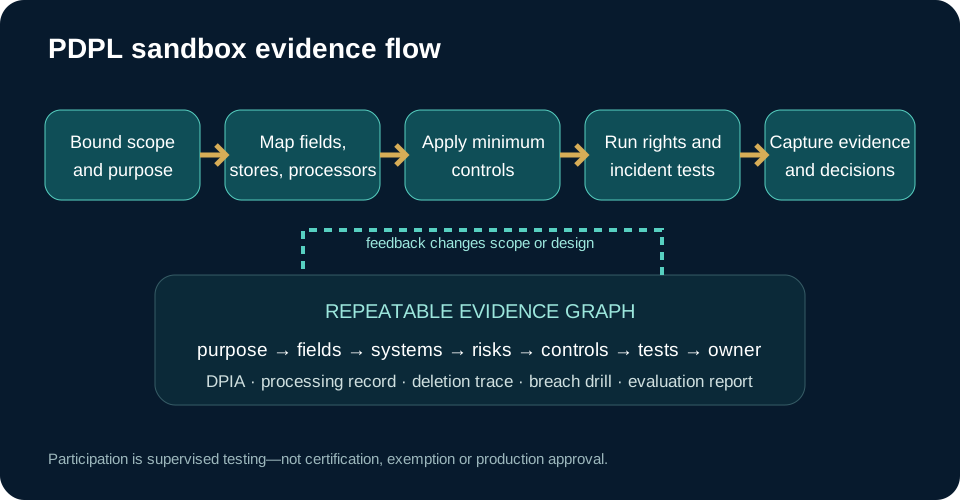
The engineering goal is not a large compliance folder. It is a small, internally consistent evidence graph: each purpose points to minimum fields; each field points to stores and processors; each risk points to a control; each control points to a repeatable test; and each test has an owner and result. That structure makes supervised feedback actionable and remains useful long after the sandbox test ends.
Official references
These references document the tools discussed. Examples and design decisions are illustrative and should be adapted to the project and its versions.
- SDAIA National Data Governance Platform — Data Regulatory Sandbox, verified 21 October 2026
- SDAIA — PDPL Implementing Regulations
- SDAIA — Privacy impact assessment service
- SDAIA — Personal data breach notification service
- SDAIA — Guide to the Personal Data Protection Law
- SDAIA — Rules for appointing a Personal Data Protection Officer
Prepared by: Noor Yasser
Working through a similar engineering challenge?
I help teams turn architecture decisions into a clear scope and dependable, reviewable implementation.