PIF and Aramco closed their HUMAIN transaction on November 1, 2026. Aramco, through a wholly owned subsidiary, now holds 49% of HUMAIN; PIF retains 51%. The official announcement says Aramco will contribute approximately SAR 9.9 billion ($2.6 billion) in cash during 2026, in addition to AI, compute and digital assets.
This is a material Saudi technology event because it moves the 2025 term sheet into a closed ownership structure and combines capital, energy and industrial demand with a company designed to span data centers, high-performance infrastructure, cloud platforms, models and applications. It is not, however, proof that the announced 3-gigawatt data-center target is already installed, that every service is generally available, or that an integrated full stack removes architecture and governance work for customers.
This article separates three layers. Ownership percentages, the 2026 cash contribution, the planned 2030 capacity target and HUMAIN's four stated capability areas are documented facts from PIF, Aramco and SPA. Statements about global leadership, attractive margins, export ambitions and business value are company claims. The procurement, platform architecture, security and evaluation guidance below is engineering analysis.
Answer first
The transaction creates a clearer ownership and funding structure for HUMAIN, but technology teams should evaluate services, not shareholders. A Saudi enterprise considering HUMAIN should request a concrete service catalog: available regions, operational capacity, accelerator types, tenancy model, data-location terms, model endpoints, identity controls, observability, support commitments, export paths and pricing units.
Treat the announced full stack as five contracts rather than one product:
| Layer | Official ambition | Engineering question before adoption |
|---|---|---|
| Data centers | Next-generation AI capacity | Which site and capacity are operational for this workload? |
| Compute and cloud | High-performance infrastructure and cloud platforms | What accelerator, scheduler, quota, isolation and failure domain apply? |
| Models | Advanced models including ALLAM | Which version, context, safety, residency and lifecycle contract applies? |
| Applications | Industry and public-sector solutions | Which data and actions can the application access, and who approves effects? |
| Operations | Scale deployment of AI | Which SLA, telemetry, incident and exit controls are contractual? |
The announcement says HUMAIN plans to deploy 3 GW of AI data-center capacity by 2030. That is a forward-looking capacity goal, not a statement that 3 GW is available today. Build procurement and migration decisions from delivered regions and tested service limits, not the end-state headline.
What closed on November 1
The Aramco announcement, the PIF release and Saudi Press Agency report agree on the core transaction facts:
- PIF retains 51% of HUMAIN;
- Aramco acquires 49% through a wholly owned subsidiary;
- Aramco's contribution includes approximately SAR 9.9 billion in cash during 2026;
- AI, compute and digital assets are also being contributed;
- PIF and Aramco will oversee HUMAIN's expansion as shareholders;
- HUMAIN plans 3 GW of AI data-center capacity by 2030.
The closing matters because the October 28, 2025 announcement was a non-binding term sheet subject to definitive agreements, regulatory approvals and customary conditions. The November 2026 release describes the transaction as closed and gives the final ownership split and cash figure.
The releases do not publish a site-by-site construction schedule, installed accelerator inventory, service availability matrix, customer SLA, energy mix, price list or migration terms. Do not infer those details from the transaction value or capacity target.
What “full stack” means—and does not mean
PIF describes HUMAIN as operating across four areas: next-generation data centers; high-performance infrastructure and cloud platforms; advanced AI models including ALLAM; and transformative AI applications. Aramco describes the intended span as data centers and compute through models, applications and industry solutions.
That vertical scope can reduce handoffs when the contracts are real and interoperable. It can also concentrate risk if identity, data governance, capacity and model lifecycle are implicit. A credible platform architecture needs explicit boundaries:
business workload
  -> governed AI gateway
  -> approved model or training job
  -> regional compute pool and storage
  -> evidence, telemetry and cost records
  -> human or system approval for side effects
~~

“Full stack” should not mean one credential with unrestricted access across every layer. Use separate identities for build pipelines, training jobs, inference services, administrators and customer applications. Bind each identity to named datasets, model versions, tools, regions and budgets.

## Separate announced capacity from usable capacity

Power capacity is an important constraint for AI infrastructure, but a gigawatt target does not translate directly into customer-visible tokens, training runs or accelerator hours. Usable service capacity also depends on:

- commissioned buildings and electrical infrastructure;
- accelerator delivery, topology and network fabric;
- storage throughput and data-ingestion paths;
- cooling and thermal limits;
- scheduler efficiency and reserved versus shared pools;
- software availability and driver compatibility;
- maintenance, redundancy and failure-domain design;
- customer quotas, support tiers and regional availability.

For each candidate service, request a dated availability statement. Distinguish:

1. **announced capacity:** a public target or planned program;
2. **commissioned capacity:** infrastructure accepted for operation;
3. **allocatable capacity:** resources the scheduler can assign;
4. **contracted capacity:** quota reserved for the customer;
5. **delivered capacity:** work completed within the agreed performance and reliability envelope.

Only the last two answer most production planning questions.

## Build a procurement evidence pack

An enterprise evaluation should be repeatable and evidence-led. Create one record per service and region:

~~~json
{
  "provider": "HUMAIN",
  "service": "candidate-inference-service",
  "region": "documented-region",
  "availability": "preview-or-ga",
  "tenant_model": "dedicated-or-shared",
  "accelerator": "documented-type",
  "model": "name-and-version",
  "data_location": "contractual-location",
  "retention": "documented-policy",
  "sla": "contract-reference",
  "quota": "reserved-capacity",
  "exit_format": "documented-export",
  "evidence_date": "2026-11-02"
}
This is an internal evidence schema, not a HUMAIN API contract.
Ask for:
- legal entity and service owner for each contract;
- region and subprocessor list for data at rest, in transit and in logs;
- tenant isolation model for compute, storage, caches and observability;
- supported accelerator, framework, driver and container combinations;
- model versioning, deprecation, safety and fine-tuning terms;
- identity federation, service accounts, key rotation and audit logs;
- ingress and egress controls, private connectivity and customer-managed keys;
- availability objectives, support response and capacity-reservation terms;
- usage meters, pricing units, budgets and reconciliation exports;
- backup, deletion, disaster recovery and incident-notification commitments;
- artifact, dataset, checkpoint and log export formats for exit.
The transaction press release is evidence of ownership and funding. It is not a substitute for these service-level documents.
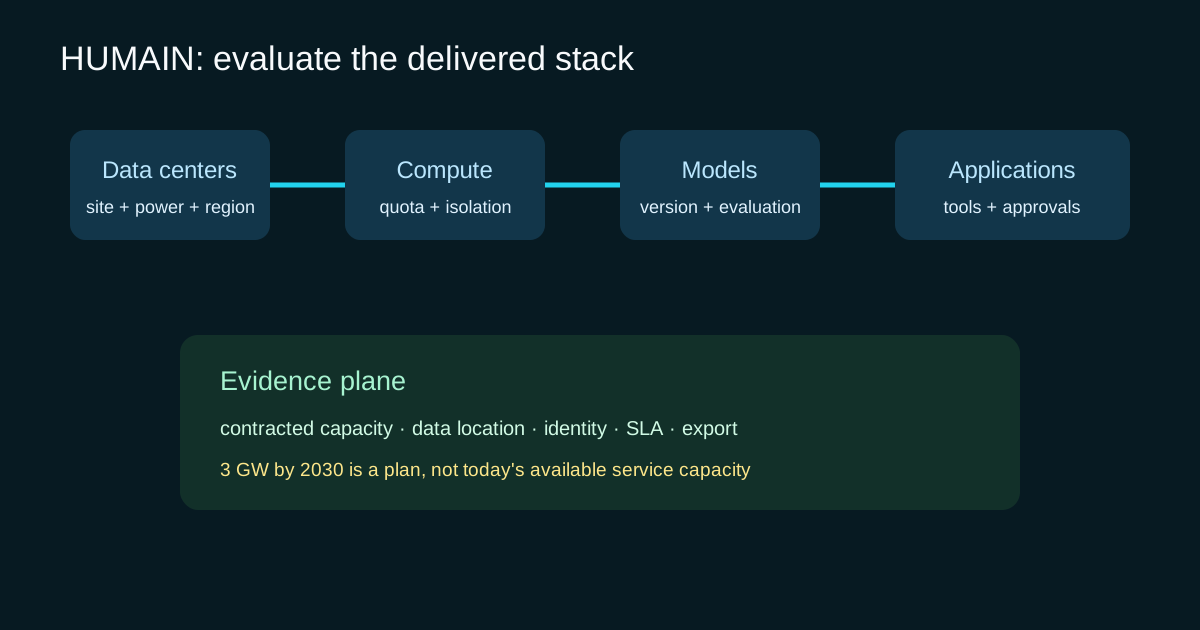
Architecture for a governed Saudi AI deployment
A portable enterprise design keeps business policy outside a provider-specific model endpoint.
### 1. Trusted workload gateway
Applications call an internal gateway that derives tenant, user, purpose and data classification from trusted identity. The gateway selects only approved model-service combinations and attaches a policy version to every request.
### 2. Regional data boundary
Store source datasets, vector indexes, prompts, outputs and telemetry in locations allowed by the actual contract and applicable regulation. “Saudi company” or “Saudi data center plan” is not a data-residency guarantee for a particular API. Confirm the path in writing.
### 3. Capacity and admission control
Training and inference need separate queues and budgets. Use per-tenant quotas, maximum context and output limits, concurrency controls and deadline-aware retry policies. Reserved accelerator capacity should map to documented business priorities, not a global first-come queue.
### 4. Model registry and evaluation
Keep an internal registry of model endpoint, version, region, safety settings, data terms and evaluation status. Re-run Arabic, English and domain-specific evaluations before promoting a new version. A provider label such as “advanced” or “multimodal” is not a production acceptance test.
### 5. Tool and action boundary
If an AI application can change industrial, financial or public-sector systems, tools must be separately authorized. Validate arguments, require approvals for high-impact actions, use idempotency keys and read authoritative state after execution.
### 6. Evidence plane
Record request identity, policy version, model version, data references, tool calls, latency, token or accelerator usage, safety outcome and business result. Protect the logs from containing unnecessary sensitive content.
This architecture can run on HUMAIN, another provider or a controlled combination. Portability is a risk control, not a rejection of local infrastructure.
What Aramco contributes strategically
The official announcement says Aramco expects to use HUMAIN infrastructure for industrial AI and contribute AI, compute and digital assets, capabilities and talent. It also says Aramco and its affiliates can benefit as a shareholder and strategic partner.
Engineering analysis: a large industrial anchor customer can improve requirement quality for asset monitoring, reliability, simulation, document intelligence and operational decision support. It can also create tension between one anchor customer's priorities and a general cloud platform. HUMAIN should therefore expose stable product contracts, quotas and roadmaps that do not require customers to infer behavior from shareholder relationships.
Aramco's CEO said the company has achieved $11.3 billion in “Technology Realized Value” since 2023, with a significant portion attributed to AI solutions. This is a company-reported business metric in the press release; the release does not provide the methodology needed to independently reproduce the figure. Do not use it as a benchmark for another organization's AI return.
A decision table for early adopters
| Workload | Potential fit | Required proof before commitment |
|---|---|---|
| Saudi-regulated inference | Local capability may support residency and support needs | Contractual processing location, subprocessors, retention and keys |
| Arabic customer service | ALLAM and Arabic focus may be relevant | Representative dialect, safety, grounding and latency evaluation |
| Industrial copilots | Aramco domain demand may shape capabilities | Tool isolation, OT boundary, human approval and offline operation |
| Large training job | Planned capacity may be attractive | Reserved accelerators, topology, checkpointing, queue and completion SLA |
| Bursty batch inference | Shared capacity can improve utilization | Quota, cold-start, price unit and overload behavior |
| Multi-provider product | HUMAIN can be one approved route | Compatible APIs, export paths, deterministic routing and fallback tests |
Use a time-bounded pilot with explicit acceptance thresholds. Do not sign a broad migration based only on a target capacity figure.
Best practices
- Cite the closing date and ownership structure exactly.
- Label 3 GW by 2030 as a plan, not current capacity.
- Separate company forecasts from independently testable service facts.
- Procure by service, region and contract version.
- Derive identity and purpose before model routing.
- Keep datasets, tools and side effects least-privileged.
- Evaluate Arabic and domain workloads with representative data.
- Reserve capacity for critical workloads and enforce admission control.
- Record model, policy, region and cost evidence per request.
- Maintain tested data, artifact and model exit paths.
Anti-patterns and limits
- Reporting the 2025 term sheet as if it were the November 2026 closing.
- Saying Aramco owns HUMAIN outright; PIF retains 51%.
- Treating SAR 9.9 billion as the complete transaction valuation; the release describes a 2026 cash contribution plus assets.
- Saying 3 GW is operational today.
- Assuming a local provider automatically satisfies every residency requirement.
- Treating full-stack scope as proof of interoperability.
- Using shareholder business-value claims as customer ROI forecasts.
- Coupling application identity, data, models and tools to one provider account.
- Migrating without export, rollback and incident obligations.
The public sources do not disclose every contributed asset or the delivery schedule of individual services. Those limits should remain visible until HUMAIN publishes service-specific documentation or a customer contract supplies it.
Executive checklist
- Record the final 51/49 ownership and November 1 closing.
- Treat SAR 9.9 billion as the announced 2026 cash contribution, not a valuation.
- Map each needed capability to a named HUMAIN service and region.
- Verify operational, allocatable and contracted capacity separately.
- Document data location, retention, isolation, identity and key control.
- Benchmark Arabic, English and industrial tasks on representative workloads.
- Add admission control, budgets, quotas and failure policy.
- Separate model calls from approved external actions.
- Capture service, model, policy, region and business-outcome evidence.
- Test export and rollback before expanding the pilot.
Related reading: Saudi Data Regulatory Sandbox engineering readiness, Claude on Google Cloud: choose the managed path, GPT-6 Rosalind governed workflow, the AI, RAG and vector search hub, and applied AI engineering services.
Primary references
- Aramco — PIF and Aramco close HUMAIN transaction
- PIF — transaction closing release
- Saudi Press Agency — transaction announcement
- Aramco — 2025 non-binding HUMAIN term sheet
- PIF — HUMAIN portfolio profile
- Wikimedia Commons — Aramco building in Dammam
- Creative Commons — CC0 1.0
Prepared by: Noor Yasser
Official references
These references document the tools discussed. Examples and design decisions are illustrative and should be adapted to the project and its versions.
- Aramco — PIF and Aramco close HUMAIN transaction
- PIF — HUMAIN transaction closing release
- Saudi Press Agency — HUMAIN transaction announcement
- Aramco — 2025 non-binding HUMAIN term sheet
- PIF — HUMAIN portfolio profile
- Ashashyou — Aramco building in Dammam, Wikimedia Commons
- Creative Commons — CC0 1.0 Universal
Prepared by: Noor Yasser
Working through a similar engineering challenge?
I help teams turn architecture decisions into a clear scope and dependable, reviewable implementation.