
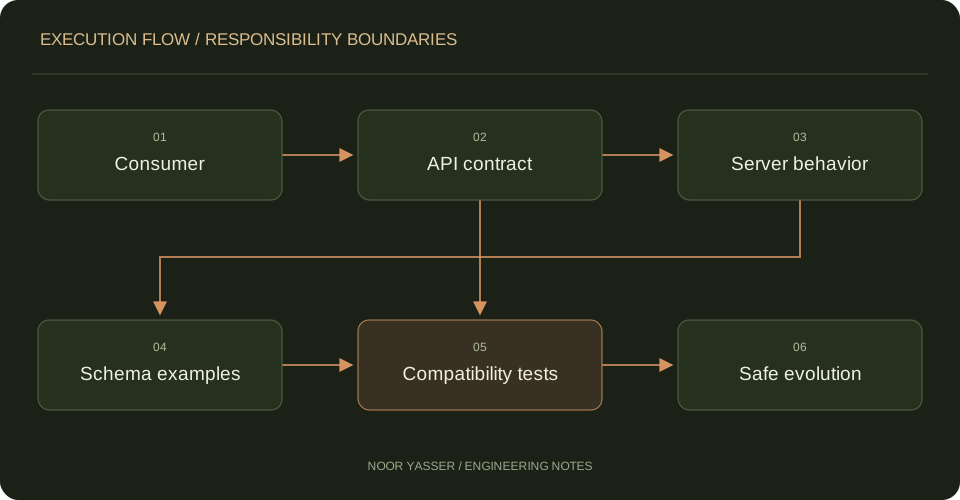
An API is not simply a collection of endpoints that work in Postman. Another application depends on its behavior during success, failure, delays and data changes. Ambiguous error shapes or unstable ordering transfer implementation uncertainty to every integration. Define the contract before clients depend on it, then verify the implementation follows it.
Start with a specific consumer need
An order list may need a summary, identifier, state and total; heavy details can live elsewhere. Specify types, null semantics, timestamps and money representation. Minor currency units with an explicit currency can be useful, but document the choice rather than assuming every currency has identical precision.
Make the contract reviewable
OpenAPI describes operations, parameters, response schemas and security mechanisms. A specification does not enforce itself. Review contract changes alongside code and use representative examples and compatibility checks. Keep serializer and validation changes synchronized with documentation.
{
  "error": {
    "code": "ORDER_STATE_CONFLICT",
    "message": "The order cannot be cancelled in its current state.",
    "request_id": "req_example_123"
  }
}
Give errors stable meaning
Clients should depend on a stable code rather than translated message text. Distinguish missing authentication, denied authorization, absence, conflicting state and invalid input with appropriate HTTP semantics. Do not expose stack traces or table names. For sensitive resources, consider whether an error inadvertently reveals a record the caller should not know exists.
Design stable pagination
Offset pagination is straightforward, but changing datasets can produce skipped or repeated items. A cursor based on created_at and id can suit a recent-orders feed with deterministic ordering. Bound page size and validate cursor scope. A cursor is not authorization: reapply tenant and resource access checks for every page.
Separate identity from permission
A valid token identifies the caller; it does not prove permission to modify a particular order or field. For retryable financial operations, define idempotency-key scope, retention and behavior when the same key arrives with different input. Those rules belong in the public contract.
Evolve without surprising consumers
Removing fields or changing their type or meaning can break older clients. Document deprecations and provide a transition path when needed. Even a new enum value warrants review if consumers treat the set as closed. Test an older client against the new server, plus network failures and boundary values. A dependable contract remains understandable long after the first successful request.
Scenario: an older client receives a new status
Adding an order status may look harmless on the server while an older client rejects an unfamiliar enum. Define whether future values are allowed and how consumers should display them. Test representative real clients rather than relying only on schema validation. Compatibility includes how a field is used, not just whether its JSON is valid.
Reviewing a new contract
Review successful output, denied access, invalid input, an empty final page and a retry after timeout. Confirm that identifier types agree and that text and timestamps handle language and timezone expectations. Before launch, ask a developer unfamiliar with the implementation to build a small consumer from the documentation alone. Their questions reveal the assumptions the contract has not made explicit.
Official references
These references document the tools discussed. Examples and design decisions are illustrative and should be adapted to the project and its versions.
Prepared by: Noor Yasser
Working through a similar engineering challenge?
I help teams turn architecture decisions into a clear scope and dependable, reviewable implementation.