

GPT‑6.1 Sol is best treated as a new production routing option, not as a one-line model-name replacement. OpenAI launched it on 29 September 2026 and positions it between GPT‑6 Astra and GPT‑6 Luna: a balanced model for complex coding, computer use and professional workflows at lower published token prices than Astra. The engineering opportunity is real, but the safe adoption path is to route tasks by evidence, reuse stable prompt prefixes, bound reasoning and tool authority, and promote traffic only after end-to-end evaluations.
OpenAI's launch post and model catalog were verified on 5 October 2026. Prices, context limits and benchmark results below are provider-published facts or claims as labeled; routing rules, rollout thresholds and architecture are engineering recommendations. A benchmark result is not a guarantee for a private workload.
What actually changed
OpenAI says GPT‑6.1 Sol approaches GPT‑6 Astra on several coding, professional-work, computer-use and scientific evaluations while charging one fifth of Astra's standard input and output token prices. The launch announcement lists API prices of $2 per million input tokens, $0.10 per million cached input tokens and $10 per million output tokens. It also identifies the API model as gpt-6.1-sol.
Those are meaningful changes for agentic products because long tasks repeatedly send tool definitions, policies, repository context and prior state. Lower input and cached-input prices can change which workflows are economically viable. Yet “one fifth of the price” is a token-price comparison, not a guaranteed fivefold reduction in cost per completed task. A model may use different reasoning, output length, tool calls, retries or fallbacks.
OpenAI reports gains on DeepSWE, AutomationBench, OSWorld and Terminal-Bench Science. Treat those numbers as company evaluation results under stated settings. The launch page notes that research or API evaluations can differ from production ChatGPT because system prompts, tools and effort settings differ. The relevant question is therefore not whether Sol won a public chart, but whether it completes your traced tasks more reliably per unit of time and money.
Read the model contract before the headline
The official model catalog lists GPT‑6.1 Sol with a 1.05-million-token context window, up to 128,000 output tokens, text and image input, and tool support including functions, web search, file search and computer use. The model comparison page also lists streaming, structured outputs and Batch API support.
A large context window is capacity, not a retrieval or instruction-following guarantee. Filling it with duplicated logs, stale documents and irrelevant tool output can increase latency and cost while making the decision boundary less clear. Keep an explicit context budget: stable policy, current task state, only the evidence needed for this turn, and compact summaries of prior tool results.
The same applies to maximum output. A 128K ceiling does not make a 128K answer desirable. Set task-specific output contracts and structured schemas. For code changes, request the patch, changed-file rationale and verification evidence rather than an unbounded narrative. For extraction, use a strict schema and reject output that does not validate.
Route by task risk and measured difficulty
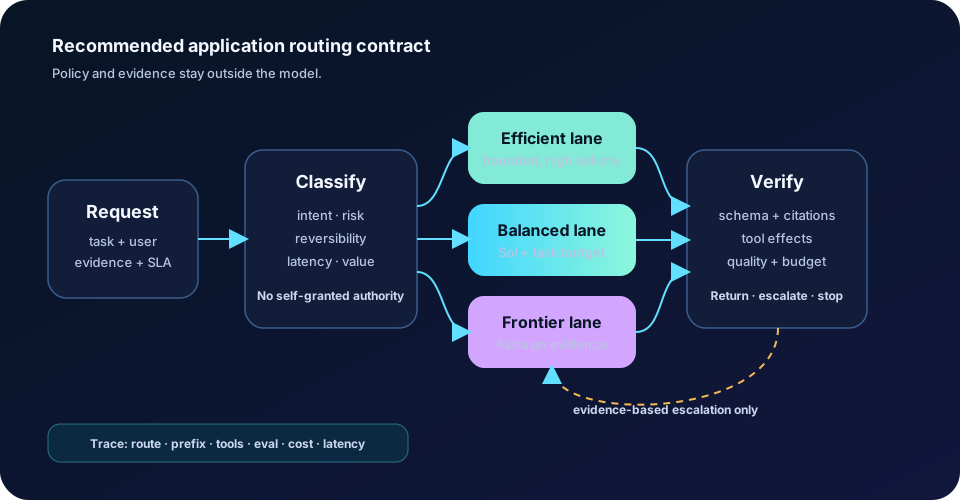
Begin with three lanes, but keep the routing policy independent of vendor names. A high-volume lane handles bounded classification, normalization and simple extraction. A balanced lane handles multi-step coding, document analysis and tool workflows. A frontier lane handles the hardest tasks or escalations where the measured value of a better result exceeds the extra cost and latency.
OpenAI currently describes Luna as the efficient high-volume model, GPT‑6.1 Sol as the capability-cost balance and Astra as the flagship for demanding work. Use that as an initial hypothesis, then fit the lanes to your evaluation data. Do not route only by prompt length. A short instruction can authorize a high-impact action, while a long document summary may be routine and read-only.
Useful routing features include task type, expected tool count, reversibility, data sensitivity, required citation quality, schema complexity, historical failure rate and service-level deadline. Never ask the model to decide its own authority. The application decides which tools, scopes and approval steps are available before the request reaches the model.
Build a routing contract around the model
The diagram in this article shows a recommended application architecture, not OpenAI's internal system. A request first receives an intent, risk and latency classification. Policy then selects the model, reasoning effort, maximum output, allowed tools and budget. The model executes inside those limits. A verifier checks schema, citations, tool effects and task-specific quality before the result is returned or escalated.
Make escalation explicit. For example, route a repository question to Sol with medium reasoning. Escalate to Astra only when a deterministic check fails, the evaluator score falls below a threshold, the task enters a protected area, or the user explicitly requests the frontier lane. A timeout, tool error or malformed output should not silently trigger a more powerful model with broader permissions.
Keep a terminal state for abstention. If required evidence is missing, return a bounded “cannot verify” result instead of inventing an answer or repeatedly spending tokens. This is especially important for web research, financial calculations, production changes and actions that affect other people.
Design prompts for reuse and cache visibility
The economic advantage of GPT‑6.1 Sol grows when repeated requests share a stable prefix. OpenAI's prompt-caching guide explains how repeated prompt prefixes can receive cached-input treatment. Put long-lived instructions, tool definitions, output schemas and stable reference material first; place user-specific and turn-specific data later.
Do not change whitespace, tool order or large policy blocks on every request without a reason. Version the stable prefix and record that version in telemetry. When a policy changes, make the change visible and expect the cache boundary to move. Cache is an optimization, not state storage: authoritative task state still belongs in your database or workflow engine.
Measure cached tokens from API usage metadata rather than assuming a hit. Track cache-hit ratio by prefix version, route and tenant, but never let one tenant's private context become another tenant's reusable prefix. Shared prefixes should contain only material intentionally common across those requests.
Bound reasoning, output and tool budgets together
GPT‑6.1 Sol supports multiple reasoning-effort settings. More effort can help on difficult tasks, but it also affects latency and total cost. A production route should define reasoning effort together with maximum output, tool-call count, wall-clock deadline and retry policy. Optimizing only input price while allowing unbounded tool loops is not cost control.
Use the Responses API as the execution envelope when the workflow needs tools or multi-step state. Give each tool a narrow schema, validate arguments server-side, attach tenant and user authorization outside the model, and make side effects idempotent. Read-only discovery can be automatic; money movement, data deletion, external messages and production changes should require policy checks and, where appropriate, human approval.
Separate a model retry from a tool retry. A transient network failure may justify retrying the same idempotent tool call. A semantically wrong plan requires new evidence, a changed instruction or escalation—not the same expensive request repeated blindly.
Evaluate the transition, not just the final answer
Before shifting production traffic, create a representative task set from real, de-identified failures and normal cases. Include easy, hard and adversarial examples; tool errors; missing documents; ambiguous permissions; long contexts; and multilingual inputs. The OpenAI evaluation guidance recommends task-specific criteria and continuous evaluation rather than relying on generic impressions.
Score the whole trajectory. For tool-using work, measure tool selection, argument validity, authorization decisions, side-effect correctness, recovery, citations and final-answer quality. A fluent answer after the wrong tool call is still a failed task. Record tokens, cached tokens, latency, tool time, retries and fallback usage beside the quality score.
Use paired comparisons on the same task inputs. Compare the current production route, Sol at selected effort levels, and the Astra fallback. Human review is valuable for nuanced quality, but deterministic checks should own schemas, calculations, compilation, tests, permissions and state transitions whenever possible.
Treat safety results as inputs, not outsourced controls
OpenAI's GPT‑6.1 Sol system card addendum reports the model under the same safeguards stack as GPT‑6 Astra and publishes results for jailbreaks, prompt injection, agentic behavior and monitorability. It also documents limitations. In one warnings evaluation, unwanted persistence was higher for Sol than Astra under the tested conditions; the card cautions that these adversarial evaluations are not production failure rates.
That nuance matters. A safer model does not eliminate application authorization. Tool calls must be constrained by authenticated identity, object-level permissions, business rules and approval state. Monitor the complete action trajectory, not only hidden reasoning or the final prose. The system card itself reports that monitors with access to actions can outperform chain-of-thought-only monitoring in its tested setting.
Prompt injection is an input-trust problem as well as a model problem. Label untrusted content, keep it out of the policy channel, restrict tools available during document or web processing, and require confirmation before untrusted text can cause an external side effect.
Calculate cost per successful task
Token prices are useful for forecasting, but unit economics should be calculated at the workflow boundary. For each route, compute input cost plus cached-input cost plus output cost, then add tool, retrieval, compute and human-review costs. Divide the total by successful tasks that meet the product rubric. Include fallback and retry spend.
A simple model is: task cost equals uncached input tokens times the input rate, plus cached tokens times the cached rate, plus output tokens times the output rate, plus external tool cost. Expected cost must then include the probability and price of a retry or Astra escalation. Use actual billing units from production telemetry; do not estimate from character count.
Latency needs the same end-to-end view. Separate queue time, first-token latency, generation, tool execution and verification. A cheaper model that makes extra serial tool calls may miss the product's deadline. Conversely, a slower high-reasoning route may be correct for asynchronous research but wrong for interactive checkout support.
Best uses and cases to avoid
GPT‑6.1 Sol is a strong candidate for complex, repeated workflows where Astra-quality is valuable but frontier pricing is difficult to sustain: repository analysis, coding agents with tests, professional document workflows, bounded computer use, research synthesis with citations and multi-tool operations with clear approval gates.
Do not use it simply because the context window is large. Search or SQL is better when the user needs a deterministic fact from structured data. A smaller model is better for simple classification or templated extraction that already meets the rubric. Astra remains the rational route when your own evaluations show a material quality gap on rare, high-value tasks.
Do not deploy computer use or write-capable agents without an execution boundary. A model upgrade cannot compensate for broad credentials, missing idempotency, absent approvals or no audit trail. If the product cannot observe and reverse an action, it is not ready to delegate that action.
Roll out with a reversible migration
Start in shadow mode: run Sol on a sampled copy of production tasks without allowing side effects, then compare outcomes against the current route. Next, enable a small cohort of low-risk traffic with deterministic verification and explicit fallback. Expand by task class only when quality, cost and latency remain within the agreed thresholds.
Pin the model ID shown in the official catalog and record the routing-policy version, prompt-prefix version, tool-set version and evaluator version for every trace. Establish rollback triggers before rollout: error rate, evaluator regression, permission violation, cost per success, latency percentile and fallback rate.
Publish the decision as a product contract. Product owners should know which tasks receive the balanced lane, which can escalate, what users see when evidence is missing, and which actions always require approval. That makes model selection an operable system rather than a hidden prompt tweak.
Production decision
The main value of GPT‑6.1 Sol is not that every request should move to it. The value is a new middle lane: enough capability for many complex workflows, with published prices that make repeated and cache-friendly agent execution more practical. Capture that value with task-aware routing, stable prefixes, bounded budgets, narrow tools, full-trajectory evaluation and a measured Astra fallback.
Teams should adopt it when their own evaluation set shows a better cost-quality frontier. They should not adopt it when a deterministic system already solves the problem, when the task is too simple to justify the model, or when the application lacks authorization and observability controls. Connect the rollout to applied AI delivery, MCP agent evaluation and durable agent supervision.
Official references
These references document the tools discussed. Examples and design decisions are illustrative and should be adapted to the project and its versions.
Prepared by: Noor Yasser
Working through a similar engineering challenge?
I help teams turn architecture decisions into a clear scope and dependable, reviewable implementation.


