Anthropic launched Claude Models on Google Cloud (Anthropic managed) on 22 October 2026. It exposes Anthropic's developer platform through a Google Cloud project, uses Google Cloud IAM for access and Google Cloud Marketplace for billing, while Anthropic operates the API and inference infrastructure. This matters because it is not the same product boundary as Google-managed Claude on Agent Platform: the identity experience can look similar while the data processor, endpoint, feature cadence, quota ownership and compliance boundary differ.
For platform and AI engineering teams, the correct decision is therefore not “Can we call Claude from Google Cloud?” Both paths can. The decision is who must operate the inference plane, where data may be processed, which controls are contractual requirements, and whether immediate access to Anthropic platform features is more valuable than keeping inference inside Google Cloud's security boundary.
This article uses the official Anthropic release notes and current Google Cloud documentation, verified on 23 October 2026. Product availability, endpoints, IAM roles and documented responsibility boundaries are source facts. The adapter design, rollout gates, monitoring model and recommendations below are engineering analysis.
What launched on October 22
The Claude Platform release notes record two changes on 22 October 2026:
- Claude Models on Google Cloud (Anthropic managed) became available, with the Claude API operated by Anthropic and reached through a Google Cloud project.
- Google Cloud IAM controls access, while Google Cloud Marketplace handles billing.
- Fast mode became available for Claude Opus 5.5 on this Anthropic-managed path.
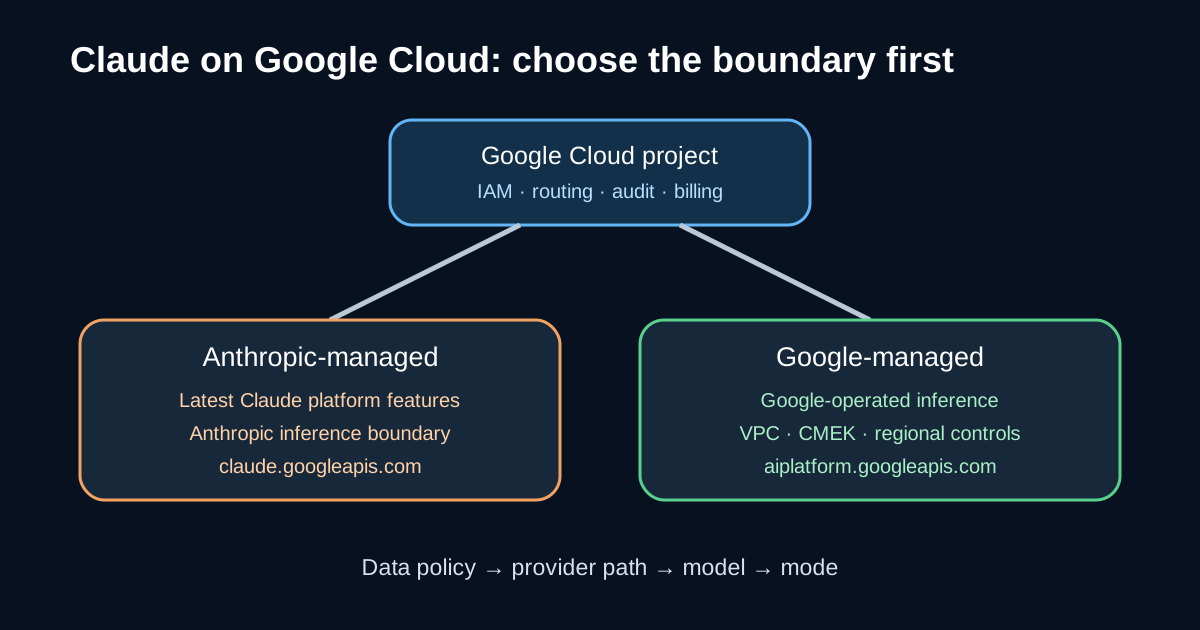
The service uses claude.googleapis.com rather than the regional Agent Platform endpoint used by Google-managed partner models. Google documents an AnthropicGoogleCloud SDK client for the new path and workspace-scoped REST endpoints under a Google Cloud project.
That combination can simplify procurement and workload identity. A service already running on Google Cloud can use Application Default Credentials or a service account instead of distributing a separate long-lived Anthropic API key. Billing can flow through Marketplace and may draw down an eligible Google Cloud commitment under the applicable Marketplace policy.
But procurement integration does not change who runs inference. Google states that storage and inference for the Anthropic-managed option occur on Anthropic-managed infrastructure and may route outside Google Cloud. Google and Anthropic act as independent data processors for their respective parts of the service. That distinction must be explicit in architecture reviews and data-flow diagrams.
Anthropic-managed versus Google-managed Claude
The two paths share Google Cloud IAM authentication, but they are not interchangeable.
| Decision dimension | Anthropic-managed on Google Cloud | Google-managed Claude |
|---|---|---|
| Inference operator | Anthropic | Google Cloud |
| Base endpoint | claude.googleapis.com | regional aiplatform.googleapis.com |
| API surface | Intended to mirror first-party Claude APIs | Agent Platform API and supported Claude surface |
| Feature cadence | Latest Anthropic features, previews and beta headers | Model Garden release schedule |
| Billing | Google Cloud Marketplace | Agent Platform billing |
| Quota ownership | Requests through Cloud console; limits managed by Anthropic | Google Cloud quotas |
| Data boundary | Anthropic-managed infrastructure; geography must be reviewed | Google-operated boundary and regional controls |
| Primary SDK | AnthropicGoogleCloud | Agent Platform or Vertex-compatible client |
| Best fit | First-party feature parity with Google identity and billing | Google-only processing, VPC controls and native integrations |
Google's Anthropic-managed documentation specifically recommends the Google-managed path when Google must be the sole data processor, when inference must remain inside the Google Cloud security boundary, or when the workload depends on VPC Service Controls, customer-managed encryption keys, regional data residency, particular Google compliance programs, BigQuery, Model Armor or Agent Engine integration.
Choose the Anthropic-managed path when the priority is the first-party Claude platform surface, faster access to new models and research previews, Anthropic beta headers, Claude Console resources and Google Cloud identity or procurement. Do not choose it merely because the hostname ends in googleapis.com.
Model the control plane and data plane separately
A safe architecture draws two boundaries.
The Google Cloud integration layer is the control and access plane for project identity, IAM authentication, API routing, Cloud Audit Logs and Marketplace billing. Anthropic's platform is the service and inference plane for the Anthropic-managed option. Each plane has its own terms, operational owner and evidence.
A useful request trace should capture:
- the Google Cloud project and service account that obtained the OAuth token;
- the Claude workspace resolved for the request;
- the selected model and API version;
- the region or
inference_geopolicy applied; - a correlation identifier that is safe to log;
- latency, token usage, rate-limit metadata and stop reason;
- the application tenant and policy decision that authorized the call.
Never record the bearer token, raw secrets or sensitive prompt contents by default. Cloud Audit Logs can prove an identity called the integration layer; application telemetry must still prove which product tenant and policy allowed the business request.
Data classification must happen before routing. A public documentation question, an internal source-code review and a health record do not have the same residency or retention requirements. Bind every route to an explicit data class and approved provider path rather than letting an SDK default decide.
Google says the Anthropic-managed path follows the first-party Claude API retention policy, and Zero Data Retention may be available by arrangement. A possible contract is not an active control. Record whether ZDR is enabled for the specific organization and workspace, and block restricted workloads until evidence exists.
Set IAM without turning project access into platform administration
Google documents two relevant predefined roles:
roles/claude.userallows API calls.roles/claude.adminis required for Claude Console administration.
Runtime services should receive the user role, not the admin role. Console administrators should be a small, reviewed group with separate identities. Avoid granting broad project roles such as Owner merely to make the API work.
The activation flow creates a separate Anthropic organization for the Google Cloud project. Google warns that API keys, workspaces, HIPAA controls, ZDR and settings from an existing first-party Anthropic organization do not carry over. Treat activation as a new security boundary, not as an alias of an organization you already operate.
Before production:
- identify the owner and break-glass administrators;
- create separate development, staging and production projects or workspaces;
- bind service accounts to the narrowest project and role;
- prohibit user credentials in production workloads;
- enable audit-log retention and export;
- inventory organization settings that must be recreated;
- verify support, retention and data-residency agreements for this new organization.
Use short-lived Google credentials through Application Default Credentials or workload identity. Do not copy the output of gcloud auth print-access-token into environment files, container images or CI variables.
Build a provider adapter before migrating traffic
The Messages API shape may mirror Anthropic's API, but the surrounding contracts differ. Hide those differences behind an internal provider interface:
type ClaudeRoute = {
  path: "anthropic-google-cloud" | "google-managed";
  projectId: string;
  workspaceId?: string;
  model: string;
  apiVersion: string;
  inferenceGeo?: string;
  dataClass: "public" | "internal" | "restricted";
};

interface ClaudeGateway {
  generate(route: ClaudeRoute, request: NormalizedMessageRequest):
    Promise<NormalizedMessageResponse>;
}
The adapter should own endpoint construction, credential acquisition, API-version headers, beta-feature allowlists, error normalization, streaming, retry classification and telemetry. Product code should not concatenate a claude.googleapis.com path or know how an OAuth token was obtained.
Keep model selection separate from provider-path selection. “Use Opus 5.5” is a capability choice. “Use Anthropic-managed on Google Cloud” is an infrastructure and governance choice. Combining them in one flag makes later residency or cost routing difficult.
Do not normalize away meaningful differences. If one path lacks a beta tool or returns different quota metadata, expose a typed capability result and fail closed. Silent fallback can move restricted data to an unapproved processor or remove a safety control.
Related reading: group Claude models without parsing model IDs and route Claude Haiku 5.5 by measured outcomes.
Migrate through contract tests and shadow evaluation
Start with a golden set that represents real request classes without including uncontrolled production secrets. Assert the response contract rather than exact prose:
- required structured-output fields and schema validity;
- tool-call names, arguments and authorization decisions;
- citation presence and source alignment;
- refusal and stop-reason handling;
- maximum output and streaming event behavior;
- prompt-cache and beta-feature behavior;
- error mapping for authentication, quota, timeout and invalid request;
- latency and cost envelopes for each route.
Run the new path in shadow mode only for approved data. Compare quality and operational signals without returning the shadow response to users. A shadow request is still a real disclosure to a processor, so residency and consent rules still apply.
Move to a canary by workload class, not random percentage alone. Begin with low-risk internal tasks, then expand to customer traffic after quality, quota, audit and incident controls are proven. Keep a reversible route switch and record which provider path generated every response.
An uncertain network result needs request-aware recovery. Retrying a pure generation may be acceptable under a bounded policy; retrying a tool-enabled agent can duplicate an external action. Separate model generation from tool execution, attach idempotency keys to business commands, and reconcile an unknown outcome before repeating it.
Use Fast mode deliberately
Anthropic's release notes say Fast mode is available for Claude Opus 5.5 on the Anthropic-managed Google Cloud path. This is an availability fact, not evidence that every request should use it.
Route Fast mode to latency-sensitive tasks where the extra serving cost and quota profile are justified by user value. Examples can include interactive coding assistance or synchronous incident triage. Keep standard mode for offline analysis, batchable work and requests where latency does not change the product outcome.
Measure end-to-end latency, not only model token speed:
user latency =
  admission queue
  + credential acquisition
  + network and routing
  + time to first token
  + generation
  + tool execution
  + response rendering
A faster model path cannot repair a saturated application queue, slow tool or repeated authentication exchange. Cache credentials safely, reuse network connections, stream when the UX benefits, and enforce per-tenant admission budgets.
Do not automatically fall back from Fast mode to another provider path if that changes the approved data boundary. Fallback rules require the same governance checks as primary routing.
Observability, quotas and incident response
The Anthropic-managed path accepts Google Cloud quota requests, but Google documents that Anthropic manages its rate limits and quotas. Your dashboards therefore need both Google integration signals and Anthropic service behavior.
Track:
- requests, tokens and latency by project, workspace, model and route;
- OAuth authentication failures separately from model authorization errors;
- 429 rate limits separately from transient 5xx overload;
- time to first token and full completion time;
- Fast versus standard mode outcomes;
- structured-output and tool-call validation failures;
- policy denials by data class;
- spend and commitment consumption;
- regional policy mismatches;
- fallback and manual-override events.
Set retry policies by error semantics. Back off on a retryable overload, honor server guidance, and cap attempts within the user deadline. Do not retry invalid authentication, unsupported beta headers or schema errors. Use a circuit breaker to stop a broken route from amplifying load, but keep an explicit operator path for recovery.
A multi-provider design needs incident runbooks that say which workloads may move. Availability pressure is not authority to break residency, retention or processor rules.
When not to use the Anthropic-managed path
Prefer Google-managed Claude when governance requires Google to be the sole processor, inference inside the Google Cloud boundary, regional controls, VPC Service Controls, CMEK, a specific Google compliance program or tight integration with Agent Engine, BigQuery or Model Armor.
Prefer the first-party Anthropic API directly when Google Marketplace procurement and Google IAM add no value, and your organization already has the required Anthropic controls, support and networking. An extra integration layer is not automatically simpler.
Do not migrate solely to consolidate an invoice. Billing alignment is useful, but a production move also creates a separate Anthropic organization, new IAM bindings, endpoint behavior, quota ownership and a new evidence package.
Production decision checklist
Choose the processor and data boundary first. Confirm the feature set second. Then prove the route operationally.
For the Anthropic-managed Google Cloud path, document the separate Anthropic organization, grant roles/claude.user to workloads and reserve roles/claude.admin for administrators. Pin the API version, restrict beta headers, classify data before routing, configure inference_geo where required, verify retention and ZDR status, export audit evidence, and test quota and incident behavior.
For Google-managed Claude, verify the required region, VPC Service Controls, CMEK, compliance and native service integrations. Do not assume feature parity with the first-party Anthropic release schedule.
The launch expands deployment choice; it does not collapse the responsibility model. The strongest design makes the managed path explicit in code, policy, telemetry and contracts—so a convenient IAM login never hides where inference runs or who processes the data.
For architecture help across AI providers, see the AI and software engineering services.
Official references
These references document the tools discussed. Examples and design decisions are illustrative and should be adapted to the project and its versions.
Prepared by: Noor Yasser
Working through a similar engineering challenge?
I help teams turn architecture decisions into a clear scope and dependable, reviewable implementation.