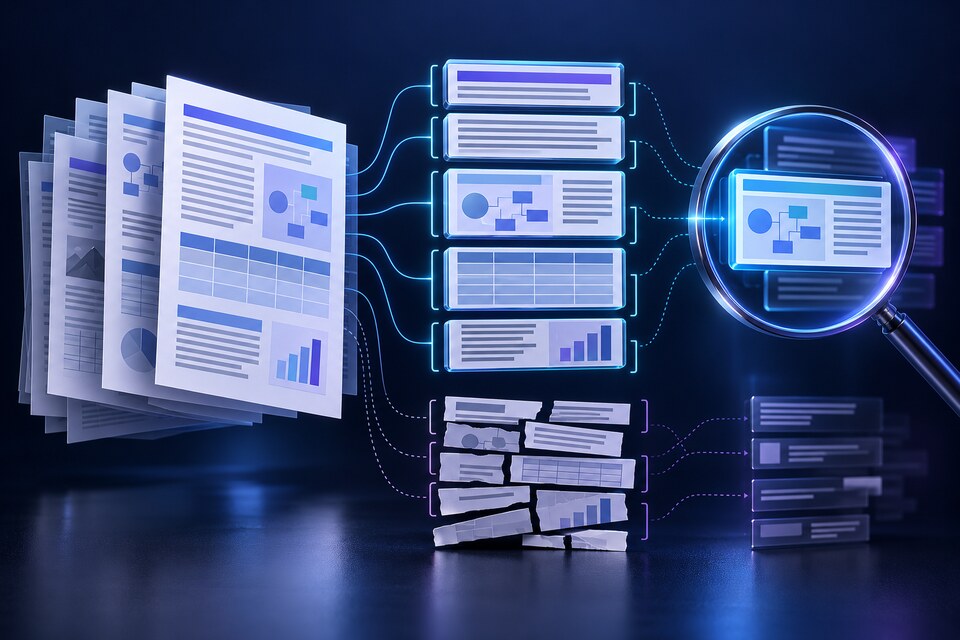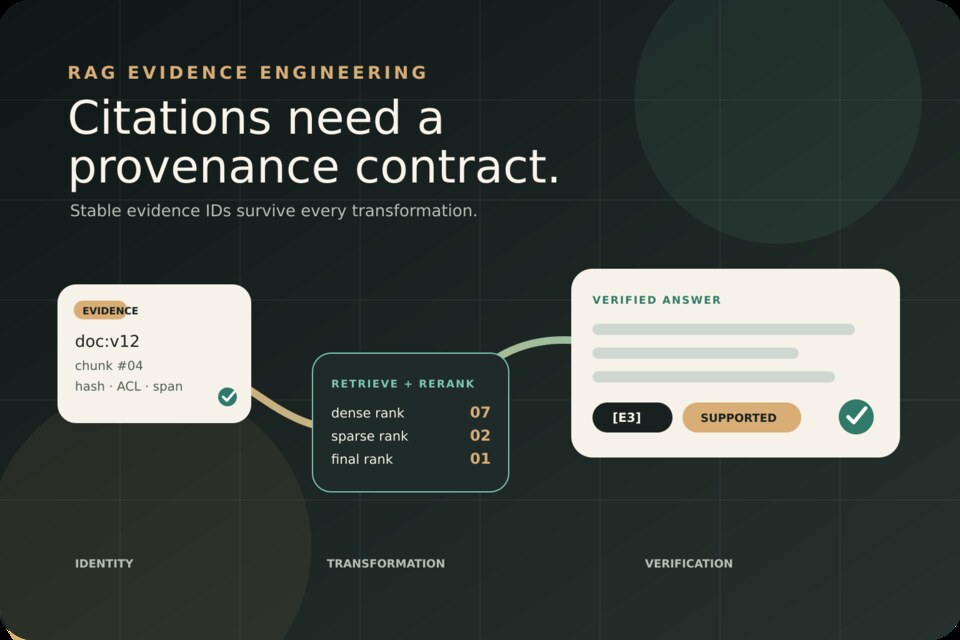
Reliable RAG citations require an evidence pipeline, not a prompt that merely asks the model to “add sources.” Every passage that reaches the model needs a stable evidence ID tied to an authorized document revision, an exact chunk or span, and the retrieval run that selected it. That identity must survive query rewriting, hybrid retrieval, reranking, deduplication and context packing. The answer layer should emit only IDs from the supplied evidence set, while a verifier resolves those IDs, checks access and confirms that each cited passage supports the nearby claim. This architecture matters for product documentation, support, compliance and internal knowledge systems where a plausible answer without traceable evidence is still a failure.
OpenAI documents that File Search output can contain file-citation annotations, while the underlying search results are not returned unless the request explicitly includes file_search_call.results. Anthropic provides native citations for document content and search-result blocks. Qdrant stores metadata as payload alongside points and can return that payload with retrieved candidates. Those are useful primitives, but none automatically defines your source-version policy, tenant boundary, claim-support test or invalidation workflow. The application must own that contract.
Define citation success before choosing a provider
A citation is successful only when a reader can answer four questions: which source supports this claim, which revision was used, which exact passage was supplied, and whether the reader is allowed to see it. A link to a document homepage is not enough when the source changes. A chunk ID is not enough when it cannot be resolved outside the vector database. A model-generated footnote number is not enough when it was never checked against the retrieved set.
Separate answer correctness from citation quality. An answer can be correct by coincidence while citing the wrong passage. A citation can point to a relevant passage while the sentence overstates it. Measure claim coverage, citation validity and passage entailment separately from style. For high-risk workflows, abstaining with a clear evidence gap is better than manufacturing a complete-looking answer.
Build an immutable evidence contract
Represent every retrievable unit with stable fields such as tenant_id, document_id, document_version, chunk_id, source_uri, title, section_path, content_hash, span_start and span_end. Store ingestion and validity timestamps when freshness matters. Keep authorization labels in trusted metadata, not in text the model can reinterpret. The vector score and reranker score belong to a retrieval observation; they are not source identity.
The document revision should be immutable. When content changes, create a new version and new chunk hashes, then retire the old version through a controlled alias or validity rule. This makes a citation reproducible and allows an audit record to show what the model actually saw. If the product displays “latest,” resolve that label before retrieval and record the concrete version used.
Qdrant points can carry optional JSON payload and support filtering on payload fields. Use that payload for identity and trusted scoping, create payload indexes for fields used in filters, and request the required payload in the query response. Do not depend on reconstructing provenance from the chunk text after retrieval.
Preserve identity through retrieval and reranking
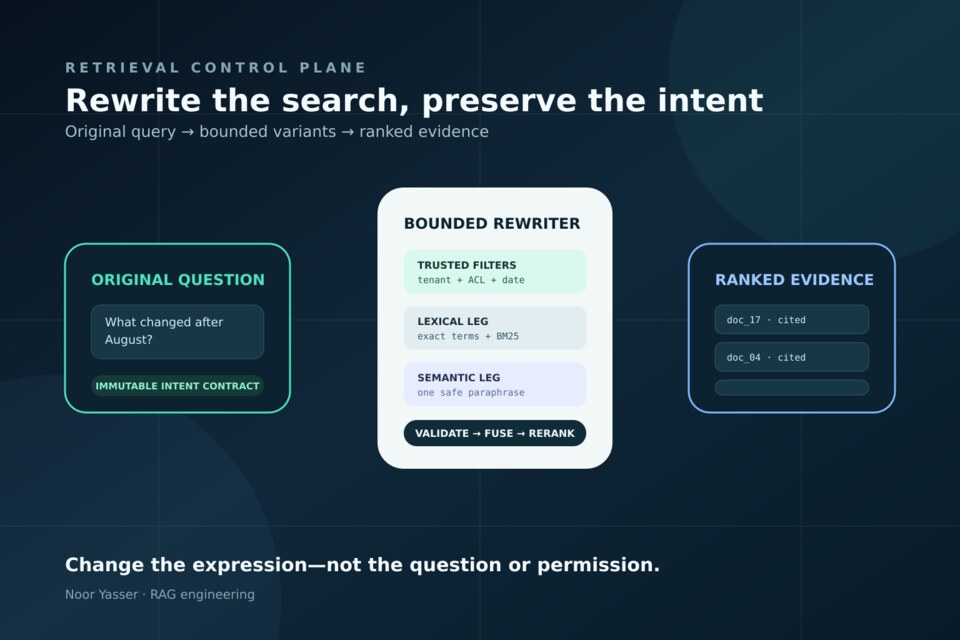
Query rewriting should produce retrieval queries, not new source identities. Dense and sparse retrieval may return the same chunk through different paths. Fuse candidates by immutable evidence ID, preserve the contributing ranks and scores as diagnostics, then rerank the canonical candidates. Never assign citation numbers before deduplication because the same passage can otherwise appear under multiple numbers.
Qdrant hybrid queries can run multiple prefetches and combine their candidates with fusion. The fused rank is useful for ordering, but the application still needs the original point ID and payload. A reranker should receive an envelope containing evidence_id and text and must return that evidence_id unchanged. Reject any result whose ID is missing, duplicated unexpectedly or outside the authorized candidate set.
Keep a retrieval ledger for each answer: original user query, rewritten queries, filters, candidate IDs, fusion output, reranker order, thresholds and model versions. Redact sensitive text if logs do not have the same security boundary as the knowledge base. The ledger is for debugging and evaluation; it should not become an uncontrolled copy of private documents.
Pack context without breaking provenance
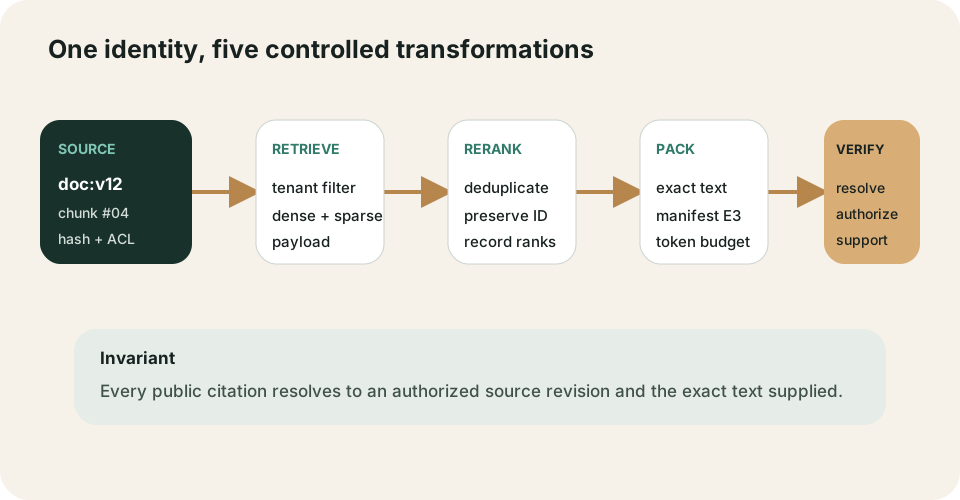
Context construction often destroys citations accidentally. Teams concatenate neighboring chunks, trim text to fit a token budget, or summarize candidates, then keep the original offsets as if the passage were unchanged. Instead, create an evidence manifest after final packing. Each packed block receives a request-local label such as E1, but E1 maps to an immutable evidence record and the exact text sent to the model.
If adjacent chunks are merged, store the ordered child IDs and the merged text hash. If a block is trimmed, record the new span or treat it as a derived evidence block with parents. Never point to characters that were not supplied. Put the evidence label, title and section outside untrusted source text so a document cannot forge an instruction or impersonate another source.
An illustrative context envelope is:
\`\`\`json { "evidence_id": "E3", "source": { "tenant_id": "tenant_42", "document_id": "refund-policy", "document_version": "2026-10-10", "chunk_id": "refund-policy#returns#04", "content_hash": "sha256:...", "uri": "/policies/refunds#returns" }, "text": "Refund requests must be submitted within ...", "retrieval": {"dense_rank": 7, "sparse_rank": 2, "final_rank": 1} } \`\`\`
The public response can expose a safe title and URI while the audit record retains internal IDs. Do not expose tenant IDs, storage paths or confidential filenames merely because they exist in payload.
Choose native or portable citation generation
Provider-native citations reduce formatting work when the entire evidence flow fits the provider contract. Anthropic document citations can attach references to specific source locations, and its search-result content blocks let Claude cite application-supplied search results using the source and title provided. OpenAI File Search can emit file_citation annotations in response text. Use these features when their source representation, streaming behavior and output metadata meet the product requirement.
A portable approach is better when retrieval and generation use different vendors, when you need Qdrant or SQL alongside provider search, or when one answer mixes several evidence systems. Give the model a closed evidence manifest and require structured claim objects with evidence IDs selected from an enum. Render human-readable footnotes in application code, not in free-form model text. This prevents a harmless wording change from corrupting citation numbering.
Do not assume native citations remove the need for validation. Confirm that every returned annotation resolves to an input source, that cited text belongs to the recorded revision, and that the UI displays the correct target. Streaming consumers must apply annotation events without losing or shifting character ranges when text is transformed.
Verify claims after generation
The first verifier is deterministic. Parse the response, collect evidence IDs, reject unknown or unauthorized IDs, detect citations with no nearby claim and detect factual claims with no citation. Resolve every ID through the evidence manifest rather than trusting a URI repeated by the model. Recheck tenant and document permissions at response time because authorization can change during a long request.
The second verifier evaluates support. Split the answer into atomic claims and test whether the cited passage entails each claim without relying on hidden outside knowledge. Treat partial support, source conflict and excessive certainty as separate outcomes. A model-based judge can help at scale, but calibrate it against human labels and keep deterministic failure categories visible.
The third verifier checks freshness and authority. A policy draft may contain the right words but be superseded. A forum post may answer the question but not be authoritative. Rank source authority and validity independently from semantic relevance. If current truth lives in a database, retrieve the record directly and cite the system-of-record view rather than an old prose snapshot.
Evaluate the evidence pipeline, not only the final prose
Build a labeled set with questions, expected claims, acceptable evidence IDs, forbidden evidence and abstention cases. Measure retrieval recall before reranking, evidence recall after context packing, citation precision, citation coverage, unsupported-claim rate, stale-source rate and authorization violations. Also measure latency and token cost by stage so teams can see whether an extra reranker or verifier earns its budget.
Test adversarial cases: duplicated documents, contradictory revisions, a malicious chunk that asks the model to ignore citation rules, a result from another tenant, an answer that combines two sources into a stronger claim than either supports, and a source removed between retrieval and rendering. Regression tests should preserve evidence IDs and expected failure modes, not only approximate answer wording.
Offline metrics are necessary but not enough. In production, log resolvable citation events, user opens, broken targets, abstentions and source-version drift without recording sensitive content indiscriminately. Sample traces for review and keep an incident path for a citation that exposed metadata the user should not see.
Handle updates, deletion and auditability
Source deletion must invalidate both retrieval and rendering. Tombstone the document version, remove or filter its points, and decide whether historical audit records may retain a non-public snapshot under a stricter policy. A previously generated answer should not keep a public link to revoked content. The response page can show that evidence was withdrawn while an authorized audit system preserves the event.
Re-embedding does not have to change source identity. The vector representation and embedding model are indexing metadata; document_id, document_version and chunk identity describe evidence. If a new chunker changes boundaries, create new chunk IDs and retain parent lineage. Never silently reuse an old chunk ID for different text.
Store the retrieval and generation configuration with the answer: embedding version, collection or alias, filter policy version, reranker, context builder, model and prompt revision. This is not proof that the answer was correct, but it makes failures reproducible enough to repair.
Security boundaries
Apply tenant and access filters before vector search, then recheck after retrieval and before rendering. Do not retrieve broadly and ask the model to hide unauthorized results. Keep document titles and source URIs under the same access policy as content; metadata can reveal customer names, legal matters or product plans.
Treat retrieved text as untrusted input. Delimit it from instructions, prevent tools from interpreting it as an action request, and do not let a chunk choose its own evidence ID. If the system supports external URLs, enforce an allowlist or signed source registry so citations cannot become attacker-controlled links.
Cache keys must include tenant, authorization scope, source versions and retrieval-policy revision. A semantically identical question from another tenant cannot reuse the same evidence response. Invalidate caches when permissions or source validity changes, not only when text changes.
When not to use RAG citations
Use SQL or an API when the answer is an exact current value, such as inventory, account balance or order status. Use conventional search when the user needs discovery and can inspect results directly. Use a curated static knowledge page when the evidence set is tiny and changes through review. RAG is useful when semantic retrieval and synthesis add value; citations do not repair a source that is incomplete, unauthorized or structurally better queried elsewhere.
Avoid RAG for decisions that require a complete legal record unless the system can prove corpus completeness and review. Avoid generating a confident synthesis from mutually inconsistent policies without surfacing the conflict. A citation-rich answer can still be wrong, so the interface must communicate limits and support escalation.
Production checklist
Define immutable document and chunk identities. Store source revision, safe URI, section path, checksum and authorization metadata. Filter before retrieval and preserve evidence IDs through fusion and reranking. Build a final evidence manifest from the exact packed text. Restrict generation to manifest IDs, render citations in application code, and validate every annotation. Measure support and coverage separately from answer quality. Version the whole retrieval stack, invalidate revoked evidence, and prefer abstention when support is insufficient. A RAG answer is trustworthy only when its evidence remains traceable after every transformation.
Official references
These references document the tools discussed. Examples and design decisions are illustrative and should be adapted to the project and its versions.
- OpenAI — Citation formatting guidance, verified 18 October 2026
- OpenAI — File Search guide and file citation annotations, verified 18 October 2026
- Anthropic — Citations with document content, verified 18 October 2026
- Anthropic — Search result content blocks and citations, verified 18 October 2026
- Qdrant — Payload and payload indexes, verified 18 October 2026
- Qdrant — Hybrid and multi-stage queries, verified 18 October 2026
Prepared by: Noor Yasser
Working through a similar engineering challenge?
I help teams turn architecture decisions into a clear scope and dependable, reviewable implementation.