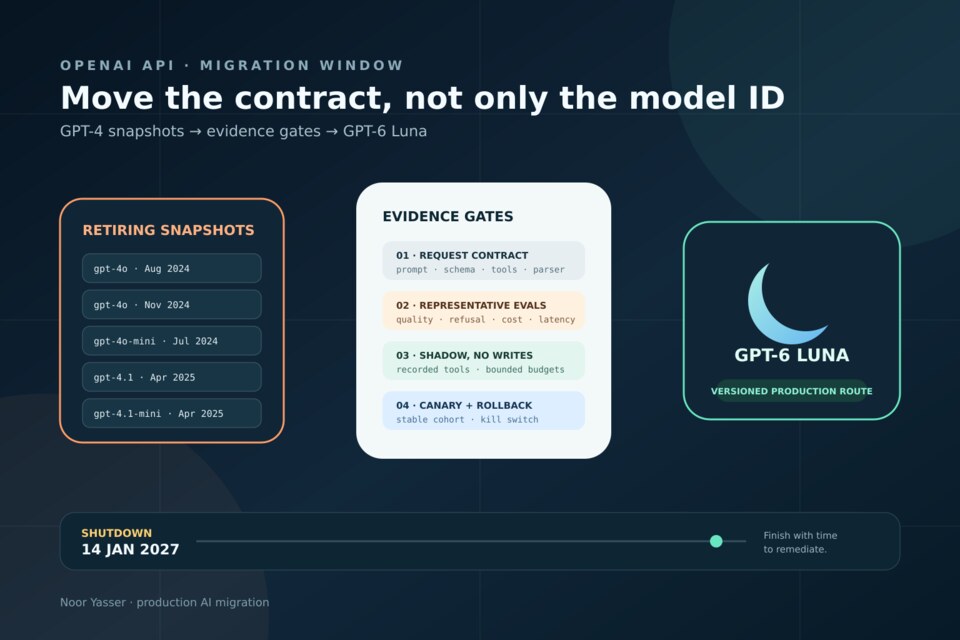
Anthropic is removing fast mode from Claude Opus 4.8 on November 30, 2026. After that date, requests that combine the model ID claude-opus-4-8 with speed: "fast" will return an error. This does not mean Claude Opus 4.8 itself retires on that date: Anthropic's model lifecycle page still lists the model as active, with retirement not sooner than May 28, 2027.
This article separates those two lifecycle events and turns the fast-mode deadline into a measured production migration. The deprecation date, supported models, request fields, pricing, rate-limit behavior and Opus 5.5 compatibility changes are documented facts from Anthropic's official pages, verified on November 1, 2026. The inventory, evaluation, rollout, fallback and observability design is engineering guidance—not a claim about undocumented platform behavior.
The answer first
If any production path sends speed: "fast" to claude-opus-4-8, migrate that workload to claude-opus-5-5 before November 30. Do not change only the model string. Opus 5.5 changes the thinking contract, defaults to a different effort level, changes some tool-use behavior, has separate fast-mode capacity, and does not support Priority Tier. Build a compatibility test first, then compare quality, latency, token usage, tool success and cost on a representative evaluation set.
Run the new route behind a feature flag. Record both requested speed and usage.speed, because a label in configuration is not proof of the inference mode that served the request. Keep an explicit standard-speed fallback for capacity errors only when it still satisfies the product's latency and quality contract. Remove the old Opus 4.8 fast route and its beta header after the canary is stable.
| Question | Documented answer | Engineering consequence |
|---|---|---|
| What ends on November 30? | Fast mode on Claude Opus 4.8 | Remove speed: "fast" from every 4.8 path or migrate it |
| Is Opus 4.8 itself retiring then? | No; the model remains listed as active | Do not misclassify standard 4.8 traffic as a November outage |
| Recommended fast target | Claude Opus 5.5 | Test its request and response contracts before traffic shift |
| Does 5.5 need the old beta header? | No | Delete header injection after the route moves |
| How do you prove the serving mode? | Read usage.speed | Monitor actual mode, not requested intent alone |
| What happens at fast capacity limits? | 429 or 529; 429 can include retry-after | Use a bounded retry or deliberate standard fallback |
What Anthropic actually deprecated
The October 30 Claude Platform release note says fast mode for Claude Opus 4.8 is deprecated and will be removed on November 30, 2026. Anthropic's fast-mode guide says that after removal, a request to claude-opus-4-8 with speed: "fast" returns an error, and tells customers who want fast mode to move to Claude Opus 5.5.
The distinction matters because the model lifecycle is different. Anthropic's model-deprecations page lists claude-opus-4-8 as active and gives a tentative model retirement date no sooner than May 28, 2027. A production incident runbook should therefore distinguish:
- fast-mode feature retirement: November 30, 2026;
- Claude Opus 4.8 model retirement: not announced for November; the current lifecycle table says not sooner than May 28, 2027;
- your internal route retirement: the date you stop sending new traffic after validation.
This prevents two opposite mistakes: ignoring the fast-mode deadline because the model is active, or rushing all standard Opus 4.8 workloads into a model migration they did not need for this specific deadline.
Discover every affected request path
Searching application code for one model ID is not enough. Fast mode can be injected by an SDK wrapper, gateway policy, environment variable, managed-agent model object, feature flag or request template.
Inventory at least these surfaces:
- direct Messages API payloads containing
model: "claude-opus-4-8"andspeed: "fast"; - Managed Agents definitions whose model object includes the same model and speed;
- shared clients that append the
fast-mode-2026-02-01beta header; - model aliases in an internal router, such as
opus-fastorpremium-low-latency; - fallback branches that activate only after a timeout or capacity error;
- scheduled jobs and rarely used admin workflows;
- dashboards, alerts and budgets grouped by the old model or beta feature;
- integration tests and fixtures that validate only HTTP success, not response shape.
Emit an inventory row per route:
{
  "route": "support-escalation-agent",
  "model": "claude-opus-4-8",
  "requested_speed": "fast",
  "beta_header": "fast-mode-2026-02-01",
  "effort": "high",
  "thinking_field": "omitted",
  "tool_choice": "required",
  "computer_tool": null,
  "traffic_share": 0.08,
  "fallback": "opus-4-8-standard",
  "owner": "support-platform"
}
This is an internal inventory format, not an Anthropic API schema. Its purpose is to expose compatibility risk before any request changes.
Treat Opus 5.5 as a contract migration
Anthropic's migration guide says code moving from Opus 4.8 must first satisfy the general Opus 5.5 request rules and thinking-response handling. Several differences can affect applications even when prompts stay identical.
### Thinking and effort
On Opus 4.8, thinking is off when the request omits the thinking field. On Opus 5.5, thinking runs even when that field is omitted. Anthropic also documents a default effort change: Opus 4.8 defaults to high, while Opus 5.5 defaults to medium.
Do not let those defaults decide a production migration implicitly. Set effort explicitly for each evaluated workload, parse thinking-aware responses, and compare both quality and token use. A route that depends on the old “omitted means off” behavior needs an intentional redesign because Opus 5.5 uses adaptive thinking rather than the old opt-in assumption.
### Tool contracts
The Opus 5.5 documentation lists breaking changes around forced tool use, model-linked thinking blocks and an earlier computer-use tool version. If your agent forces a tool, replays conversations containing thinking blocks, or uses computer_20251124, include those paths in compatibility tests. Do not infer compatibility from a successful text-only prompt.
### Prompt caching and Priority Tier
The minimum cacheable prompt on Opus 5.5 is 512 tokens, lower than the 1,024-token minimum documented for Opus 4.8. That can change cache creation and cost patterns without a code change. At the same time, Anthropic's migration guide says Priority Tier is not supported on Opus 5.5, whereas Opus 4.8 retains it. Fast mode and Priority Tier are separate capacity products; never assume one replaces the other.
Fast mode is throughput, not instant first byte
Anthropic describes fast mode as the same model running with a faster inference configuration. The company says it can deliver up to 2.5 times higher output tokens per second. The documentation explicitly says the benefit focuses on output tokens per second, not time to first token.
Measure the latency components separately:
end_to_end = queue_wait + request_setup + TTFT + generation + tool_time + post_processing
generation = output_tokens / observed_OTPS
If tool calls or queueing dominate, higher OTPS may not materially improve the user journey. Conversely, a long streaming answer can benefit even if TTFT stays flat. Report p50 and p95 for TTFT, OTPS and end-to-end latency; one average hides saturation and tail behavior.
Anthropic's current pricing page lists Opus 5.5 fast mode at $8 per million input tokens and $40 per million output tokens. Opus 4.8 fast mode is listed at $10 and $50. These are provider prices, not a forecast of your bill. Prompt caching and data-residency multipliers can stack with fast-mode pricing, so compute cost from real usage records instead of multiplying request count by a headline rate.
Build an evaluation contract before the canary
Create a frozen evaluation set from real, privacy-reviewed tasks that represent each route. Include short answers, long streaming generation, tool sequences, refusals, cacheable prompts and peak-context requests.
Score at least:
- task correctness and instruction adherence;
- tool selection, argument validity and completion rate;
- response parser compatibility;
- thinking-block and stop-reason handling;
- TTFT, OTPS and end-to-end p50/p95;
- input, cached-input and output tokens;
usage.speeddistribution;- 429, 529 and other error rates;
- retry amplification and standard-fallback rate;
- cost per successful task, not cost per raw request.
Use the same prompt, tools, seed data and scoring rules for the old and new routes. Do not compare an Opus 4.8 fast production trace with a lightly loaded Opus 5.5 development request and call the difference a model result.
Design the router and fallback deliberately
A safe router makes the serving decision observable:
{
  "route": "support-escalation-agent",
  "model": "claude-opus-5-5",
  "speed": "fast",
  "effort": "high",
  "migration_version": "opus-fast-v2",
  "fallback_policy": "standard_same_model_on_fast_capacity",
  "deadline_ms": 30000
}
This is an application policy, not a provider request. Translate only supported fields into the Anthropic payload.
Anthropic documents separate fast-mode limits and anthropic-fast-* response headers for input and output tokens. Successful responses expose usage.speed as fast or standard. When fast capacity is exhausted, a 429 can include retry-after; fast requests can also return 529 for capacity conditions.
Choose one policy per product path:
| Condition | Latency-sensitive interactive route | Asynchronous quality route |
|---|---|---|
Fast 429 with short retry-after | Wait only within the remaining request deadline | Bounded retry with jitter |
| Fast capacity exceeds deadline | Retry Opus 5.5 without speed if standard meets the contract | Queue or use standard mode |
| 529 overload | Respect retry budget; avoid immediate fan-out | Backoff and queue |
| Contract or parser error | Stop canary and inspect | Do not mask it with speed fallback |
| Quality regression | Route cohort back to approved baseline | Hold expansion and retune |
Do not send multiple speculative fallbacks without a shared deadline and cancellation. That can multiply cost and load precisely when the fast pool is constrained.
Roll out in seven controlled stages
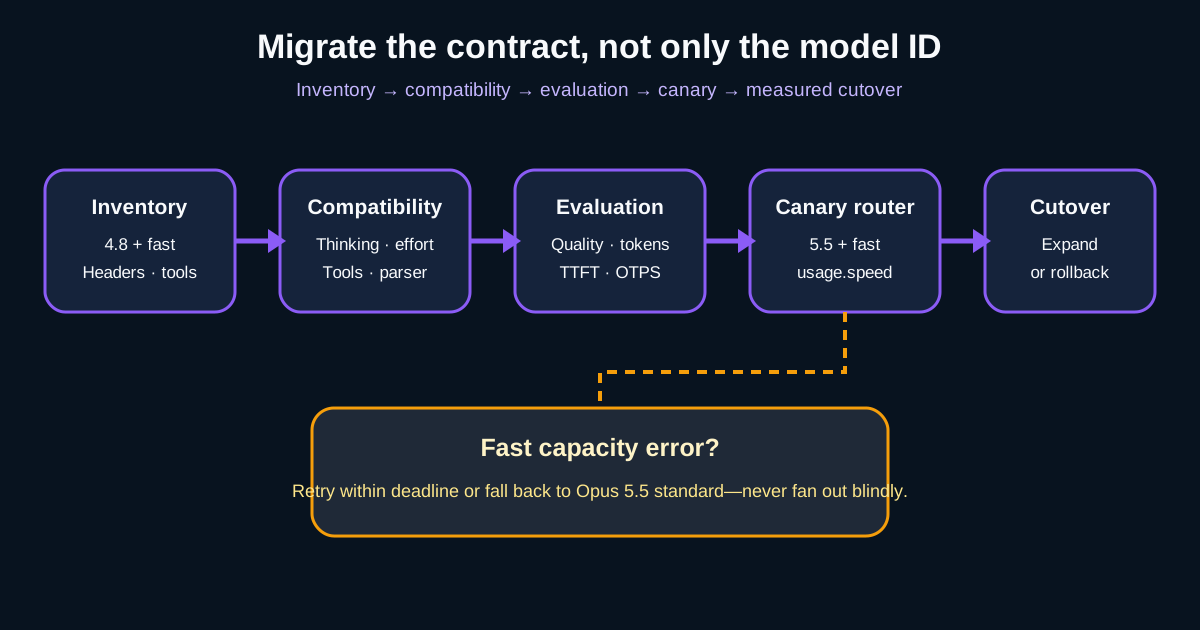
- Inventory: identify every Opus 4.8 fast route, beta header and hidden fallback.
- Compatibility: update thinking, effort, tool and parser contracts without moving production traffic.
- Offline evaluation: compare quality, tokens, cost and latency on a frozen set.
- Capacity probe: observe fast-mode headers and
usage.speedat low volume. - Canary: move a small deterministic cohort behind a reversible flag.
- Expand: increase traffic only when quality, errors, latency and cost stay within thresholds.
- Retire old wiring: remove Opus 4.8 fast configuration, the beta header and deadline alerts; keep standard Opus 4.8 only if it still has an explicit owner and use case.
Add a deployment guard that fails CI when a new configuration combines claude-opus-4-8 and speed: "fast". A deadline-specific alert should count remaining affected routes, not merely days until November 30.
Best practices
- Separate model lifecycle from feature lifecycle in inventory and alerts.
- Pin a migration version in router decisions and logs.
- Set effort explicitly after measuring each workload.
- Parse thinking-aware and tool-aware responses before the canary.
- Record requested speed and actual
usage.speed. - Monitor dedicated fast input and output token headers.
- Bound all retries by the original end-to-end deadline.
- Calculate cost per verified business outcome.
- Keep a one-action rollback to the previously approved route.
- Remove stale beta headers and aliases after the migration.
Anti-patterns and limits
- Announcing that Claude Opus 4.8 retires on November 30; only its fast mode has that date.
- Replacing only the model ID and assuming request and response compatibility.
- Using a successful text prompt as proof that tools, thinking and computer use work.
- Treating fast mode as a TTFT guarantee.
- Assuming
speed: "fast"in configuration proves that fast mode served the request. - Retrying 429 or 529 indefinitely outside the user deadline.
- Hiding parser failures behind a standard-speed fallback.
- Comparing provider list prices without cache, residency and token-shape effects.
- Leaving the old beta header and route alias active after cutover.
Fast mode cannot remove tool latency, queueing, provider capacity limits or application post-processing. A well-run migration makes these boundaries visible; it does not promise an end-to-end speedup for every workload.
Executive checklist
- Search code, gateways, agents and fallbacks for Opus 4.8 plus fast speed.
- Record owners, traffic share, effort, tools, beta headers and deadlines.
- Update Opus 5.5 thinking and tool contracts.
- Set explicit effort and build the representative evaluation set.
- Capture TTFT, OTPS, end-to-end latency, errors, tokens and cost.
- Verify
usage.speedand fast rate-limit headers. - Canary behind a reversible router version.
- Test bounded standard-speed fallback and overload behavior.
- Remove the Opus 4.8 fast route before November 30.
- Keep standard Opus 4.8 only with an explicit lifecycle owner.
Related reading: Claude Opus 5.5 production migration, Anthropic API 2026-10-21 migration guide, Claude prompt caching in production, and the AI, RAG and vector search hub.
Primary references
- Anthropic — Claude Platform release notes
- Anthropic — Fast mode
- Anthropic — Claude Opus 5.5 migration guide
- Anthropic — Rate limits
- Anthropic — Pricing
- Anthropic — Model deprecations
- Wikimedia Commons — Taiwan High Speed Rail train at Taichung station
- Creative Commons — Attribution 4.0 International
Prepared by: Noor Yasser
Official references
These references document the tools discussed. Examples and design decisions are illustrative and should be adapted to the project and its versions.
Prepared by: Noor Yasser
Working through a similar engineering challenge?
I help teams turn architecture decisions into a clear scope and dependable, reviewable implementation.