OpenAI released GPT-6-Cyber on November 5, 2026 as a cyber-specialized GPT-6 Astra variant for authorized vulnerability discovery, reproduction and fix verification. The model is not a general API entitlement: initial access is restricted to separately approved Daybreak Red customers, and the API requires an approved project, the matching access-program value and additional account and network controls.
That makes adoption a control-plane problem before it is a prompting problem. A capable model can help a qualified security team shorten the path from a suspicious code path to a reproducible finding and tested patch, but it cannot determine whether a target is legally in scope, make production exploitation safe, or replace coordinated disclosure and human judgment.
The release details and access requirements below come from OpenAI's official announcement, API documentation and system card, verified on November 7, 2026. Benchmark results, Linux and Firefox finding counts, and alignment rates are OpenAI-reported claims. The workflow, isolation architecture, approval gates and evidence contract are engineering guidance.
Answer first
Use GPT-6-Cyber only inside a dedicated, approved research project whose runtime enforces the engagement scope independently of the model. Put targets, methods, time windows and prohibited actions in a signed scope manifest; isolate the model from production; mediate every filesystem, network and execution tool; require human approval before boundary-crossing actions; and record enough evidence to reproduce both the finding and the fix.
| Question | Proceed when | Stop or redesign when |
|---|---|---|
| Is access valid? | The organization and non-default API project are approved for GPT-6-Cyber and Daybreak Red | A model name works in a console but project approval cannot be proved |
| Is the target authorized? | Asset identifiers, owners, dates and permitted methods are explicit | Scope is inferred from a hostname, ticket comment or verbal request |
| Is execution contained? | A disposable lab reproduces the relevant service with deny-by-default egress | The first reproduction attempt would touch customer or production systems |
| Can actions be reviewed? | Tool calls are checked against scope and high-risk steps pause for approval | The agent can freely scan, exploit, persist or exfiltrate |
| Can a fix be verified? | Baseline, exploit, patch, regression and negative tests are preserved | Success is inferred from a plausible explanation or a single clean run |
What OpenAI actually released
The official launch announcement describes GPT-6-Cyber as a model trained to find and validate exploitable vulnerabilities while following researcher-defined boundaries. OpenAI classifies it as Critical in cybersecurity under its Preparedness Framework. The system card says it is a cyber-specialized variant of GPT-6 Astra with post-training intended to increase security capability and reduce cyber refusals within authorized work.
OpenAI reports 48.5% on ExploitGym compared with 32.1% for GPT-5.6 Cyber, and says the model stayed away from out-of-scope services in 99.93% of one alignment evaluation without a deployment prompt and 100% with it. The company also says its researchers developed 948 Linux privilege-escalation exploits and found 81 previously unknown high-severity Firefox vulnerabilities, with Mozilla releasing fixes for many of them.
These are vendor-reported results, not evidence that the model will reproduce those rates in a different codebase or operating environment. Benchmark boundaries are cleaner than real engagements; a reported alignment rate is not a substitute for network policy; and a vulnerability count does not show false-positive cost, triage time or patch acceptance for your team.
Access is a deployment contract
The model page says an organization needs Daybreak Red access plus separate approval for GPT-6-Cyber. Enabling Daybreak Red alone does not grant the specialist model. The Daybreak API guide adds four operational checks:
- confirm approval with the account team;
- enable Daybreak Red on the specific, preferably non-default project used by the application;
- allowlist the application's public egress IP addresses;
- when the project uses Zero Data Retention, configure Private Safety Processing and verify the project shows the validated retention state.
A minimal request identifies both the model and access program and includes a stable pseudonymous safety identifier:
{
  "model": "gpt-6-cyber",
  "access_programs": {"cyber": "daybreak_red"},
  "safety_identifier": "researcher_7f2a",
  "input": "Design a regression test for the reviewed parser fix in case VR-184. Do not contact external systems."
}
The identifier should support abuse and incident review without placing a person's email or other direct identifier into every request. The prompt still does not create authorization. Authorization belongs in your application state and tool policy.
OpenAI documents distinct errors for a wrong program value, a program the model does not support, and a program not enabled for the project. Treat those as configuration failures. Do not silently fall back to a different model or standard access path for a task whose controls and approvals were designed for Daybreak Red.
Build an independent scope manifest
Create an immutable record before a session starts:
{
  "engagement_id": "VR-184",
  "owner": "product-security",
  "targets": ["lab-api.internal:8443"],
  "source_repositories": ["payments/parser"],
  "allowed_actions": ["read_source", "compile", "run_local_tests", "send_lab_http"],
  "forbidden_actions": ["production_network", "credential_collection", "persistence", "third_party_targets"],
  "valid_from": "2026-11-07T07:00:00Z",
  "valid_to": "2026-11-07T15:00:00Z",
  "approvers": ["security_lead", "service_owner"],
  "artifact_policy": "encrypted-30d",
  "scope_hash": "sha256:..."
}
Resolve hostnames to an approved address set before execution and pin the result for the engagement. Otherwise DNS changes or shared infrastructure can move a request outside the intended boundary. Represent repositories by immutable commit, container images by digest and lab data by snapshot ID. A target string without identity and time is not a reliable boundary.
Reference architecture
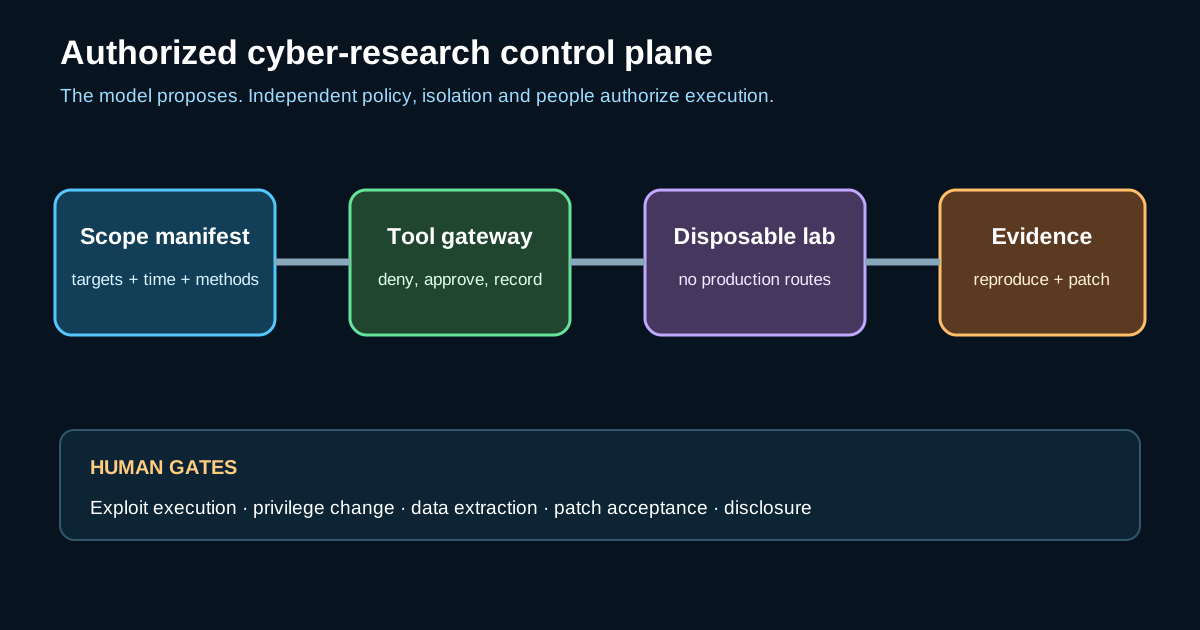
Separate the research control plane from the execution plane:
- Identity and access: map the approved user or service to the approved OpenAI project, engagement and role. Use short-lived credentials and least privilege.
- Session broker: creates one research session with the scope manifest, model, safety identifier, retention policy and artifact destinations.
- Policy-enforcing tool gateway: validates every command, file path, network destination and side effect against scope. The model proposes; the gateway decides.
- Disposable lab: reproduces the target from reviewed artifacts, starts from a clean snapshot, denies production routes and exposes only the approved fixtures.
- Evidence ledger: records prompts, model and policy versions, proposed and executed tools, approvals, stdout and stderr, packet captures when appropriate, hashes and timestamps.
- Human gates: require qualified review for exploit execution, privilege changes, data extraction, patch acceptance and disclosure.
OpenAI's cybersecurity checks guidance explicitly distinguishes trusted access from application tooling and engagement scope. It recommends reviewing sensitive tool calls, denying unauthorized actions, pausing ambiguous or high-risk changes, enforcing filesystem and network boundaries, retaining audit logs and failing closed when review is unavailable.
Run research as a state machine
Use explicit transitions rather than letting a single conversation drift from triage into exploitation:
- Requested: capture the hypothesis, reporter, asset owner and business impact.
- Scoped: approve exact targets, versions, techniques, time window and prohibited actions.
- Provisioned: build the isolated replica and verify network deny rules from inside it.
- Triaged: ask the model to inspect code and produce competing hypotheses, not an exploit first.
- Reproduced: execute the smallest approved proof in the lab; preserve the failing input and environment.
- Patched: develop the minimal fix and document security assumptions.
- Verified: show the baseline still fails, the patch blocks the proof, expected behavior remains and nearby variants are tested.
- Disclosed: route the evidence to the owner under the agreed disclosure process.
- Closed: revoke credentials, destroy the lab, retain permitted evidence and record residual risk.
Every transition should have a machine-checkable precondition. A human approval is tied to one concrete action and scope hash, not a reusable “approve all” flag.
Verify findings and patches separately
A model-generated exploit is not yet a vulnerability report. Require:
- a deterministic or bounded-retry reproduction on a pinned vulnerable build;
- a clear violated security invariant and attacker preconditions;
- evidence that the effect is caused by the suspected flaw rather than the harness;
- severity analysis based on reachable impact, not payload drama;
- a minimal patch linked to the root cause;
- a regression test that fails before and passes after;
- negative and compatibility tests around adjacent inputs;
- independent human review before production merge or disclosure.
When the model cannot reproduce a hypothesis, keep “unconfirmed” distinct from “not vulnerable.” Network policy, missing fixtures or nondeterminism can create false negatives. Likewise, a patch that blocks one payload may only add a signature, not repair the invariant.
Best practices
- Start with read-only code review and local tests; grant stronger tools only when the hypothesis requires them.
- Keep a separate API project and key for approved cyber research.
- Enforce outbound allowlists at the runtime, not in prompt text.
- Pin source commits, dependencies, images and test data.
- Use small, purpose-specific tools instead of a general unrestricted shell when practical.
- Redact secrets and unrelated personal data before model input and evidence storage.
- Bind approvals to the exact command, target, scope version and expiration.
- Measure finding precision, reproduction success, time to patch, regression quality and reviewer effort.
- Exercise emergency revocation for users, keys, projects and lab sessions.
Anti-patterns and limitations
Avoid treating Daybreak approval as permission to test any reachable asset, exposing production credentials to make the lab realistic, allowing unrestricted internet egress, hiding rejected tool calls from the audit trail, or merging a patch because the model both proposed and “verified” it.
GPT-6-Cyber does not remove ordinary secure-development obligations. It can hallucinate root causes, overfit to a crash, miss environment-specific constraints or produce a patch with a new flaw. OpenAI's restrictions and safety systems reduce certain risks but do not enforce your contract, law, customer authorization, change process or disclosure obligations.
Executive checklist
- Confirm organization, project and model-specific Daybreak Red approval.
- Configure the approved project, egress IP allowlist and applicable retention controls.
- Create a signed, time-bounded scope manifest with immutable target identities.
- Reproduce targets in a disposable lab with production routes denied.
- Put every tool call behind a policy gateway and specific approval gates.
- Preserve a tamper-evident ledger of proposed and executed actions.
- Verify vulnerability, root cause, patch and regression behavior independently.
- Revoke access and destroy the lab at engagement close.
- Report vendor benchmarks as vendor claims, not local guarantees.
For related architecture, read OpenAI Pando and agent-scale Git infrastructure, the Model Spec action contract, and guarded computer use with GPT-6.1 Terra. The AI, RAG and vector-search hub collects the broader engineering series.
References
- OpenAI — Introducing GPT-6 Cyber
- OpenAI API — GPT-6-Cyber model
- OpenAI API — Use Daybreak in the Responses API
- OpenAI API — Cybersecurity checks
- OpenAI — GPT-6 Cyber system card
- OpenAI API — Changelog
- Cover photo — Maj. Christopher Vasquez, Wikimedia Commons
Prepared by: Noor Yasser
Official references
These references document the tools discussed. Examples and design decisions are illustrative and should be adapted to the project and its versions.
Prepared by: Noor Yasser
Working through a similar engineering challenge?
I help teams turn architecture decisions into a clear scope and dependable, reviewable implementation.