OpenAI published Pando on November 2, 2026: a Git-compatible repository backend built for the concurrency created by coding agents. The company says Pando now powers its monorepo, coordinates unrelated branch updates independently, stores incoming packfiles as immutable blobs, serves reusable packs through regional caches, and compacts them in the background.
The important lesson is not “replace Git.” Pando preserves the Git protocol and client while changing the consistency and storage assumptions behind the service. For engineering teams adopting Codex or other coding agents, the practical question is whether source control, CI and review can absorb more simultaneous branches, pushes, fetches and merges without turning the repository into a global coordination bottleneck.
This article separates three layers. Pando's architecture and OpenAI's production figures are documented in OpenAI's engineering post, but the performance numbers are company-reported and specific to its monorepo. Git object, packfile and wire-protocol behavior is documented by the Git project. The capacity model, rollout design and operational controls below are engineering analysis, not an OpenAI product announcement or a claim that Pando is generally available.
Answer first
Agent-scale source control needs four contracts:
| Contract | What must remain true | Evidence to collect |
|---|---|---|
| Branch write | Competing updates to one ref serialize safely; unrelated refs do not block each other | ref conflict rate, push acknowledgment, read-after-write check |
| Object availability | A visible ref never points to missing commits, trees or blobs | reachability check, pack validation, delayed-reader test |
| Read delivery | Many clients can fetch shared history without repeated server-side repacking | cache hit rate, CPU per GiB, time to first byte, clone throughput |
| Workflow compatibility | Existing Git, CI, webhooks and review systems keep their behavioral contract | conformance suite, integration inventory, dual-run comparison |
Start by measuring push-to-fetch latency: the time from an accepted push until an independent worker can fetch and verify the commit. Add branch-conflict rate, pack generation CPU, bytes transferred, cache reuse, merge success, CI queue delay and object-reachability failures. Do not redesign storage until those measurements show the actual bottleneck.
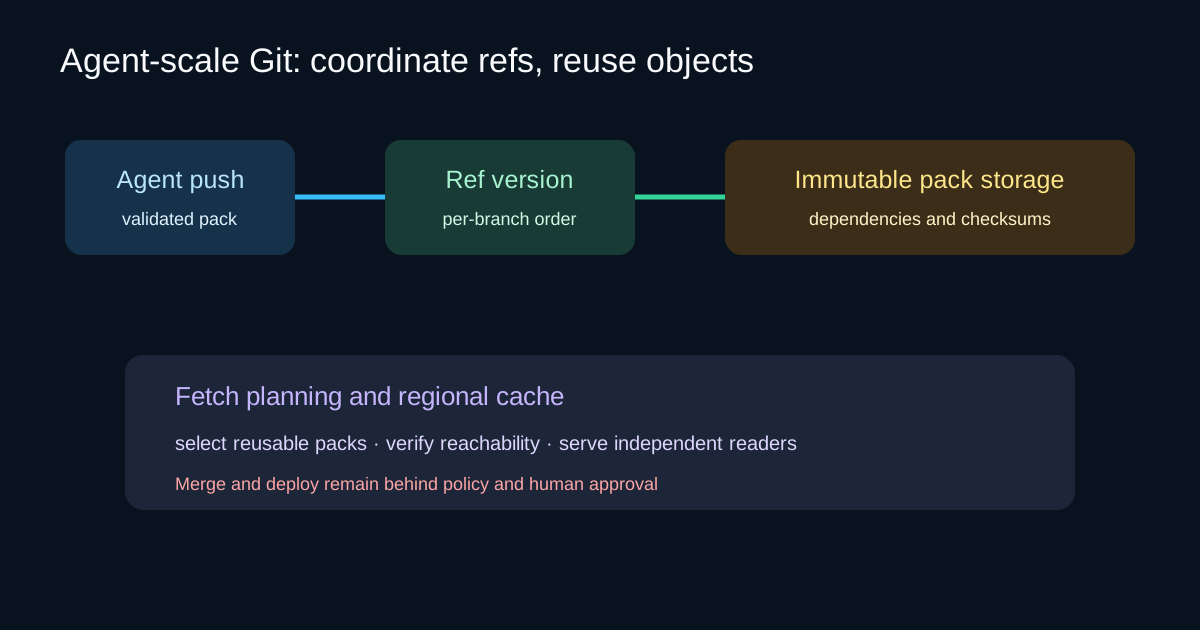
Pando is useful as a case study because it moves coordination from the whole repository to each reference, and moves expensive pack generation from the read path toward reusable data received on writes. That trade exchanges repository-wide point-in-time consistency and some additional bytes for horizontal write concurrency and cacheable reads.
What OpenAI announced
According to OpenAI's engineering post, Codex increased parallel work in the company's monorepo: more branches, pushes, merges, fetches and clones from development environments, research jobs and CI. OpenAI says the previous system sometimes fell below 90% reliability.
OpenAI reports that Pando:
- now powers all development in the OpenAI monorepo;
- remains compatible with the Git protocol and client;
- serializes updates per ref while allowing unrelated refs to progress independently;
- stores incoming packfiles in blob storage and ref-version metadata separately;
- uses reusable packfiles and regional caches for fetches;
- reduced median push latency by nearly 80%, described earlier in the post as nearly fivefold;
- can deliver nearly one petabyte of Git data per day;
- has served more than 57 TB of Git packs in one hour with over 99% of bytes from local disk cache.
These figures are OpenAI's production observations, not independently reproduced benchmarks. The interactive comparison in the post is explicitly described as a synthetic teaching model. It should help explain design choices, not forecast another organization's performance.
OpenAI also says Pando was built with Codex in ten weeks, began serving production traffic in April 2026, and used conformance tests, deterministic simulations, Lean and TLA+ work, and continuous agent-driven testing. Those are company statements about its development process. They do not remove the need for human ownership, security review or production verification.
The Git constraint: refs and objects must agree
Git history is a graph of immutable objects: blobs, trees, commits and tags. A branch is a mutable ref pointing to a commit. The official Git pack-format documentation defines how objects and deltas are compressed in packfiles, while the pack protocol explains how clients and servers negotiate the data needed for fetch and push.
A repository service therefore has two correctness obligations:
- two writers cannot silently move the same ref from one expected tip to different successors; and
- a ref must not become readable until every object reachable from its tip can be supplied.
Conventional replication often keeps full repository copies and coordinates ref updates across replicas. That can give a coherent view of all refs, but quorum round trips and replica disk work sit on the write path. A shared write-ahead manifest lets pack uploads run in parallel, yet unrelated branches can still contend on one compare-and-swap key.
Pando's published design removes that repository-wide ordering point. Each ref has versions; a version records its tip, the pack that introduced it and the earlier versions on which that pack depends. A multi-key metadata transaction records the version and updates the ref pointer. Conflicts occur when writers target the same ref, not merely because they share a repository.
Causal consistency is a product decision
Pando provides serializable updates to an individual ref and read-your-own-write behavior, but not a point-in-time snapshot of every ref. During a multi-branch read, one client could observe a newer value of branch A and an older value of branch B while another observes the reverse.
That can be acceptable when the real workflow is branch-local:
- an agent pushes its topic branch;
- CI fetches that exact commit;
- review compares it to a recorded base;
- merge automation validates the current trunk and target tips;
- release systems pin immutable commit IDs.
It is unsafe if a downstream system assumes that listing several refs creates an atomic repository snapshot. Examples include release scripts that select “latest” commits from multiple branches, policy checks that compare independently read refs without recording versions, or deployment manifests assembled from moving names.
Before relaxing consistency, create a dependency inventory:
{
  "consumer": "release-orchestrator",
  "reads": ["refs/heads/main", "refs/heads/config"],
  "requires_atomic_snapshot": true,
  "safe_identifier": "commit-id-or-signed-manifest",
  "owner": "platform-team",
  "migration_test": "replay-with-ref-skew"
}
This is an internal evidence schema, not a Pando API.
Why reusable packfiles change the read path
In a conventional fetch, the server uses the client's “have” and “want” commits to compute a tailored object difference, then creates a pack. Tailoring minimizes bytes but consumes CPU and disk I/O and makes the response difficult to cache across clients.
Pando instead tracks packs received on pushes and their dependencies. When a client fetches, the service selects stored packs covering the missing ref-version range. OpenAI says it uses Git's “packfile-uri” capability to let clients download these packs separately and its Express service to cache them regionally.
The tradeoff is explicit:
- benefit: one immutable pack can serve many clients with little computation;
- cost: a client may receive objects it already has;
- constraint: the server must prove that the client has every dependency omitted from the reusable pack;
- operational need: cache integrity, URI authorization, checksum validation and interrupted-download recovery become critical.
Git protocol v2 is relevant because it makes capabilities and commands explicit and omits ref advertisement unless requested. Compatibility should still be proven against the exact client versions, proxies, credential helpers and CI images in production.
Compaction without putting repacking on every request
One pack per push cannot remain the fetch unit forever. A client behind by a day could need tens of thousands of small downloads. Pando groups packs into geometric “covers” similar to levels in a log-structured merge tree. Background workers can repack a cover for compression, while the cover also acts as a skip structure over ref versions.
A production implementation needs a clear compaction contract:
| Concern | Required control |
|---|---|
| Publication | A cover is visible only after all referenced packs and indexes validate |
| Concurrency | Compaction cannot delete data needed by active fetches |
| Corruption | Every pack and index has a verified checksum and provenance record |
| Retry | Jobs are idempotent and leases prevent two workers publishing conflicting covers |
| Backlog | Alert on age, bytes, level imbalance and fetch fan-out, not job count alone |
| Recovery | Rebuild indexes and covers from immutable source packs before destructive cleanup |
OpenAI says Pando keeps packs at every level rather than discarding them. That simplifies some recovery and API reads but increases storage retention. Another team may choose garbage collection, yet only after proving reachability, retention windows, reader leases and restore procedures.
A practical architecture for coding-agent scale
Do not start with a custom Git server. Start with workload isolation and evidence.
### 1. Agent workspaces
Give each agent or task an isolated checkout, a scoped credential, an explicit base commit and a unique branch. Enforce maximum lifetime and storage, and remove credentials before artifacts are retained.
### 2. Ref admission control
Require compare-and-swap semantics for branch updates. Protect trunk and release refs. Limit push concurrency per actor and repository, but avoid a single global lock for unrelated branches.
### 3. Immutable object plane
Validate pack structure while ingesting, store immutable bytes under content-derived identity, and record the exact dependencies before publishing a ref version. Treat pack parsing as an untrusted-input boundary.
### 4. Fetch planner and cache
Plan from recorded commit/ref-version mappings. Sign pack URLs for a narrow audience and time window. Validate checksums at the client, observe cache misses and keep an authoritative fallback path.
### 5. Merge and CI control plane
Deduplicate CI for the same commit and policy version. Use merge queues, bounded retry and required checks. A successful agent push is not approval to merge or deploy.
### 6. Evidence and security plane
Record actor, agent run, credential, base and tip commit, policy version, pack checksum, ref decision, CI result, review decision and deployment linkage. Retain enough metadata to investigate an action without logging source or secrets unnecessarily.
agent workspace -> validated push -> immutable pack storage
       |                  |                 |
       v                  v                 v
 scoped identity     ref version       regional cache
       |                  |                 |
       +------> CI and merge policy <------+
                         |
                         v
                 signed evidence record
~~

## Roll out behind a compatibility boundary

OpenAI says it introduced Pando as a read- and write-through proxy to the previous source-control system, kept both synchronized, migrated clients in phases and moved hundreds of integrations covering APIs, webhooks and repository downloads.

That is a sound migration shape:

1. inventory Git clients, CI runners, webhooks, review bots, mirrors and backup jobs;
2. replay read traffic and compare object and ref results;
3. shadow accepted writes into the new backend without serving them;
4. verify reachability, ref tips, hooks and downstream events;
5. canary low-risk repositories or actors through the proxy;
6. maintain an explicit rollback path and reconcile divergent outcomes;
7. expand only when push-to-fetch, merge reliability and correctness gates pass;
8. retire the old path only after restore and disaster-recovery drills.

Do not dual-write two authorities from application code. One proxy should own the decision, idempotency key and reconciliation record.

## Evaluation gates

Test behavior, not only throughput:

- standard Git conformance across supported client versions;
- concurrent pushes to the same and unrelated refs;
- force-with-lease and protected-branch behavior;
- interrupted push, partial blob upload and metadata timeout;
- visible ref with delayed or missing object prevention;
- cache poisoning, expired URI and wrong-tenant access;
- clone/fetch after long inactivity and deep history;
- compaction crash, duplicate job and index corruption;
- webhook ordering, duplication and delivery loss;
- CI deduplication and stale-base rejection;
- regional outage and metadata-store failover;
- restore from immutable packs and metadata backups.

For agent workloads, add adversarial repositories, malicious filenames, enormous objects, decompression limits, crafted packfiles, untrusted hooks and prompts that try to bypass branch policy. Agents increase rate and diversity; they do not change the trust boundary.

## Best practices

- Pin every agent task to an explicit base commit and policy version.
- Serialize competing updates per ref, not across the repository by default.
- Verify object reachability before advertising a new ref.
- Measure push-to-fetch latency with an independent reader.
- Reuse immutable data only when dependencies and checksums are provable.
- Keep merge, review and deployment authority outside the coding agent.
- Use conformance, deterministic simulation and fault injection together.
- Migrate through a proxy with reconciliation and rollback.
- Separate company performance claims from reproducible local evidence.
- Preserve Git compatibility unless a measured requirement justifies breaking it.

## Anti-patterns and limits

- Saying Pando is a generally available OpenAI product; the post says OpenAI is exploring ways to share the technology.
- Copying Pando because agents are fashionable without measuring repository pressure.
- Treating causal consistency as an invisible implementation detail.
- Letting a ref become visible before its reachable objects are durable.
- Reusing a pack without validating its dependency closure.
- Moving all repository writes through one global manifest or lock.
- Counting accepted pushes while ignoring independent fetch verification.
- Giving agents broad, long-lived Git or cloud credentials.
- Equating OpenAI's production figures with an independent benchmark.
- Removing the previous backend before failure and restore drills pass.

The OpenAI article does not publish Pando as a supported customer service, its complete source code, infrastructure cost, full security model or a reproducible production benchmark. Those limits matter. Most teams should first improve branch isolation, merge queues, CI deduplication, partial clone, caches and observability before considering a new repository backend.

## Executive checklist

1. Measure branch concurrency and push-to-fetch latency.
2. Map every consumer that assumes cross-ref atomicity.
3. Pin agent work to explicit commits and isolated branches.
4. Protect refs with compare-and-swap and least privilege.
5. Validate packfiles and object reachability before publication.
6. Separate immutable object storage from ref coordination.
7. Prove cache integrity, tenant scope and fallback behavior.
8. Bound compaction with leases, checksums and backlog SLOs.
9. Run Git conformance, fault injection and adversarial-agent tests.
10. Migrate through a reversible proxy and retain evidence.

Related reading: [OpenAI Model Spec agent action contracts](https://nooryasser.com/articles/openai-model-spec-agent-autonomy-action-contract/), [GPT-6.1 Terra guarded computer use](https://nooryasser.com/articles/gpt-6-1-terra-guarded-computer-use/), [distributed overload control](https://nooryasser.com/articles/distributed-overload-deadlines-load-shedding/), the [AI, RAG and vector search hub](https://nooryasser.com/topics/ai-rag-vector-search/), and [performance and cloud engineering](https://nooryasser.com/services/performance-cloud/).

## Primary references

- [OpenAI — Scaling Git at OpenAI](https://openai.com/index/scaling-git-at-openai/)
- [OpenAI — public Git fork](https://github.com/openai/git)
- [OpenAI Git — patches and notes](https://oai-git.openai.chatgpt.site/)
- [Git — pack-format documentation](https://git-scm.com/docs/pack-format)
- [Git — protocol v2](https://git-scm.com/docs/protocol-v2)
- [Git — pack protocol](https://git-scm.com/docs/gitprotocol-pack)
- [Wikimedia Commons — NERSC rack close-up](https://commons.wikimedia.org/wiki/File:Rear_of_rack_at_NERSC_data_center_-_closeup.jpg)
- [Creative Commons — CC0 1.0](https://creativecommons.org/publicdomain/zero/1.0/)

Prepared by: Noor Yasser
Official references
These references document the tools discussed. Examples and design decisions are illustrative and should be adapted to the project and its versions.
Prepared by: Noor Yasser
Working through a similar engineering challenge?
I help teams turn architecture decisions into a clear scope and dependable, reviewable implementation.