Anthropic API version 2026-10-21 is a contract migration, not a header-only upgrade. It removes sampling parameters, tightens where documents and citations may appear, renames Admin and Analytics fields, and arrives with major SDK releases that change authentication, types, tool-runner compaction and legacy APIs. Production teams should inventory usage, add contract tests, canary the new version and keep rollback independent from data migrations.
Anthropic released the API version and new SDK/CLI majors on October 21, 2026. The facts below come from Anthropic's official release notes, version reference and migration guide, verified on October 25, 2026. The rollout sequence, observability design and risk controls are engineering recommendations.
What the version actually changes
The new version is available on the Claude API, Claude Platform on AWS, Claude Models on Google Cloud through both Anthropic-managed and Google-managed paths, and Microsoft Foundry. Amazon Bedrock supports it for Claude 4.7 and later; older Bedrock models must remain on their current API version until the model is upgraded.
For Messages, token counting and Message Batches, three request parameters are removed: temperature, top_p and top_k. Sending any of them returns HTTP 400, even when the value equals a former default. A document block placed directly in an assistant message also returns 400. User text carrying a non-empty citations array is rejected, including text nested in a search_result; citation-enablement settings on documents and search results remain valid.
Admin and Enterprise Analytics responses also rename fields. These are silent parser risks: the request may succeed while a permissive consumer records null or drops data.
| Surface | Old contract | New contract |
|---|---|---|
| RBAC groups | roles | role_ids |
| RBAC members | group_id | rbac_group_id |
| RBAC roles | name | display_name |
| Rate limits | group_type | group.type |
| API keys | workspace_id | scope.workspace_id when workspace-scoped |
| Usage and cost | actor.email | actor.email_address |
| Activity summaries | summaries | data |
API version and SDK major are separate changes
Anthropic published first supporting versions including Python 2.0.0, TypeScript 1.0.0, C# 13.0.0, Go 2.0.0, Java 3.0.0, PHP 1.0.0, Ruby 2.0.0 and ant CLI 2.0.0. These versions send 2026-10-21 by default, but the SDK majors also contain changes unrelated to the wire version.
The SDKs now send an API key as Authorization: Bearer instead of X-Api-Key. The Claude API accepts either header, but a gateway, test double, log-redaction rule or middleware that expects only X-Api-Key can fail. A client also holds one credential rather than sending both an API key and auth token. Type definitions split message parameters by role; direct construction or subclassing of the old union type may fail even when equivalent dictionaries still work.
TypeScript and Ruby tool-runner client compaction is removed in favor of server-side compaction. Legacy Text Completions is removed from several SDKs and the CLI. Beta model calls move to the beta namespace. New SDK and CLI versions use Apache 2.0 rather than MIT, which matters to dependency and license inventories even though it does not require runtime code changes.
Treat the work as two upgrade axes:
- Wire contract: request and response behavior selected by
anthropic-version. - Client contract: types, authentication, helpers, defaults and removed methods in the SDK major.
Testing only the final combination hides which axis caused a failure.
Build an impact inventory before editing code
Search every service, shared library, proxy and batch worker for:
- the
anthropic-versionheader and SDK package versions; temperature,top_pandtop_k;- assistant document blocks and user-supplied citation arrays;
- Admin and Analytics field names in code, SQL models and dashboards;
X-Api-Key,Authorizationand credential precedence;- Text Completions, beta Models calls and tool-runner compaction options;
- strict enum switches over streaming or response variants.
Do not rely on application code alone. API gateways, service meshes, log pipelines, fixtures and generated clients can contain the old assumptions. Record each call site with owner, cloud path, model family, traffic volume, data sensitivity and rollback mechanism.
A safe migration architecture
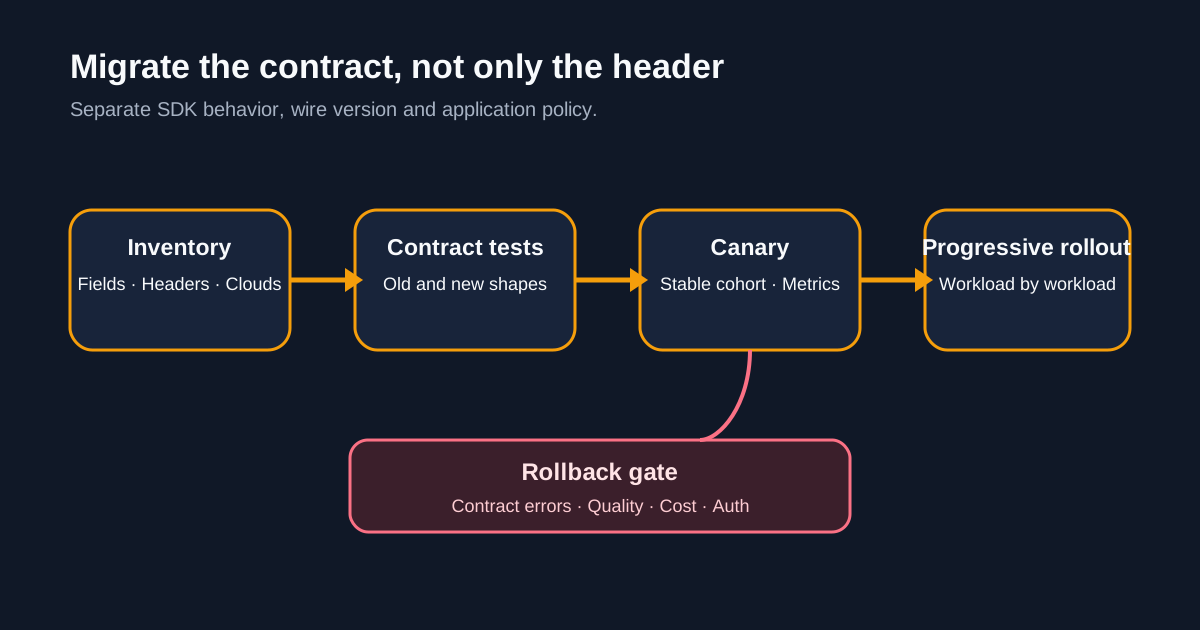
Put API version selection behind configuration rather than scattering a literal header. Keep it separate from the model ID and SDK package lock. A request adapter should normalize application intent into the provider contract, while a response adapter exposes one internal schema to the rest of the product.
type ClaudeWireVersion = "2023-06-01" | "2026-10-21";

function buildClaudeRequest(input: AppRequest, version: ClaudeWireVersion) {
  const body = {
    model: input.model,
    max_tokens: input.maxTokens,
    messages: normalizeRoles(input.messages)
  } as Record<string, unknown>;

  if (version === "2023-06-01" && input.legacySampling) {
    Object.assign(body, input.legacySampling);
  }

  assertNoAssistantDocuments(body);
  assertNoUserCitationPayloads(body);
  return { version, body };
}
This adapter makes the incompatible parameters impossible to send on the new version. It is safer than deleting fields at a distant HTTP layer, because silent deletion can conceal an application that still depends on non-default sampling.
Replace sampling assumptions with explicit product contracts
Under the new version there is no replacement knob for non-default sampling values. Anthropic states that requests use the defaults, including temperature 1.0, when those parameters are omitted. If a workflow depended on low temperature for repeatability, measure the behavior change rather than translating it into an invented equivalent.
Use clearer prompts, structured outputs, deterministic validators and bounded retry or review policies. For exact authorization, pricing or eligibility, use code. Keep a request on the older version only when its business requirement cannot yet tolerate the change and the platform/model combination still supports that version. Document that exception with an owner and expiry condition.
Contract tests that catch real breakage
Create golden request fixtures for each active capability: plain Messages, tool use, images, documents, search results, citations, token counting, batches and Admin/Analytics reads. Run them against a test project using both versions where supported.
Test at least:
- success and expected 400 responses for removed fields;
- multi-turn replay containing earlier assistant citations;
- documents in valid user positions and invalid assistant positions;
- strict deserialization of every renamed Admin field;
- Default Workspace versus organization-wide API key scopes;
- proxy authentication and secret redaction with
Authorization; - streaming parsers accepting unknown future event variants;
- batch items and token-count requests using the same normalized payload.
Do not compare generated text byte for byte. Compare schema validity, tool-call contracts, citation placement, safety routing, latency, token usage and task-specific evaluation outcomes.
Roll out with traffic evidence
Use four stages:
- Compile and fixture stage. Upgrade types in a branch and make contract tests pass without production traffic.
- Shadow stage. Rebuild representative requests for the new contract and compare outcomes where duplicate inference is permitted and privacy policy allows it.
- Canary stage. Route a small, explicit cohort to the new SDK and version. Keep side effects idempotent so a rollback does not duplicate tools or payments.
- Progressive stage. Expand by workload, tenant or region only after error, quality and cost gates pass.
Separate deploy rollback from data rollback. An Admin collector that stores the new scope object should add compatible columns before switching readers; do not destructively rename fields in the same release as the API cutover.
Observability and decision gates
Tag metrics with the internal integration name, SDK major, API version, cloud path and model family. Monitor HTTP 400 by normalized error category, authentication failures, parser errors, tool-call validity, batch item failures, latency, input/output tokens and application evaluation scores.
Never put API keys, full prompts or personal data into tags. Preserve provider request IDs and a hash of the sanitized request shape for debugging. A useful rollback gate is not merely “error rate increased”; define thresholds for contract failures, quality regression and cost change before the canary starts.
Security and gateway changes
The authentication-header move deserves an explicit security review. Update allowlists, WAF rules, outbound proxy forwarding, secret scanners and log redaction. Ensure the gateway removes credentials it terminates before forwarding. Anthropic's migration guide says one request should present one credential to the Claude API; do not accidentally forward a gateway bearer token as the provider credential.
The ant CLI removes command-line key flags because command arguments are exposed in shell history and process listings. Prefer environment injection from a secret manager, stdin-supported options or the CLI login flow. This is a security improvement, but automation that still passes --api-key will stop and must be repaired deliberately.
Best practices and anti-patterns
Best practices
- Pin SDK majors and API versions explicitly in deployment evidence.
- Normalize provider requests and responses behind tested adapters.
- Add new storage fields before switching readers.
- Canary by a stable cohort and keep a fast version rollback.
- Review gateway authentication and log-redaction behavior.
- Re-evaluate output quality when sampling behavior changes.
Anti-patterns
- Updating the SDK and header in one unobserved production jump.
- Globally stripping rejected fields without finding their owners.
- Treating null
workspace_idas Default Workspace after migration. - Assuming HTTP 200 means dashboards parsed renamed fields correctly.
- Logging the new Authorization header while debugging.
- Using model output to replace deterministic authorization rules.
When to delay the cutover
Delay a specific workload when it depends on an older Bedrock model, requires non-default sampling with measured business value, or lacks test coverage for documents, citations or renamed admin data. Delay is not a permanent strategy: keep the exception narrow, record the blocker and test a supported model or workflow replacement.
Do not delay every service because one legacy path is blocked. Version selection belongs at the integration or request adapter so compatible workloads can move independently.
Executive migration checklist
- Inventory versions, models, clouds, fields, sampling parameters and authentication assumptions.
- Separate SDK-major work from wire-version work.
- Build request and response adapters with invalid-shape assertions.
- Add contract fixtures for Messages, batches, citations, Admin and Analytics.
- Update gateways and redaction for bearer authentication.
- Run quality evaluations for workflows that used sampling parameters.
- Shadow where permitted, then canary a stable cohort with rollback gates.
- Expand gradually and retire documented exceptions only after proof.
Related reading: Anthropic User Profiles and enforcement webhooks, Claude on Google Cloud architecture, RAG citation provenance, and the AI engineering library.
Primary references
- Anthropic — Claude Platform release notes
- Anthropic — Migrating to API version 2026-10-21
- Anthropic — API versioning
- Anthropic — Using the Messages API
- Anthropic — Model deprecations
- Unsplash License
- Eric Stoynov — licensed server-rack photograph
Official references
These references document the tools discussed. Examples and design decisions are illustrative and should be adapted to the project and its versions.
Prepared by: Noor Yasser
Working through a similar engineering challenge?
I help teams turn architecture decisions into a clear scope and dependable, reviewable implementation.