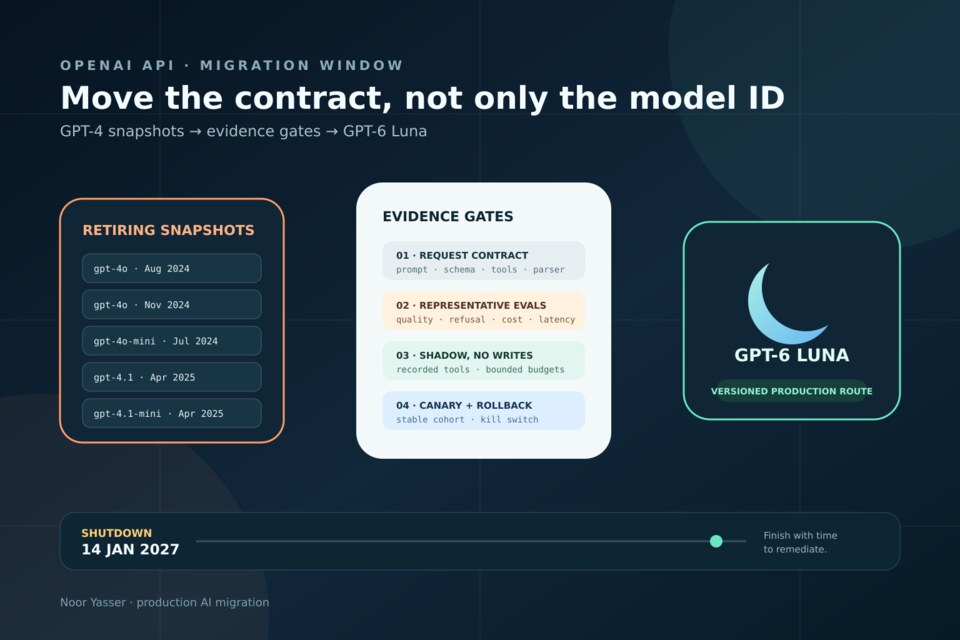
OpenAI announced on 14 October 2026 that five dated GPT-4-series API snapshots will be removed on 14 January 2027: two GPT-4o snapshots, GPT-4o mini, GPT-4.1 and GPT-4.1 mini. OpenAI recommends GPT-6 Luna for all five. The practical response is not a one-line model-name replacement: inventory every production route, freeze a representative test set, version the complete request contract, compare outputs and tool behavior, then ship through shadow traffic and a reversible canary. This matters to teams running structured extraction, tool calling, customer support, content workflows or fine-tuned GPT-4 descendants—especially because fine-tuned versions inherit the same shutdown date.
The official OpenAI deprecations page is the source of record for the announcement and dates. It lists `gpt-4o-2024-08-06`, `gpt-4o-2024-11-20`, `gpt-4o-mini-2024-07-18`, `gpt-4.1-2025-04-14` and `gpt-4.1-mini-2025-04-14` for shutdown on 14 January 2027, with `gpt-6-luna` as the recommended replacement. Those model IDs, dates and replacement are documented facts. The testing, routing and rollout plan below is engineering analysis for reducing migration risk; OpenAI has not claimed that every application will behave identically after changing the model.
What exactly is being retired
The notice targets explicit dated snapshots, not an abstract product family. That distinction matters because production systems often hide model IDs behind aliases, environment variables, prompt-management tools, SDK defaults, batch jobs, fine-tuning job outputs or a vendor gateway. Search configuration, code, observability dimensions and deployment manifests for the exact IDs. Also inspect stored request templates and scheduled workers that may run less often than the main API path.
Build one inventory row per route: owner, endpoint, model ID, snapshot or fine-tuned model, prompt version, schema version, tools, traffic, data class, latency SLO, fallback, last successful request and removal deadline. Treat an unresolved row as operational debt. A dashboard showing only the visible model name is insufficient if the actual request is rewritten by a gateway.
Fine-tuned models need a separate branch in the plan. OpenAI states that fine-tuned versions of the listed models follow the same shutdown schedule as their base models. The GPT-6 Luna model page currently marks fine-tuning as unsupported. Therefore, do not assume that an existing fine-tuned model can be recreated directly on Luna. Recover the original training and validation data, document the behavior the fine-tune supplied, test whether prompting, retrieval or deterministic code can replace it, and choose another supported path only after verifying current official documentation.
The migration unit is the request contract
Changing only `model` ignores the parts most likely to cause regressions. Version the model together with instructions, message roles, reasoning effort, tool definitions, JSON Schema, response parser, retry policy, timeouts, safety checks, conversation-state strategy and cost or latency budgets. A release should point to one immutable contract bundle so the old and new paths can be replayed and compared.
The GPT-6 Luna documentation describes a 1.05-million-token context window, 128,000 maximum output tokens, text and image input, Structured Outputs, function calling and reasoning-effort controls. It also says built-in tools and function calling use the Responses API, while Chat Completions supports function calling only when reasoning effort is `none`. These capabilities are useful, but they are not evidence that your prompt, schema or tool policy is compatible. Test the exact endpoint and parameters you intend to ship.
contract: support-ticket-v12
model: gpt-6-luna
endpoint: responses
instructions: sha256:...
tools: sha256:...
output_schema: sha256:...
reasoning_effort: none
timeout_ms: 12000
max_output_tokens: 900
fallback: gpt4-contract-v11
The hash values are an example of traceable configuration, not a required OpenAI format. The point is that an incident should reveal exactly which behavior bundle produced a response and which known-good bundle can receive traffic again.
Separate model migration from endpoint migration
OpenAI recommends the Responses API for new projects, and its migration guide explains that Chat Completions remains supported and that teams can migrate one user flow at a time. If your GPT-4 route already uses Chat Completions, decide whether to change the model and endpoint in one controlled experiment or in two releases. Two releases isolate causality; one release may be efficient when the target behavior requires Responses-only tools.
With Responses, state can be carried explicitly or through previous response identifiers, output is a typed item array, and Structured Outputs move to `text.format`. A parser that expects `choices[0].message.content` will not survive that endpoint change. Add contract tests for successful text, refusal, incomplete output, multiple tool calls, tool error, timeout, cancellation and streamed events. Store no sensitive payload merely to make migration easier; preserve the application’s existing data-control requirements.
Build a representative evaluation set
OpenAI’s model optimization guide recommends establishing a baseline, testing representative real-world inputs and iterating from measured results. Start with production traces that are permitted for evaluation, remove or protect sensitive data, and stratify by task rather than drawing a convenient random sample. Include common traffic, rare but costly cases, adversarial inputs, long contexts, multilingual requests, empty fields, malformed documents, ambiguous instructions, known refusals and tool failures.
Score the user-visible contract, not stylistic similarity to the old output. For classification, measure per-class precision and recall. For extraction, validate fields and business constraints. For support answers, test groundedness, policy compliance and escalation decisions. For agents, measure correct tool selection, valid arguments, side-effect authorization, loop bounds and final-state correctness. Track latency percentiles, input and output tokens, retry rate and cost per accepted task alongside quality.
Pairwise comparison is useful when judgment is subjective, but include deterministic graders wherever a rule exists. A model answer can sound better while breaking a required enum or dropping a citation. The official evaluation best-practices guide emphasizes task-specific tests and continuous evaluation. Keep the evaluation dataset and grader versions stable long enough to compare the old and new contracts fairly.
Structured outputs and tools are release gates
The Structured Outputs guide says strict schemas constrain responses to a supported subset of JSON Schema, while applications must still handle refusals and incomplete responses. Replay every production schema. Validate required fields, enum values, nesting limits, maximum-output behavior and your parser’s treatment of refusal or truncation. Schema compliance is necessary but not sufficient: a perfectly shaped object can contain the wrong business decision.
For tools, follow the multi-step flow documented in OpenAI’s function-calling guide: the model requests a function, the application executes it, returns the result and receives the next response. During migration, compare tool choice, arguments, call order and completion behavior. Keep authorization in application code. The model may propose a refund or account change, but a deterministic policy must verify tenant, permission, amount and idempotency before any side effect.
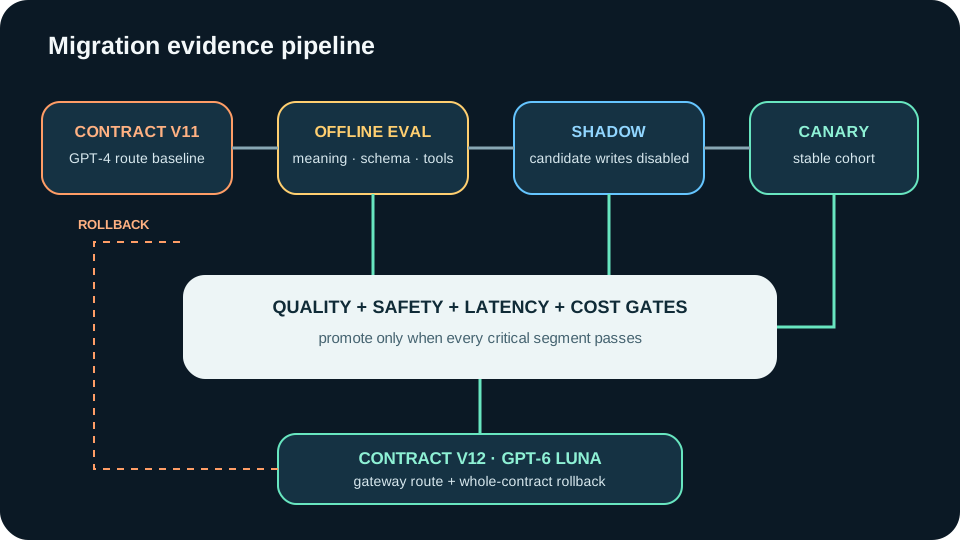
Shadow testing should disable writes. Run the Luna contract beside the current route on sampled traffic, send real operations only through the control path, and replace candidate-side tools with recorded or read-only results. Otherwise a “test” can duplicate emails, charges or database mutations. Log candidate decisions under a separate namespace and cap token, time and tool budgets so malformed loops cannot consume production capacity.
A rollout architecture with a real rollback
Place selection behind a server-side model gateway. Resolve a stable cohort before the request, attach a contract version, execute one route, validate the response, record outcome metrics and expose a kill switch that returns new traffic to the old route. Do not route on transient values such as random client state if the same conversation must stay coherent.
The safe sequence is offline replay, read-only shadow traffic, employee or synthetic traffic, a small stable production cohort, staged expansion and full cutover. Promote only when quality, schema validity, tool safety, latency and cost remain inside explicit budgets for enough traffic to cover important strata. Stop automatically on severe policy failures, unauthorized tool attempts, parser errors, business KPI regression or unexplained cost growth.
Rollback must restore the whole previous contract, not only the previous model ID. Keep the old prompt, tool schemas, parser and endpoint deployable until the new route is stable. Because the old snapshots disappear on 14 January 2027, rollback is a temporary safety mechanism, not a migration strategy. Finish with margin for remediation rather than scheduling final cutover near the removal date.
Decision table for migration owners
An explicit GPT-4 snapshot with no tools should first pass output-quality, refusal, latency and cost tests against Luna. A structured extraction route must add schema and semantic field validation. A tool-using agent must add tool-choice, argument, authorization and side-effect tests. A long-context workflow must test relevant-context placement and cost under realistic document sizes rather than the advertised maximum alone. A fine-tuned descendant must enter a redesign track because Luna is documented as not supporting fine-tuning today.
For a route whose business rule can be expressed deterministically, consider removing the LLM from that decision instead of recreating it. SQL is better for exact account state, code is better for permissions and totals, and search or retrieval is better for locating evidence. Use the model for interpretation or generation only where uncertainty is expected and evaluated.
Best practices and anti-patterns
Good practice is to pin explicit model IDs, record the resolved contract version, separate facts from generated text, validate outputs at system boundaries, limit tools, test by traffic segment and rehearse rollback. Give each route an owner and a completion criterion. Keep a migration ledger that links inventory, evaluation evidence, launch decision and final removal of the old ID.
Avoid blind global replacement, evaluating only happy-path prompts, comparing prose by exact string match, enabling write tools in shadow mode, trusting schema shape as semantic correctness, or claiming success from a small average score. Do not depend on the deprecation date as the test deadline; capacity, code freezes and unexpected regressions need calendar room.
Limits and what is still unknown
The deprecation page provides the affected IDs, recommended replacement and shutdown date. It does not certify equivalent behavior for every GPT-4 prompt, tool, fine-tune or workload. Prices, rate limits and model capabilities may vary by tier or change, so production decisions should read the current model and pricing pages rather than copy a static estimate. This article also cannot prove your migration without application-specific traces and acceptance criteria.
The existing OpenAI Evals platform has its own announced transition dates, so do not make the retirement of one evaluation product a blocker. The durable asset is your versioned dataset, graders and pass criteria. They can run in a current OpenAI workflow or in your own CI as long as the inputs, outputs and decisions remain reproducible.
Executive checklist
First, find every listed model ID and fine-tuned descendant. Second, assign an owner and freeze a representative evaluation set. Third, create a versioned Luna request contract and decide whether endpoint migration is separate. Fourth, prove output meaning, schemas, tools, refusals, latency and cost. Fifth, shadow with writes disabled, canary by a stable cohort and rehearse whole-contract rollback. Finally, remove the old snapshots and alerts before 14 January 2027, while the team still has time to correct failures.
The deadline is fixed, but the migration does not need to be rushed. Treat it as an evidence-driven production change: inventory, measure, constrain, canary and retire.
Official references
These references document the tools discussed. Examples and design decisions are illustrative and should be adapted to the project and its versions.
- OpenAI — API deprecations: GPT-4 series model deprecations, announced 14 October 2026
- OpenAI — GPT-6 Luna model documentation, verified 14 October 2026
- OpenAI — Model optimization workflow, verified 14 October 2026
- OpenAI — Evaluation best practices, verified 14 October 2026
- OpenAI — Structured model outputs, verified 14 October 2026
- OpenAI — Function calling guide, verified 14 October 2026
- OpenAI — Migrate to the Responses API, verified 14 October 2026
Prepared by: Noor Yasser
Working through a similar engineering challenge?
I help teams turn architecture decisions into a clear scope and dependable, reviewable implementation.