
Qdrant hybrid search is a retrieval pipeline, not a switch that automatically improves RAG. Dense embeddings recover semantic similarity; sparse retrieval recovers exact terms, identifiers and rare names; fusion combines their candidate lists; filters enforce tenant and business scope; and an optional reranker spends more compute on a small set. It is worth using when labeled queries show that dense and sparse fail on different cases. It is unnecessary when one retriever already meets the product's relevance, latency and cost targets.
Start from the failure each retriever can repair
Dense embeddings are strong when the user paraphrases the indexed content. A query such as “how do I return a damaged order?” can match a policy titled “Defective-item refund workflow” even without shared wording. Dense retrieval can still miss a SKU, error code, invoice number or rare Arabic product name because similarity compresses lexical detail into a fixed-size representation.
Sparse retrieval such as BM25 preserves token evidence. It can surface product code NY-4821 or an exact legal phrase, but it is weaker when the query and document express the same idea with different vocabulary. Hybrid search helps only if these errors are complementary. If both retrievers miss the correct chunk because ingestion removed it, the language is unsupported, or authorization excluded it, fusion cannot create evidence that is absent from both lists.
Build a labeled set before changing the architecture. Include natural-language questions, exact identifiers, mixed Arabic and English, misspellings, short ambiguous queries and intentionally unanswerable cases. For each query, record the relevant chunk IDs and allowed tenant. Measure dense-only, sparse-only and fused rankings on the same labels. Qdrant's hybrid tuning guide explicitly recommends verifying that fusion beats the better individual retriever rather than assuming two indexes are better than one.
Design the collection around named vectors and filterable facts
Store dense and sparse representations as named vectors on the same point. The point payload should carry facts that must not be inferred from an embedding: tenant_id, language, document_id, document_version, source type, publication state and any product constraint used at query time. The payload is for scope and filtering; the vector is for relevance. Do not encode authorization only inside text and expect similarity search to enforce it.
Create payload indexes before ingestion for fields used in filters. Qdrant's indexing documentation explains that payload indexes provide cardinality estimates for planning and that filter-aware HNSW edges benefit when those indexes exist before the graph is built. If an index is added later, rebuild the HNSW index to gain those edges. Strict mode can reject filtering on unindexed fields so a configuration mistake fails at the API boundary instead of becoming a latency incident.
Use immutable point IDs derived from document and chunk identity, and store an embedding_model_version for migration. Updating a document should write a new version, verify it, then retire the old points. Do not mix vector dimensions or semantic spaces under the same named vector. Blue-green named vectors or collections make an embedding migration measurable and reversible.
Apply the same scope to every candidate leg
The tenant filter belongs inside both dense and sparse prefetches. Applying authorization only after fusion wastes candidates and can leak relevance signals across tenants. More importantly, a late filter can leave too few allowed results because the candidate budget was spent on inaccessible points. Build the scope in trusted application code from the authenticated principal; never accept a tenant_id from the model or raw user input.
For many small tenants, Qdrant documents a shared collection with a keyword payload index marked is_tenant=true. That hint colocates a tenant's points and improves tenant-specific reads. A smaller number of large tenants may justify user-defined shards, while a tiered design can keep small tenants shared and promote heavy tenants. Collection-per-tenant provides a strong administrative boundary but adds collection overhead and is rarely the first choice at large tenant counts.
Sparse ranking has another boundary. The multitenancy guide notes that shard-wide IDF statistics mix vocabulary across payload-partitioned tenants. From Qdrant 1.19, the idf search parameter can define a tenant-scoped corpus separately from the narrower retrieval filter. Without that choice, a term rare for one merchant may appear common because other tenants use it heavily. The retrieval filter and IDF corpus solve different problems; configure both intentionally.
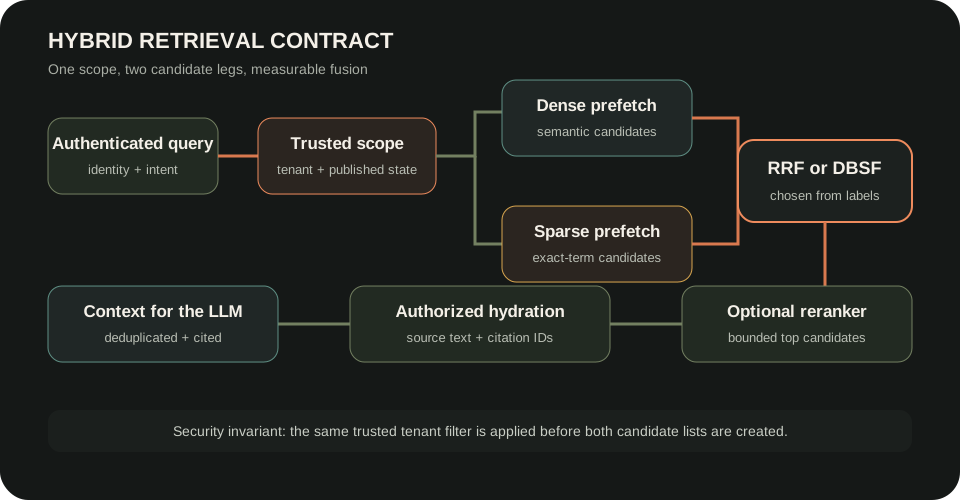
Run dense and sparse prefetches before fusion
Qdrant's hybrid query API executes prefetch queries, then applies the main query over their results. Give each prefetch a candidate limit larger than the final result count. Fusion only reorders candidates that a prefetch returned. Ten final results from two ten-item lists leave little room for recovery; a deeper pool improves recall but increases CPU, memory access and transfer into later stages.
The following request illustrates two named vectors, one trusted tenant filter and Reciprocal Rank Fusion. The sparse query values are produced by the sparse embedding model used during indexing; the dense query must use the same dense model version as the collection. Values and limits are examples to tune on labels and production latency.
const tenantFilter = {
  must: [
    { key: 'tenant_id', match: { value: authorizedTenantId } },
    { key: 'state', match: { value: 'published' } }
  ]
};

const result = await qdrant.query('knowledge', {
  prefetch: [
    { query: denseVector, using: 'dense_v3', filter: tenantFilter, limit: 80 },
    { query: sparseVector, using: 'bm25', filter: tenantFilter, limit: 80 }
  ],
  query: { rrf: { k: 2, weights: [1.0, 1.0] } },
  limit: 20,
  with_payload: ['document_id', 'chunk_id', 'version', 'language']
});
Pagination needs the same discipline. Qdrant documents that offset affects the main query, so every prefetch limit must cover at least final limit plus offset. For user-facing search, deep offset pagination can also create unstable pages as the index changes. Prefer a bounded result experience or a stable application-level continuation contract rather than pretending ANN ranking is an immutable SQL order.
Choose RRF or DBSF from what the scores mean
Reciprocal Rank Fusion uses positions, not raw score magnitudes. It is a safe starting point because cosine similarity and BM25 scores live on incompatible scales. A document that ranks near the top in both lists receives support from both even though the numerical scores cannot be added directly. Qdrant supports weights and k; tune them on a training split and confirm the decision on held-out queries.
Distribution-Based Score Fusion normalizes each returned score distribution before summing it. It can preserve the fact that one dense result won by a wide margin, which RRF flattens into a rank step. That is useful only when score gaps carry a stable signal. A small or unusual candidate list can make its distribution noisy. Qdrant's guidance suggests RRF as the safe default without score priors, DBSF when raw score spacing is trusted, and weighted RRF when labeled data supports tuning.
Avoid a fixed alpha over unnormalized dense and sparse scores. A bounded cosine value and an unbounded sparse score do not share a unit, and their ranges move with each query. The retriever with the larger numerical scale can dominate for accidental reasons. RRF removes scale; DBSF normalizes each list. Whichever method wins must beat dense-only and sparse-only on product-relevant labels, not just on a generic benchmark.
Add a reranker only after candidate recall is healthy
Fusion improves ordering among retrieved candidates. A cross-encoder or late-interaction reranker can inspect the query and candidate text more precisely, but it cannot restore a relevant chunk excluded by both prefetches. Measure Recall at candidate depth before measuring nDCG or MRR after reranking. If candidate recall is weak, fix chunking, model coverage, filters or prefetch depth first.
A practical pipeline retrieves perhaps tens or hundreds of candidates per leg, fuses them, reranks a bounded top set, then hydrates full chunk text from the authoritative store under the same tenant policy. Hydration after ranking keeps vector payloads small and lets PostgreSQL Row-Level Security or another source-of-truth policy revalidate access before model context is built. Store enough payload to identify and order chunks, not every private document body merely for convenience.
Reranking adds model latency and cost. Keep it when the gain on labeled queries changes product outcomes: fewer wrong citations, better first useful result or fewer escalations. Remove it if fusion already meets the target. For an assistant, context construction should also deduplicate overlapping chunks, cap sources per document, preserve headings and attach stable citation IDs before the LLM sees anything.
Tune HNSW and quantization after relevance is measurable
HNSW search is approximate. Increasing hnsw_ef generally explores more candidates and can improve recall at higher cost. Filterable HNSW adds edges informed by indexed payload values; combinations of strict filters may still fragment traversal, and Qdrant documents ACORN as an alternative that explores farther when direct neighbors are filtered. Do not copy a universal ef value. Benchmark with the actual filters, shard count and concurrency.
Quantization trades representation precision for memory and speed. Qdrant supports scalar, binary, product and TurboQuant methods with different compression and recall behavior. Keep original vectors available for rescoring when the chosen design needs it, and compare recall against an unquantized baseline. A faster candidate stage that removes the only relevant document makes the LLM cheaper but the product worse.
Capacity planning must include two vector representations, their indexes, payload indexes, write-ahead activity, replication and reranker work. Hybrid search is not a free query modifier. Track p50, p95 and p99 per dense prefetch, sparse prefetch, fusion, reranking and hydration so the slow stage is visible. Also track filtered candidate counts; a drop can indicate an authorization or publishing-state issue rather than a vector problem.
Evaluate the pipeline as a decision system
Report retrieval by query class. Exact identifiers may need sparse dominance; conceptual support questions may need dense dominance; Arabic-English mixed queries may expose embedding or tokenizer gaps. Use Recall at candidate depth, nDCG@k or MRR for final order, and zero-result rate under each tenant filter. Then measure latency, index size, cost and answer groundedness separately. An aggregate score can hide a broken high-value class.
Run ablations: dense only, sparse only, default RRF, tuned RRF, DBSF, then the winning fusion with and without reranking. Hold chunking and embeddings constant during that comparison. Next, change one upstream variable at a time. Store the configuration and model versions with every evaluation run so a result can be reproduced. The broader RAG retrieval evaluation guide explains how to separate missing evidence from generation errors.
Hybrid search is a poor fit when users issue only exact database keys, when SQL can answer the question deterministically, when the corpus is tiny enough for a simpler text index, or when labeled data shows no meaningful gain over one retriever. It also cannot make stale documents current. Inventory, order status and permissions usually belong to authorized live tools, not an embedding index.
Ship a bounded production rollout
Begin with shadow queries that do not affect answers. Record dense, sparse and fused candidates for the same request while returning the current production path. Review disagreements, label a representative sample and choose fusion and candidate depth from evidence. Then expose the new path to a small percentage behind a feature flag, with instant fallback to the prior retriever.
Before full rollout, test tenant isolation, empty IDF corpora, deleted documents, an embedding-model migration, index rebuild, cold caches, shard failure and a burst of concurrent queries. Alert on cross-tenant results as a security incident, not a relevance metric. Preserve the exact source and chunk IDs passed to generation so citations can be audited.
The production contract is explicit: both retrievers apply the same trusted scope; each has enough candidate depth; fusion is chosen from labels; reranking is optional; hydration rechecks authorization; and the final context carries citations. Hybrid search earns its complexity only when this measured pipeline improves real queries. For architecture and implementation support, see AI integrations and retrieval systems.
Official references
These references document the tools discussed. Examples and design decisions are illustrative and should be adapted to the project and its versions.
Prepared by: Noor Yasser
Working through a similar engineering challenge?
I help teams turn architecture decisions into a clear scope and dependable, reviewable implementation.