

OpenAI announced on October 5, 2026 that API customers can opt in to invisible text watermarking for select models, while the API default remains off. The underlying method, textGrain, changes token sampling to embed a statistical signal that an authorized detector can test. It is useful as one provenance signal for disclosure and review, but it is not proof of authorship, truth, ownership or policy compliance. Production teams should preserve generation records, label content at the product layer, measure detector error on their own text, and keep human review for consequential decisions.
This article separates documented facts from engineering recommendations. OpenAI's announcement, technical report, API documentation and help guidance were verified on October 6, 2026; the rollout architecture and release gates below are design guidance, not claims about OpenAI's private infrastructure.
What changed on October 5
OpenAI's announcement says text watermarking is available as an opt-in capability for API customers globally on select models and remains off by default. OpenAI also said eligible ChatGPT and Codex text output in the European Union would receive an invisible watermark over the following weeks. Detector access initially remains limited to approved researchers and expert organizations.
That is three distinct surfaces, not one universal detector: generation through supported API models, regional product rollout in ChatGPT and Codex, and controlled text-detector access. A product team should not infer that every OpenAI response is watermarked, that an unsupported model will carry the signal, or that a public text-verification endpoint exists.
The announcement gives the event date as October 5, 2026. It also frames the launch as a response to text-provenance requirements under the EU AI Act. That regulatory context explains the rollout, but the engineering question is narrower: what evidence does the signal provide, how fragile is it, and where does it belong in a production decision?
How textGrain embeds a signal
The textGrain technical report describes generation as an entropy-calibrated coupling between next-token probabilities and keyed pseudorandomness. At each step, tokens are partitioned into keyed vocabulary blocks. Optimal transport chooses a coupling that favors a detectable dependence while a Kullback–Leibler penalty limits how much sampling entropy is removed. Within the selected block, relative token probabilities are retained.
The useful intuition is a budget. With no dependence on the keyed randomness, there is no watermark to detect. If the key determines too much of the sample, variation and output quality can suffer. textGrain targets a bounded average loss of sampling entropy, giving watermark strength an information-theoretic interpretation instead of treating it as an arbitrary green-list bias.
The method is designed so that averaging over keys recovers the original next-token distribution under the report's assumptions. That does not mean every fixed key produces identical behavior, nor does a numerical solver guarantee the requested entropy loss at every token. The report explicitly separates idealized guarantees from finite-precision implementation and empirical calibration.
How detection works
The detector receives text and a secret key. For each scored position it reconstructs the keyed vocabulary partition, cost table and selected column from the preceding context, identifies the observed token's block, and converts the associated cost into a score. Scores from distinct context windows are summed and compared with a calibrated null distribution.
Under the report's assumptions, the sum follows a Gamma distribution for unwatermarked text, allowing a threshold for a target false-positive rate. The detector does not need the generating model or the entropy budget, but it does need matching tokenizer and watermark configuration. Repeated contexts are handled carefully because reusing the same pseudorandom table would invalidate an independence assumption.
This is statistical evidence, not a cryptographic signature over an immutable document. A signature can fail when bytes change; a statistical watermark can remain partly detectable after some editing, yet also weaken gradually. That makes it useful for population-level provenance and triage, but dangerous as the only basis for punishment, hiring, grading or fraud accusations.
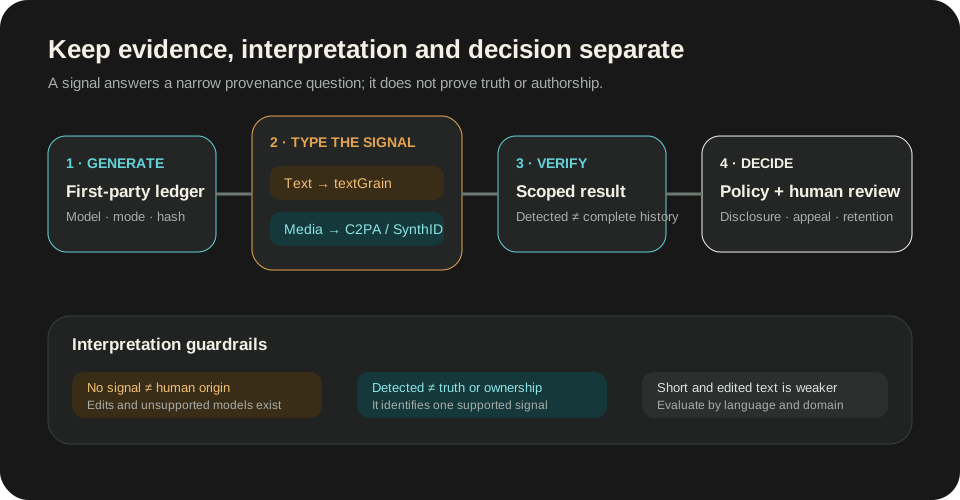
Read the published numbers correctly
OpenAI reports that, at a target false-positive rate of 1%, its detector found watermarks in about 80% of 200-token psychology passages and about 95% of 400-token passages. Detection was lower for constrained domains such as mathematics. In a separate 400-token evaluation, replacing 10% of words with synonyms reduced detection from about 92% to 66%; replacing 25% reduced it to 17%.
These are company-reported evaluations on specified datasets and conditions, not universal service-level guarantees. They show three operational truths: short text carries less evidence, low-entropy text offers fewer token choices, and editing can erase the signal. Translation, summarization, templating, copyediting and mixing human and generated passages can all shift the real distribution.
Do not turn the 1% target into the statement that any positive result is 99% likely to be AI-generated. False-positive rate is conditional on non-watermarked inputs under a calibration distribution. Positive predictive value also depends on how common watermarked text is in the population being tested and how closely production text matches calibration.
Watermarking and the Content Provenance API are different
OpenAI's current Content Provenance API documentation covers image and audio uploads. Images can return C2PA Content Credential and SynthID results; audio can return SynthID results. Text verification is described separately and requires approved access.
C2PA is signed metadata that can describe origin and editing history, but metadata can be removed by conversion or sharing. SynthID is an embedded media watermark that may survive some transformations. textGrain is a statistical signal in generated token choices. A product should keep these evidence types distinct instead of collapsing them into a boolean `is_ai` field.
| Signal | Normal input | Strongest safe interpretation | Important limit | |---|---|---|---| | textGrain detector | Text | A supported OpenAI text watermark was statistically detected | Editing, length and domain affect detection | | C2PA | Image metadata | A trusted signed manifest records issuer and AI action | Metadata may be absent or stripped | | SynthID | Supported image or audio | A recognized embedded watermark was detected | Non-detection does not prove human origin | | Application ledger | Your request and response records | Your system generated this artifact under recorded settings | Covers only traffic you recorded and retained |
The API documentation says `not_detected` means no supported signal was found, not that a human created the file. It also recommends treating provenance as evidence in a broader review, checking the issuer, using original files where possible and retaining human review for high-stakes workflows.
A production provenance architecture
Start at generation, not detection. Give each request an internal generation ID and record tenant, user or service policy, model snapshot, supported provenance mode, prompt-template version, output hash, creation time, disclosure requirement and retention class. Do not store raw prompts or outputs longer than necessary; the ledger should follow the product's privacy and access policy.
Return a visible disclosure or machine-readable product label when the user experience requires it. The invisible watermark is a resilience layer, not a replacement for transparent UX. Store the output hash before downstream rewriting so the system can distinguish the original response from a later human-edited derivative.
At ingestion, route images and audio through the documented Content Provenance API only when the format, size, consent and review purpose fit. Route text to a detector only if your organization has approved access and a documented use case. Persist the raw provider result, signal type, model or issuer fields when available, detector version, threshold policy and timestamp. Derive a review decision separately so policy changes do not rewrite evidence.
{
  "artifact_id": "art_01...",
  "kind": "text",
  "generation": {
    "provider": "openai",
    "model_snapshot": "approved-snapshot",
    "watermark_requested": true
  },
  "evidence": {
    "signal": "textgrain",
    "outcome": "detected",
    "detector_policy_version": "prov-2026-10"
  },
  "decision": "human_review_required"
}
This is an application schema, not an OpenAI response shape. It deliberately separates what your system requested, what a detector observed and what your policy decided. Never fabricate `detected` from a generation flag, and never infer a user, prompt or conversation from a watermark result.
Rollout without turning provenance into surveillance
First inventory where generated text leaves your product: customer messages, reports, support drafts, educational material, marketplace listings and internal notes. Classify which outputs need visible disclosure, durable provenance, both, or neither. Enable watermarking only on a supported model after verifying the current API contract; do not invent a request parameter from a launch post.
Run an offline evaluation on consented, non-sensitive samples. Measure detection by language, length, domain, temperature, template density and expected editing path. Include negatives from human writing and unsupported models. Report confusion matrices and confidence intervals, not one accuracy number. Keep a protected holdout set and re-test whenever model, tokenizer, detector or copyediting pipeline changes.
Then use the signal for low-risk routing: attach a disclosure, prioritize manual review or measure aggregate coverage. Do not automatically reject a student, applicant, author or customer because one detector returned positive. Require corroborating evidence, an appeal path and a retention limit. Keep detector access and results behind least-privilege roles because provenance investigations can expose sensitive documents even when they do not identify the generating account.
Best uses
Text watermarking fits products that already control generation and want a signal that may survive simple copying: publishing tools, enterprise knowledge assistants, customer-support drafting and platforms that need aggregate transparency measurement. It is most useful for sufficiently long, natural-language output that remains largely intact.
The separate Content Provenance API fits trust-and-safety or editorial pipelines checking supported image and audio files. Send the original file where possible, preserve each result independently and retry only transient failures such as rate limits or server errors. A malformed or unsupported file is a validation outcome, not a reason for blind retries.
Use your own generation ledger when you control the request. It can provide stronger first-party evidence than later statistical detection because it records the actual transaction. Combine ledger, visible disclosure, provenance signal and review policy; no single layer covers every edit, export or provider.
When not to use it
Do not use watermark detection as a general AI-content detector. The official documentation says the media API checks supported OpenAI signals, not every provider, and the text rollout has model and access limits. Do not use absence as proof of human authorship. Do not use presence to decide truth, legality, ownership or who wrote the prompt.
Avoid watermark-dependent enforcement for short labels, code fragments, equations, structured JSON or heavily templated content. These outputs offer limited token freedom and may not retain a robust signal. If your requirement is non-repudiation of an approved document, use a cryptographic signature and immutable audit record; statistical watermarking solves a different problem.
Do not silently enable provenance in a way that conflicts with customer contracts, regional requirements or promised data handling. Review the supported models, data controls and cloud-provider availability for the actual deployment. Feature availability in an announcement is not proof that every account, region and model exposes the same configuration.
Failure modes and anti-patterns
The first anti-pattern is one boolean called `ai_generated`. It erases provider scope, signal type, confidence, issuer, date and transformation history. The second is treating a detector threshold as a moral judgment. The third is testing only long English prose and then enforcing the result on Arabic, code, mathematics or translated content.
Watch for detector drift, unsupported-model traffic, low scored-token counts, transformation-induced signal loss, repeated submissions, disproportionate flags by language and reviewers overriding automation. Rate-limit verification endpoints, hash exact uploads to avoid repeated checks and never expose detector internals or keys to clients.
A result also needs provenance. Store which detector and policy produced it. If the organization changes its threshold or receives a better detector, re-evaluate from retained evidence only when retention and user expectations permit; do not rewrite the historical decision silently.
A practical decision rule
Adopt text watermarking when the product controls generation, uses supported models, produces enough natural language and has a concrete disclosure or review purpose. Keep it optional and observable during evaluation. Pair it with a first-party generation ledger and visible UX.
Do not adopt it as a universal classifier or a shortcut around due process. A detected signal can support the narrow statement that a compatible OpenAI watermark was found under a particular detector configuration. It cannot tell you who generated the text, how much a human changed it, whether it is accurate or whether its use was allowed.
For related production controls, see Applied AI and retrieval systems, GPT-6.1 model routing and OpenAI Ultrafast latency architecture. Provenance belongs beside model selection, evaluation, security and user-facing disclosure—not above them.
Official references
These references document the tools discussed. Examples and design decisions are illustrative and should be adapted to the project and its versions.
Prepared by: Noor Yasser
Working through a similar engineering challenge?
I help teams turn architecture decisions into a clear scope and dependable, reviewable implementation.


