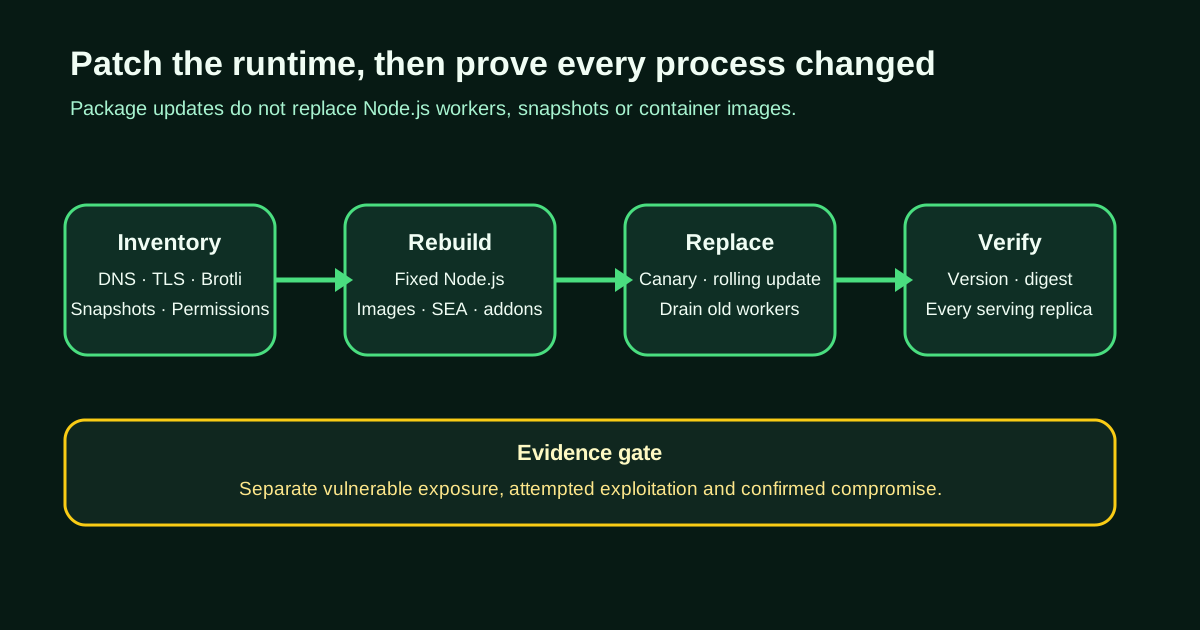
Node.js published security releases for the active 22.x, 24.x and 26.x lines on October 21, 2026. The release fixes four high-severity issues, including a Brotli decoder out-of-bounds write that can corrupt process memory, plus DNS and TLS hostname-validation inconsistencies. Production teams should upgrade to Node.js 22.23.4, 24.22.1 or 26.12.1, rebuild images and snapshots, replace every running process, and verify the runtime that actually serves traffic. Updating application packages alone does not patch these runtime flaws.
This article separates official Node.js facts from engineering recommendations. Vulnerability descriptions, affected lines and fixed versions come from the Node.js Project advisory published and last updated on October 21, 2026. The rollout, detection and architectural controls below are defensive guidance. No public exploitation claim is made unless the primary advisory states it.
What the security release contains
The Node.js Project lists ten runtime issues plus dependency updates for c-ares, CA certificates, OpenSSL, SQLite and Undici. The highest severity is High.
| CVE | Severity | Boundary | Affected active lines |
|---|---|---|---|
| CVE-2026-105482 | High | dns.resolve*() and dns.reverse() truncate names at NUL | 22, 24, 26 |
| CVE-2026-105483 | High | TLS hostname check mishandles fullwidth digits in IP literals | 24, 26 |
| CVE-2026-106069 | High | TLS validation and OS resolution disagree on leading-zero IPv4 | 22, 24, 26 |
| CVE-2026-111497 | High | Brotli streaming decoder writes beyond an internal buffer | 22, 24, 26 |
| CVE-2026-105481 | Medium | Keep-alive socket accepts an unsolicited early response | 22, 24, 26 |
| CVE-2026-106072 | Medium | Numeric DNS SAN can authenticate a non-canonical IP spelling | 22, 24, 26 |
| CVE-2026-106074 | Medium | UUID and randomInt entropy caches repeat across snapshots/SEAs | 22, 24, 26 |
| CVE-2026-106070 | Low | ZipFile may return attacker-controlled prefix bytes after validation failure | 26 |
| CVE-2026-106071 | Low | Permission wildcard radix lookup can over-grant filesystem access | 26 |
| CVE-2026-106073 | Low | fs.realpathSync() bypasses a Permission Model read check | 22, 24, 26 |
The three fixed active releases are:
- Node.js 22.23.4;
- Node.js 24.22.1;
- Node.js 26.12.1.
End-of-Life branches do not receive the same assurance. Move to a supported fixed line or obtain a documented vendor backport; “the service still starts” is not evidence that the runtime is safe.
Why the Brotli issue gets first priority
CVE-2026-111497 is inside the Brotli decoder bundled with Node.js. The advisory says an invalid block switch was treated as a temporary need for more input instead of a permanent format error. In streaming decompression, additional bytes could then be appended beyond an eight-byte internal buffer.
An attacker must be able to supply Brotli data that the application decompresses through node:zlib. Impact can include a crash, process-memory disclosure or remote code execution. That does not mean every Node.js HTTP service is remotely exploitable: reachability depends on whether untrusted compressed data reaches the vulnerable decoder. It does mean that exposed upload, archive, messaging, proxy or transformation paths deserve urgent inventory.
Search for direct and wrapped use of Brotli:
rg -n "brotli|createBrotliDecompress|BrotliDecompress|zlib" src app packagesAlso inspect dependencies and worker services that decompress customer-controlled blobs. A source search is incomplete when native addons, queues or separate media workers own the decode path.
Do not send exploit files to production to test reachability. Confirm code paths with safe fixtures, dependency tracing and staging tests, then patch.
DNS NUL truncation breaks validate-then-resolve designs
CVE-2026-105482 affects dns.resolve*() and dns.reverse(). A name such as attacker.example\0.trusted.example can be validated as one string by application logic, then truncated when passed as a C string to c-ares, causing a query for attacker.example.
This matters for SSRF defenses, webhooks, tenant-supplied integration hosts and outbound proxy allowlists. A dangerous pattern is:
- validate the original hostname against an allowlist;
- resolve it later through a runtime function;
- connect to the resolved address while assuming both stages used the same identity.
Patch the runtime first. Defense in depth should reject NUL and control characters, parse once, canonicalize once, and bind the validated host to the connection policy. Re-check resolved IPs against blocked private, loopback, link-local and metadata ranges when the product accepts external destinations.
TLS verification must not disagree with connection parsing
Three advisory entries concern non-canonical IP text:
- CVE-2026-105483: fullwidth digits can be treated as a DNS name during certificate matching even though resolution reaches an IPv4 address;
- CVE-2026-106069: a leading-zero IPv4 component can be interpreted differently by WHATWG normalization and an operating-system resolver;
- CVE-2026-106072: alternate spellings such as hexadecimal, a single integer or shortened IPv4 can allow DNS SAN matching where an IP Address SAN should be required.
The security boundary is identity agreement: parsing, resolution, connection and certificate verification must refer to the same canonical endpoint.
For user-configured upstreams, reject ambiguous IP spellings rather than trying to support every historical form. Parse the URL, normalize the hostname, use net.isIP() for IP literals, require canonical text, and apply certificate policy to the same value used for the connection. Do not override checkServerIdentity with a callback that simply returns success.
Keep-alive responses and request identity
CVE-2026-105481 affects HTTP Agent connection reuse. An unsolicited response may already be buffered on an idle socket before a new request is sent. If the event loop is busy, the guard can be removed when the socket is reassigned, allowing the stale bytes to be parsed as the new request's response.
The patch is the primary fix. Operationally, treat outbound response identity as more than a status code. For sensitive internal APIs, include request correlation, signed responses or application-level idempotency where appropriate. Keep synchronous CPU work off the main event loop; event-loop starvation is also an availability risk, although eliminating it is not a substitute for upgrading.
Snapshots and single executable applications must be rebuilt
CVE-2026-106074 affects entropy caches used by crypto.randomUUID(), crypto.randomUUIDv7() and crypto.randomInt() when they are populated while building a user-land startup snapshot or a single executable application using useSnapshot. Every process launched from the artifact can repeat the cached values until refill.
The advisory gives upper bounds of 127 repeated UUIDs and roughly 1,000 repeated randomInt() results. Collisions can break uniqueness assumptions; cross-process observation can make values predictable.
Upgrading the Node binary used at runtime is not enough if the shipped artifact embeds a snapshot created by a vulnerable builder. Rebuild snapshots and SEAs with the fixed runtime, publish a new artifact digest, redeploy it, and review whether snapshot creation invokes UUID or random-number APIs.
Do not use UUIDs or random integers as authentication secrets merely because they are usually unique. Tokens need an explicit cryptographic design and enough entropy for their threat model.
Permission Model fixes do not replace sandboxing
CVE-2026-106071 can over-grant a shorter path when a wildcard filesystem rule is stored in a particular radix-tree shape. CVE-2026-106073 leaves fs.realpathSync() able to reveal path existence and symlink targets outside an allowed read scope.
Patch even when the process uses the Permission Model only as defense in depth. Then retest the exact flags used in production. Keep operating-system controls—container user, read-only filesystem, mount boundaries, seccomp and mandatory access control—because a language-runtime permission layer is not a complete hostile-code sandbox.
Upgrade plan for hosts, containers and serverless functions
Use a replacement workflow rather than editing one machine in place:
- Inventory: record service, environment, runtime line, complete version, image or artifact digest, build pipeline and whether Brotli, custom TLS, DNS allowlists, snapshots, SEAs or Permission Model flags are used.
- Choose the fixed line: upgrade to 22.23.4, 24.22.1 or 26.12.1. If a platform ships a backport, require a vendor advisory covering the relevant CVEs.
- Rebuild: rebuild base images, application images, native addons, snapshots and SEAs from trusted sources. Do not copy a vulnerable Node binary from an old stage.
- Canary: test DNS/TLS clients, compressed inputs, proxies, uploads, queues, UUID uniqueness, cold starts and filesystem permissions.
- Replace: roll out immutable artifacts, drain old workers and restart process managers. Serverless functions need a new deployed artifact or runtime selection.
- Verify: query the runtime version from every serving replica and confirm that autoscaling templates reference the new digest.
- Monitor: watch crashes, decompression errors, outbound TLS failures, DNS rejections, duplicate identifiers and unexpected permission denials.
console.log({
  node: process.version,
  release: process.release,
  platform: process.platform,
  arch: process.arch,
});
That output proves only the process you reached. In a load-balanced fleet, sample or enumerate every instance through authenticated operations telemetry. Remove temporary diagnostics after verification.
Container verification example
Use the image actually scheduled in production:
docker run --rm --entrypoint node your-registry/app@sha256:IMAGE_DIGEST -p "process.version + ' ' + process.versions.openssl"Then verify the orchestrator no longer runs old digests. Tags can be moved and are weak evidence; record the immutable digest in deployment and audit data.
For Kubernetes, update the workload image, use a controlled rolling deployment, watch readiness and error budgets, and query Pod image IDs after rollout. A successful build does not prove that old Pods, jobs or autoscaling templates disappeared.
Incident review without overclaiming compromise
The Node.js advisory describes vulnerability mechanics; it does not state that every exposed service was exploited. Separate three findings:
- vulnerable: an affected runtime and reachable feature existed;
- attempted exploitation: logs or telemetry show crafted input consistent with a known path;
- confirmed compromise: process, host or business evidence demonstrates unauthorized impact.
For Brotli-exposed services, preserve crash dumps where policy allows, container termination reasons, kernel events, request metadata and the hash of suspicious compressed input. For DNS/TLS paths, preserve normalized and original destinations, connection addresses and certificate-validation failures. Avoid logging secrets or raw customer payloads unnecessarily.
If memory corruption may have occurred, rotate credentials accessible to the process according to incident scope, rebuild from trusted artifacts and investigate lateral movement. A restart alone destroys volatile evidence and does not establish containment.
What common checks miss
npm audit evaluates known vulnerabilities in package dependencies. It does not prove that the Node.js runtime, embedded Brotli code, TLS verification or c-ares behavior is patched. Likewise:
- updating
package-lock.jsondoes not change the host runtime; - rebuilding with a floating tag is not proof of the final digest;
- patching the CLI does not prove PM2, systemd, containers or serverless functions use it;
- a healthy readiness endpoint does not prove all replicas changed;
- a WAF cannot reliably repair memory-safety and identity-parsing flaws inside the runtime.
Best practices and anti-patterns
Best practices
- Pin an active Node.js line and consume security releases quickly.
- Record runtime version and immutable artifact digest in deployment telemetry.
- Treat decompression, DNS resolution and TLS verification as security boundaries.
- Reject ambiguous host representations before allowlist checks.
- Rebuild derived artifacts such as snapshots and SEAs after runtime security updates.
- Test rollback so it restores service without silently restoring a vulnerable image.
Anti-patterns
- Assuming
npm auditpatches Node.js itself. - Allowing arbitrary compressed data to reach decompression workers without bounds.
- Validating one hostname string but connecting with a differently normalized value.
- Keeping old Pods or process-manager workers alive after files change on disk.
- Claiming compromise from a version scan alone.
- Using a runtime permission model as the only isolation boundary for hostile code.
When a full emergency rollout may be scoped
Every affected active line should be upgraded. Risk-based sequencing can prioritize services that decompress untrusted Brotli, accept tenant-defined hosts, use custom TLS clients, build snapshots/SEAs or run untrusted plugins under the Permission Model. Internal services without those paths still inherit dependency and defense-in-depth fixes, so “not internet-facing” is a reason to sequence, not a reason to stay unpatched.
If a vendor-managed platform controls Node.js, obtain the platform's deployment confirmation and fixed runtime identity. Do not upload exploit samples to prove the provider's claim.
Executive checklist
- Find every Node.js 22, 24 and 26 runtime, including build images and jobs.
- Upgrade to 22.23.4, 24.22.1 or 26.12.1.
- Rebuild containers, native modules, startup snapshots and SEAs.
- Canary DNS, TLS, Brotli, HTTP keep-alive, UUID and permission behavior.
- Replace all workers and verify image digests across the fleet.
- Preserve evidence and classify exposure, attempts and compromise separately.
- Remove old base images and deployment templates so autoscaling cannot reintroduce them.
Related guides: PHP2Shell patch and verification, Kubernetes TLS rotation, stopping cascading failures, and the engineering article library.
Primary references
- Node.js Project — October 21, 2026 security releases
- Node.js v22.23.4 release
- Node.js v24.22.1 release
- Node.js v26.12.1 release
- Node.js documentation — Zlib
- Node.js documentation — DNS
- Node.js documentation — TLS
- Node.js documentation — Permissions
- Unsplash License
- Cong Long Vu — licensed terminal photograph
Official references
These references document the tools discussed. Examples and design decisions are illustrative and should be adapted to the project and its versions.
- Node.js Project — October 21, 2026 security releases
- Node.js v22.23.4 release
- Node.js v24.22.1 release
- Node.js v26.12.1 release
- Node.js documentation — Zlib
- Node.js documentation — DNS
- Node.js documentation — TLS
- Node.js documentation — Permissions
- Unsplash License
- Cong Long Vu — licensed terminal photograph
Prepared by: Noor Yasser
Working through a similar engineering challenge?
I help teams turn architecture decisions into a clear scope and dependable, reviewable implementation.