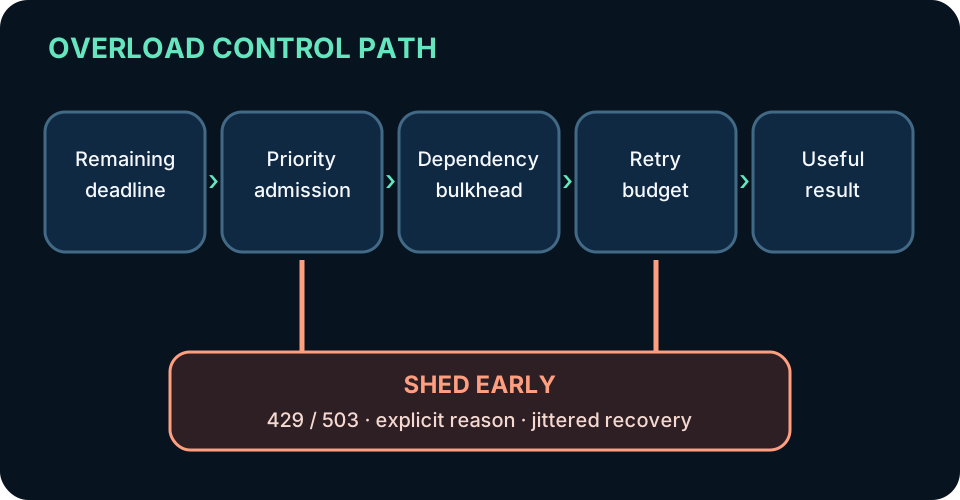
A distributed system survives overload by stopping useless work early, not by letting every request wait longer. Give each request one end-to-end deadline, subtract time already spent before every downstream call, bound concurrency and queues at each dependency, allow retries from one layer only and cap them with a retry budget. When useful capacity is exhausted, return a deliberate 429 or 503, or serve a cheaper response whose reduced quality is explicit. This protects goodput and prevents a slow dependency from becoming a cascading outage.
This is a practical reliability guide based on current official gRPC, AWS Builders' Library, Google SRE and Envoy documentation, verified on 20 October 2026. The numeric budgets are illustrative; real thresholds must come from workload tests, service objectives and the cost of incorrect degradation.
Overload is a queueing problem before it is a CPU problem
When arrivals exceed completed work, requests accumulate somewhere: an ingress proxy, application thread pool, event loop, database connection pool or broker. A longer queue can hide rejection briefly, but it consumes memory and pushes useful requests past the time at which callers still care. By the time CPU reaches 100%, queue delay may already dominate latency.
Measure offered load, admitted load and completed useful work separately. Google SRE calls the last measure goodput: responses that complete within the conditions users can actually use. Throughput can rise while goodput falls if the system finishes expired work, repeated retries or responses the caller has already abandoned.
Useful overload signals include in-flight work, queue age, pool wait time, event-loop delay, memory pressure, open file descriptors, downstream saturation and the share of requests with too little deadline remaining. CPU alone is insufficient. A service blocked on a saturated database can fail with moderate CPU, while a compute-heavy service may operate correctly near its planned CPU ceiling.
Use one deadline across the whole call graph
A timeout belongs to one network attempt. A deadline expresses when the user operation stops being valuable. Without an end-to-end deadline, each hop can spend its full local timeout, so a five-service chain turns a 500 ms user objective into several seconds of hidden work.
gRPC does not set a deadline by default; clients should set a realistic one. Its deadline guide documents propagation by converting the absolute deadline into a remaining timeout and deducting elapsed time, which avoids clock-skew problems between machines. HTTP systems can carry a signed or trusted remaining-budget header inside the platform, but must never accept an arbitrary larger deadline from an untrusted public caller.
Reserve time for the response path and local cleanup. For an illustrative 1,200 ms operation, the gateway might spend at most 100 ms, the application 200 ms, reserve 250 ms for response and jitter, and grant the dependency no more than the smaller of its normal timeout or the remaining 650 ms. If only 40 ms remains and the call normally needs 150 ms, reject before starting it.
Cancellation must travel with the deadline. A client returning DEADLINE_EXCEEDED while the server continues a database scan has improved client latency but not system capacity. Propagate cancellation to database drivers, HTTP clients, queues and child tasks where their contracts support it. Side effects need separate semantics: a timed-out payment call may have succeeded, so mark the result unknown and reconcile by idempotency key instead of assuming cancellation reversed it.
Bound concurrency and queue time per dependency
Use a separate concurrency budget for each dependency or workload class. One slow recommendation service should not consume every worker needed for checkout. This is the bulkhead principle: isolate the capacity used by unrelated failure domains and priorities.
Admission should happen before acquiring expensive resources. A bounded semaphore, worker pool or proxy circuit breaker can cap active calls. A small bounded queue may absorb brief variance; attach a maximum queue age and compare it with the remaining deadline. Rejecting an expired request from the head of a queue is better than executing it and returning too late.
Choose the limit through controlled load tests. Increase concurrency until useful throughput stops improving or latency, errors or resource pressure cross the objective, then preserve headroom. A static number can be a safe first contract. Adaptive concurrency can react faster, but it needs stable measurements, minimum and maximum bounds and protection against oscillation.
Envoy's circuit-breaker configuration can limit connections, pending requests, active requests and concurrent retries for an upstream cluster. These are capacity guards, not proof that the application is healthy. Envoy's Overload Manager is a different boundary: it monitors local resource pressure such as memory, CPU or file descriptors and triggers protective actions for the proxy itself.
Put retries at one layer and give them a budget
Retries are additional load placed precisely when a dependency may be struggling. If three layers each retry twice, one original request can cause far more downstream attempts. AWS recommends retrying at one appropriate layer for multi-hop operations, with bounded attempts, exponential backoff and jitter so clients do not synchronize.
Retry only failures that are plausibly transient and operations whose repeated execution is safe. gRPC status guidance distinguishes UNAVAILABLE, which can suit retrying the failing call, from FAILED_PRECONDITION, which should wait for explicit state repair. A timeout does not prove that a mutation failed; use an idempotency key and reconciliation for unknown outcomes.
A retry budget limits extra attempts relative to admitted original traffic. Envoy documents a retry budget as a percentage of active and pending requests, with a configurable minimum retry concurrency. The exact implementation can be a token bucket: successful or original requests replenish capacity, retries consume it, and exhausted capacity returns the original error instead of amplifying it.
Every retry must fit inside the original deadline. Before another attempt, include backoff, expected call time and response reserve. If they do not fit, stop. Never reset the user's deadline when crossing a queue, proxy or service boundary.
remaining = request.deadline - now
if remaining < response_reserve: reject(DEADLINE_EXCEEDED)
if !admission.tryAcquire(priority, remaining): shed(OVERLOADED)
result = callDependency(timeout=min(normal_timeout, remaining - reserve))
if result.retryable && retryBudget.allow() && enoughTimeForBackoffAndAttempt():
    sleep(exponentialBackoffWithJitter())
    retryOnceWithSameOperationId()
Shed load before the service loses control
Load shedding rejects some work so the rest can finish. Google SRE describes dropping traffic as a way to avoid running out of memory, failing health checks or serving extreme latency. The trigger should reflect saturation close to the bottleneck: concurrency, queue delay, memory pressure, database pool wait or a composite signal—not an arbitrary global request rate.
Reject as early as possible and expose a machine-readable reason. Use 429 when the caller has exceeded an applicable rate or quota, and 503 when service capacity is temporarily unavailable. Include Retry-After only when the estimate is meaningful. Clients still need jitter and a retry budget; telling every caller to retry after exactly one second creates another wave.
Prioritize by business consequence, not by which request arrived first. Health and control traffic, payment confirmation and an interactive read may need separate capacity from analytics, exports or background refresh. Authentication must precede any priority claim so a public client cannot label itself critical.
Avoid silently queueing unlimited work in Kafka, SQS or an internal job table. A durable queue prevents loss, but it does not create downstream capacity. Track oldest-message age, deadline, attempt count and completion value. Expire or park work that can no longer produce a valid outcome.
Degrade features, never correctness boundaries
Graceful degradation reduces the work per accepted request. Google SRE gives examples such as searching a smaller corpus or using a cheaper cached result. A product might omit recommendations, return a slightly stale public catalog, reduce image transformations or defer nonessential analytics.
Define degraded modes before the incident. State which fields may be stale, how long, what banner or metadata communicates that state, and which metrics activate and exit the mode. Test the mode regularly; an untested fallback often depends on the same failed service and increases load.
Never degrade authorization, payment correctness, tenant isolation, inventory ownership or audit requirements. If a safe answer needs the authoritative source and that source is unavailable, fail closed or return an explicit unavailable state. “Stale while revalidate” is useful for content, not for a revoked permission or an uncertain charge.
Coordinate autoscaling with immediate protection
Autoscaling adds capacity after measurement, scheduling, image pulls and warm-up. It cannot protect the first seconds of a spike, and scaling an application may increase pressure on a fixed database. Use load shedding and bounded concurrency as immediate controls; use Horizontal Pod Autoscaling and node scaling for sustained load after proving the downstream capacity exists.
Scale on a signal tied to demand and saturation, such as admitted concurrency or queue age, not only CPU. Keep resource requests accurate so Kubernetes can place new Pods, and account for startup readiness before counting replicas as usable. The related Kubernetes requests and limits guide explains that capacity contract; the PgBouncer admission-control guide covers protecting a fixed database from elastic clients.
Test the failure as a system
Run a load ramp beyond expected peak, then inject slow dependencies, partial errors and packet loss. Verify that queues remain bounded, expired work is cancelled, retry volume stays inside budget, high-priority goodput remains stable and recovery does not create a thundering herd. Test a dependency that succeeds after the caller times out to prove idempotency and reconciliation.
Dashboards should show offered, admitted, shed, retried, completed and expired work. Segment by caller, operation and priority. Track remaining deadline at each hop, queue age, concurrency utilization, retry-budget exhaustion, degraded-mode activation and useful success latency. An error-rate chart alone cannot distinguish controlled shedding from collapse.
Do not use this architecture to hide permanent under-capacity or a broken query. If normal traffic regularly triggers shedding, fix capacity, algorithms or ownership. Do not add retries to deterministic validation failures. Do not deploy a circuit breaker without a recovery test: a breaker that opens correctly but closes into a synchronized surge merely moves the outage.
The production contract is simple to state and demanding to enforce: one deadline, bounded waiting, isolated concurrency, one retry layer, a finite retry budget, early shedding, explicit degradation and measured recovery. Together these controls keep useful work moving when demand or dependency latency exceeds the system's safe capacity.
Official references
These references document the tools discussed. Examples and design decisions are illustrative and should be adapted to the project and its versions.
- gRPC — Deadlines and deadline propagation, verified 20 October 2026
- gRPC — Retry, throttling and server pushback, verified 20 October 2026
- AWS Builders’ Library — Timeouts, retries and backoff with jitter
- AWS Builders’ Library — Using dependency isolation to contain concurrency overload
- Google SRE — Handling overload
- Google SRE — Addressing cascading failures
- Envoy — Overload Manager architecture, verified 20 October 2026
- Envoy — Circuit breakers and retry budgets, verified 20 October 2026
Prepared by: Noor Yasser
Working through a similar engineering challenge?
I help teams turn architecture decisions into a clear scope and dependable, reviewable implementation.