Claude Fable 5.2 is Anthropic’s new model for the hardest open-ended technical work, but the most important production decision is where not to use it. Anthropic recommends Claude Opus 5.5 as the daily starting point for most coding and knowledge tasks, then moving up to Fable 5.2 only when scope and complexity justify it. A reliable rollout therefore needs a routing contract, migration tests, explicit retention approval and workload-level evidence—not a global model-name replacement.
Answer first
Treat Fable 5.2 as an escalation tier behind a measurable gate:
- keep the established daily model for ordinary requests;
- route only workloads that exceed a documented complexity threshold;
- verify data-retention eligibility before any traffic reaches Fable;
- migrate the complete conversation contract, not just the model ID;
- test thinking blocks, tool declarations, computer use, advisor models, refusal handling and rate limits;
- compare quality, cost and end-to-end latency on representative tasks;
- canary by workload and tenant, with a clean rollback path.
This approach benefits platform teams operating long-running coding agents, research workflows and complex tool-using systems. It avoids paying frontier-model prices for simple work and prevents a seemingly small SDK change from breaking tool loops or violating a data-handling promise.
What Anthropic actually announced
On November 9, 2026, Anthropic announced Claude Fable 5.2 and Claude Mythos 5.2. Anthropic says they share the same underlying model. Fable adds stronger cyber and biology safeguards and is broadly available; Mythos is intended for verified organizations doing approved cybersecurity or life-sciences work.
Anthropic reports that the new models generate output up to 30% faster than Fable 5.1 and Mythos 5.1, with standard pricing of $8 per million input tokens and $40 per million output tokens. Optional fast mode is priced at $16 and $80 respectively and is claimed to reach up to 2.5 times the output speed. These are vendor claims and list prices. They are not a forecast of your application’s total latency or cost.
The official availability section says Fable 5.2 is available on Anthropic’s platform and across supported AWS, Google Cloud and Microsoft Azure offerings. On the Claude Platform, the documented model ID is claude-fable-5-2. Access paths and feature details vary by provider, so pin the exact platform identifier and contract used by your deployment.
Anthropic also publishes benchmark results, customer quotations and internal case studies. They are useful release evidence, but engineering acceptance should use your own tasks, policies and failure conditions.
Fable and Mythos are not interchangeable product names
The shared base model does not mean the two products have the same access or operating contract.
| Question | Fable 5.2 | Mythos 5.2 |
|---|---|---|
| Intended access | Broadly available | Verified cyber or life-sciences organizations |
| Safeguard behavior | Strong cyber and biology classifiers | Controlled access for approved dual-use work |
| Default use | Escalation for difficult technical work | Specialized verified workflows |
| Production prerequisite | Platform access and retention approval | Verification program plus workload authorization |
| Safe fallback assumption | Handle refusals explicitly | Do not assume Mythos access exists everywhere |
A router must use the model actually authorized for the tenant and workload. It must never turn a Fable refusal into an automatic attempt to reach Mythos, nor disguise a restricted task as a general coding request.
Start with a workload map
Do not route on prompt length alone. A long request can be easy; a short request can conceal a high-risk or high-complexity operation. Classify workloads using observable properties:
- task family: coding, research, analysis, computer use or document work;
- expected horizon: seconds, minutes or hours;
- tool depth and number of dependent steps;
- ambiguity and cost of a wrong answer;
- need for expert review or a formal proof artifact;
- data classification and retention agreement;
- action risk, including filesystem, cloud and production side effects;
- tenant entitlement, rate-limit budget and regional provider availability.
Produce a versioned routing record:
{
  "routing_policy": "frontier-router-v4",
  "workload": "repository-migration",
  "tenant": "enterprise_42",
  "data_class": "confidential",
  "retention_approved": true,
  "risk": "high",
  "default_model": "claude-opus-5-5",
  "escalation_model": "claude-fable-5-2",
  "reason": "long_horizon_cross_service_change",
  "eval_suite": "migration-v7"
}
This record is evidence for why the expensive or more restricted tier was selected. It also makes a rollback explainable.
A production routing architecture
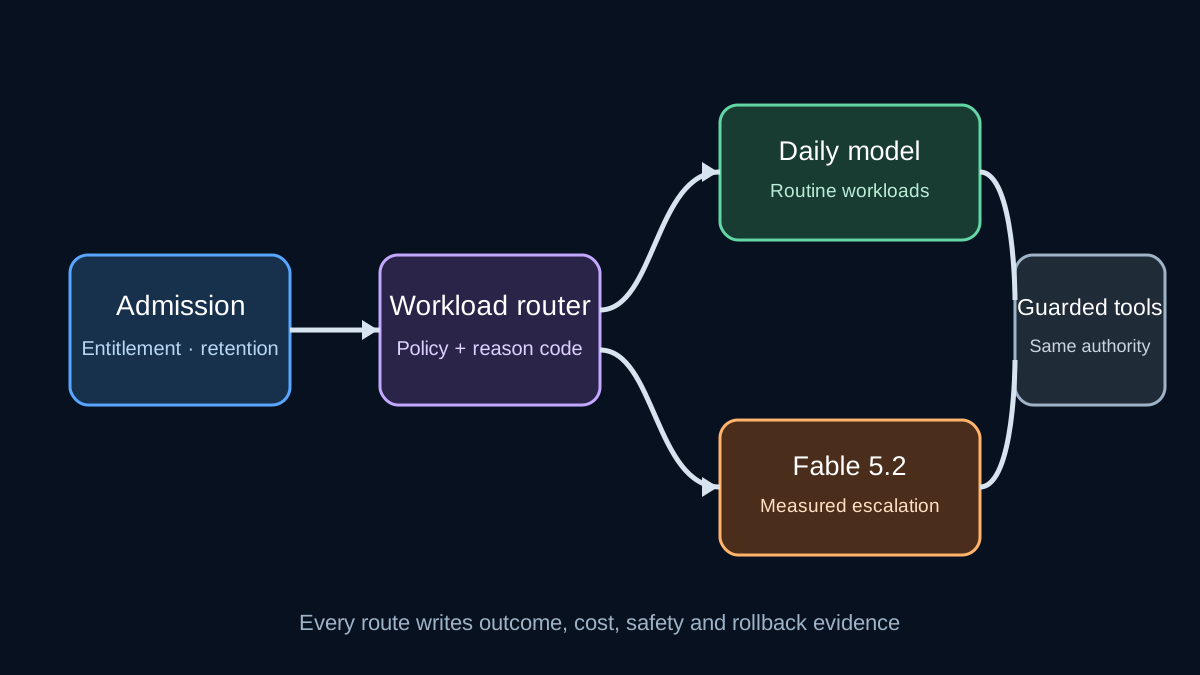
Use four layers:
- Admission: authenticate the tenant, load entitlements, classify data and reject workloads that do not meet retention or verification requirements.
- Router: select a model, effort level and speed mode from a versioned policy. The router does not execute tools.
- Agent runtime: own conversation state, tool schemas, approvals, sandboxes and side-effect logs.
- Evaluation and ledger: record the policy version, model, usage, tool trajectory, outcome, reviewer decision and cost.
A useful rule is: *escalate capability without escalating authority*. Moving from Opus to Fable may improve reasoning, but it must not silently grant filesystem access, broader network permissions, more powerful tools or permission to deploy.
Decide when Fable earns the route
A decision table keeps routing explainable:
| Workload signal | Default route | Escalate to Fable 5.2 when | Required proof |
|---|---|---|---|
| Routine extraction or classification | Haiku or Sonnet | Rarely | Schema accuracy and cost |
| Normal coding task | Opus 5.5 | Repository-wide reasoning remains unresolved | Tests, diff review, task success |
| Long migration | Opus 5.5 canary | Dependencies span services and prior model stalls | Rehearsal, rollback, reviewer approval |
| Deep research | Opus 5.5 | Evidence synthesis exceeds the daily tier | Citation precision, coverage, abstention |
| Computer-use workflow | Current supported model | Only after toolset migration and UI evals | Action trace, screenshots, read-back |
| Cyber or biology request | Policy classifier | Only the authorized product and program | Verified entitlement and scope |
The gate should be conservative at first. Increase the Fable share only when measured incremental value exceeds incremental token cost, latency and operational complexity.
Migration is more than changing one string
Anthropic’s Fable 5.2 migration guide calls the move from Fable 5.1 mostly drop-in, but documents changes that can break production. Build a compatibility matrix for every request path.
### Model and rate limits
Update claude-fable-5-1 to claude-fable-5-2, then confirm the platform-specific identifier. Fable 5.2 has separate rate limits. A canary that succeeds at low volume can still fail after full traffic moves, so load-test with realistic concurrency and output size.
### Adaptive thinking and token budgets
Fable 5.2 uses always-on adaptive thinking. Configurations that try to disable thinking can return an error, and max_tokens must leave room for both thinking and visible output. A prompt that previously suppressed thinking is not a reliable budget control. Use the supported effort setting, bound the task, and monitor truncation before raising production limits.
### Preserve thinking blocks exactly
Tool loops must pass thinking blocks back unchanged with the subsequent tool results. Editing, deleting or reconstructing prior turns can fail the prefix check. Treat stored conversation items as immutable protocol records rather than prose that middleware may normalize.
This changes observability design: log hashes, types, sizes and request IDs, but do not rewrite opaque blocks to “clean them up.”
### Replace the legacy computer-use tool
The migration guide says Fable 5.2 rejects the older computer_20251124 tool with HTTP 400. Use computer_toolset_20260801 and update the loop for the toolset contract. Re-run visual action tests; a successful API response does not prove coordinates, state recovery or approval behavior remain correct.
### Update the advisor contract
If a Fable 5.2 executor uses the advisor tool, the documented advisor model must be Fable 5.2 or Mythos 5.2. Update both the executor and advisor configuration. A partially migrated configuration is not a safe fallback.
### Recheck forced tool choice and structured output
Do not assume a previous forced tool_choice works unchanged. Follow the migration guide for supported automatic selection, strict tools or structured outputs, and verify provider-specific limitations. The test must assert both that a tool is called when required and that it is *not* called for a read-only or irrelevant request.
Retention is an admission-control rule
The Fable 5.2 model overview documents a 30-day data-retention requirement unless Anthropic expressly authorizes another arrangement. If your product promises zero data retention, do not route traffic first and seek an exception later.
Implement the rule before model selection:
if model_requires_retention and not tenant.retention_approved:
    deny_escalation("retention_contract_not_satisfied")
The denial should fall back only to a model compatible with the tenant’s contract and the task’s safety policy. Record the decision without copying sensitive prompt content into the routing log.
Effort and fast mode are separate knobs
The effort documentation describes effort as a control over thinking depth, latency and cost. The fast-mode documentation changes output speed at premium token prices on supported platforms.
Do not treat them as one “performance” slider:
- choose effort from task difficulty and evaluation evidence;
- choose fast mode from user-facing latency objectives and willingness to pay;
- choose model tier from capability and policy;
- choose tool authority independently.
For a background migration, standard speed at higher effort may be sensible. For an interactive expert review, fast mode may justify its premium. For a simple classification task, neither Fable nor fast mode is likely justified.
Prompt caching and conversation stability
Anthropic’s prompt-caching guide supports automatic or explicit cache breakpoints, with five-minute and one-hour options where available. Caching can reduce repeated prefix processing, but it does not excuse unstable conversation construction.
Keep these regions stable:
- tool definitions and system policy;
- reusable repository or domain context;
- immutable prior messages and thinking blocks;
- current task and new tool results.
Measure cache reads, writes and misses by route. A router that frequently changes system text, tool arrays or earlier turns can erase expected savings.
Build the canary around outcomes
A useful evaluation set includes successful, ambiguous and adversarial cases:
- multi-service migration with tests and rollback;
- bug investigation where the correct result is “insufficient evidence”;
- tool call that must pause for approval;
- stale tool result followed by authoritative read-back;
- duplicate or reordered tool result;
- interrupted long run resumed from a checkpoint;
- prompt-injection text inside repository or retrieved documents;
- a retention-ineligible tenant requesting escalation;
- a cyber request that should be refused or routed only to an authorized workflow;
- a computer-use step with changed UI state.
Score more than final text:
| Dimension | Example metric |
|---|---|
| Task quality | acceptance rubric or tests passed |
| Evidence | claim-to-source support and citation precision |
| Tool correctness | valid calls, arguments and unnecessary-call rate |
| Safety | approval compliance and forbidden-action rate |
| Recovery | successful resume, idempotency and read-back |
| Cost | total tokens and tool spend per accepted task |
| Latency | time to first useful evidence and completion |
| Human load | review minutes and correction count |
Anthropic’s benchmark tables are context. Your release gate is this workload-specific evidence.
Rollback without corrupting state
Keep the old route available during canary, but do not assume every in-progress Fable conversation can be handed to an older model. The migration guide notes thinking-block compatibility constraints. For rollback:
- stop admitting new Fable tasks;
- let safe in-flight tasks finish or checkpoint them;
- create a clean, source-grounded summary that excludes opaque thinking;
- start a new conversation on the fallback model;
- replay only approved tool state and immutable artifacts;
- verify the first fallback action before restoring scale.
A model alias switch without conversation-state handling can turn rollback into a protocol failure.
Best practices
- Pin the model and policy version in every run record.
- Keep routing, tool authorization and tenant entitlements separate.
- Make retention eligibility a precondition, not a warning.
- Start with the daily model; escalate from measured need.
- Use stable prompts and immutable conversation items.
- Budget thinking and visible output together.
- Load-test separate Fable rate limits.
- Re-evaluate computer use and advisor configurations.
- Record vendor claims as claims, not internal results.
- Compare cost per accepted outcome, not price per token alone.
- Keep a restartable rollback path for long tasks.
- Review routing false positives and false negatives weekly.
Anti-patterns and limits
Avoid a global search-and-replace of the model ID; routing every task to Fable because benchmark scores are higher; enabling fast mode without a latency objective; bypassing retention checks; using Mythos without verification; giving the escalated model more tool authority; editing thinking blocks; reusing a legacy computer-use schema; or declaring success from a small prompt benchmark.
Fable 5.2 may be stronger on the evaluations Anthropic reports, but no public benchmark proves it will be cheaper, safer or more accurate for a specific internal workflow. Provider availability, pricing, limits and feature contracts can also differ. Verify the current platform documentation at deployment time.
Implementation checklist
- [ ] Inventory every model ID, fallback, advisor and computer-use declaration.
- [ ] Confirm the tenant’s retention and regional platform contract.
- [ ] Define a versioned workload router and escalation reason codes.
- [ ] Set effort and fast mode independently.
- [ ] Preserve thinking blocks and prior turns unchanged.
- [ ] Replace the legacy computer-use toolset where used.
- [ ] Test refusal and fallback behavior.
- [ ] Load-test Fable-specific limits.
- [ ] Run outcome, safety, recovery, cost and latency evals.
- [ ] Canary by workload and tenant.
- [ ] Record authoritative read-back after tool side effects.
- [ ] Rehearse a clean-conversation rollback.
For related architecture, read Agent tool context is a product budget, Claude Opus 4.8 fast mode retirement, and OpenAI Model Spec: turn agent autonomy into an action contract. The engineering topic hubs connect this guide to the wider AI, RAG and vector-search path.
References
- Anthropic — Claude Fable 5.2 and Claude Mythos 5.2
- Claude Platform — Fable 5.2 overview
- Claude Platform — Fable 5.2 and Mythos 5.2 migration guide
- Claude Platform — Choosing the right model
- Claude Platform — Effort
- Claude Platform — Fast mode
- Claude Platform — Prompt caching
- Xunil — “Railroad switch details a,” public domain, Wikimedia Commons
Prepared by: Noor Yasser
Official references
These references document the tools discussed. Examples and design decisions are illustrative and should be adapted to the project and its versions.
- Anthropic — Claude Fable 5.2 and Claude Mythos 5.2
- Claude Platform — Fable 5.2 overview
- Claude Platform — Fable 5.2 and Mythos 5.2 migration guide
- Claude Platform — Choosing the right model
- Claude Platform — Effort
- Claude Platform — Fast mode
- Claude Platform — Prompt caching
- Wikimedia Commons — Railroad switch details a, Xunil, public domain
Prepared by: Noor Yasser
Working through a similar engineering challenge?
I help teams turn architecture decisions into a clear scope and dependable, reviewable implementation.