Zid's logistics guidance updated on November 10, 2026 explains a cost boundary many commerce systems model too late: the carrier charges the greater of actual weight and volumetric weight, and a later measurement difference can become an additional wallet deduction. The reliable response is not a spreadsheet after the charge. It is an evidence workflow that records the final packed parcel, calculation inputs, applicable rate rule, Air Waybill and immutable photos before the order becomes Ready.
Answer first
For a Saudi merchant using Zid Logistics, calculate a provisional chargeable weight before label creation, but treat the carrier's accepted measurement and the wallet transaction as authoritative outcomes. Store an append-only measurement record for every physical parcel. When Zid creates the shipment at the Ready transition, reconcile the declared package with the shipment and transaction records. If a weight-difference charge appears, open one case per shipment with the order number or AWB, actual weight, dimensions and clear measurement evidence. Zid's current guidance says a dispute should be submitted within five days of delivery; acceptance and refund remain subject to verification.
Search intent: practical architecture for preventing, reconciling and disputing Zid additional-weight charges. Primary keyword: Zid shipping weight dispute. Related terms include actual weight, volumetric weight, chargeable weight, AWB, Zid wallet, Ready status, packaging station, rate card, evidence ledger and shipment reconciliation.
What Zid documents
The official additional-weight guide states that chargeable weight is the higher of:
- actual weight: the packed parcel's physical weight, including products and packaging;
- volumetric weight: length × width × height divided by the conversion factor used by the carrier.
Zid's examples use a factor of 4,000 for domestic shipments and 5,000 for international shipments. Its shipping-method documentation repeats these examples and warns that carrier factors and pricing conditions can vary. Therefore, 4,000 and 5,000 are documented defaults in the current guide—not constants to hard-code across every provider and service.
For the guide's domestic example, a 40 × 30 × 20 cm parcel produces a volumetric weight of 6 kg. If its actual weight is 4 kg, the chargeable weight is 6 kg, subject to the carrier policy. The calculation is:
volumetric_weight_kg = length_cm × width_cm × height_cm ÷ factor
chargeable_weight_kg = max(actual_weight_kg, volumetric_weight_kg)
The carrier may measure the parcel during sorting, transport or verification. If its chargeable weight is greater than the allowance or declared value, the difference can be deducted from the merchant wallet. Zid also documents that a Zid Logistics shipment is created when an order is marked Ready: the label is issued, the label cost is charged and the shipment appears in the dashboard.
Facts, provider rules and engineering decisions
| Item | Classification | How to use it |
|---|---|---|
| Higher of actual and volumetric weight determines chargeable weight | Documented Zid rule | Recompute before label creation and retain inputs |
| Domestic ÷4,000 and international ÷5,000 | Current Zid examples, subject to carrier terms | Version the factor by carrier, service and effective date |
| Additional charges may be deducted from the merchant wallet | Documented platform behavior | Reconcile wallet transactions, not just order totals |
| Dispute evidence includes order/AWB, weight, dimensions and photos or video | Documented support requirement | Capture evidence at packing time |
| One dispute should be filed for each shipment | Documented support process | Use shipment identity, not a batch-level complaint |
| Submit within five days from delivery | Current documented deadline | Start an operational timer from delivered_at |
| An append-only evidence ledger and automated reconciliation | Engineering recommendation | Implement as internal control, not as a claimed Zid feature |
This separation avoids presenting an internal architecture as a platform capability.
Why catalog weight alone is insufficient
A product's stored weight helps checkout pricing, but the final parcel includes cartons, fillers, inserts, tape and sometimes multiple products or boxes. A catalog can be accurate and the shipment still differ. The inverse also happens: a product record may be stale, while a packing station measures the finished parcel correctly.
Model three distinct values:
- catalog weight — used for estimates and customer-facing shipping decisions;
- packed measurement — captured after packaging and before label creation;
- carrier measurement — used for the final charge or difference.
Never overwrite one with another. Each represents a different moment and authority.
A measurement record that survives a dispute
Create one immutable record per parcel, not only per order:
{
  "measurement_id": "msr_01...",
  "order_id": "zid_order_id",
  "package_id": "pkg_01",
  "awb": null,
  "station_id": "pack_cairo_03",
  "operator_id": "user_42",
  "measured_at": "2026-11-10T17:36:20Z",
  "actual_weight_kg": "4.000",
  "dimensions_cm": {"length": "40.0", "width": "30.0", "height": "20.0"},
  "service_scope": "domestic",
  "volumetric_factor": "4000",
  "volumetric_weight_kg": "6.000",
  "chargeable_weight_kg": "6.000",
  "rate_rule_id": "carrier-service-effective-date",
  "media_sha256": ["..."],
  "device_calibration_id": "scale-03-cal-2026-10"
}
Use decimal types, explicit units and a documented rounding stage. Do not use binary floating point for billable values. Do not infer a factor from domestic/international alone when the chosen carrier service has a more specific contract.
When the label is issued, attach the AWB and shipment identifier as a new event rather than rewriting the original measurement. That preserves what was known before the carrier handled the parcel.
Packing-station workflow
- Hydrate order data. Load products, quantities, destination, shipping method and package count. Zid's order schema exposes total weight, weight-cost details and package count; treat them as platform data, not proof of the final carton.
- Pack completely. Measure only after all protective material and labels are in place.
- Capture actual weight. Read the scale, record its unit and calibration identity, and take a clear photo showing the parcel and display.
- Capture three dimensions. Record length, width and height in centimeters. Photograph the measuring tape or capture a short video when the operation requires stronger evidence.
- Resolve the rate rule. Select carrier, service, destination scope, factor, included weight, extra-weight step and effective rate-card version.
- Calculate provisionally. Compute volumetric and chargeable weights without pretending to predict provider rounding.
- Gate Ready. Block the status transition if measurements, factor provenance or required evidence are missing.
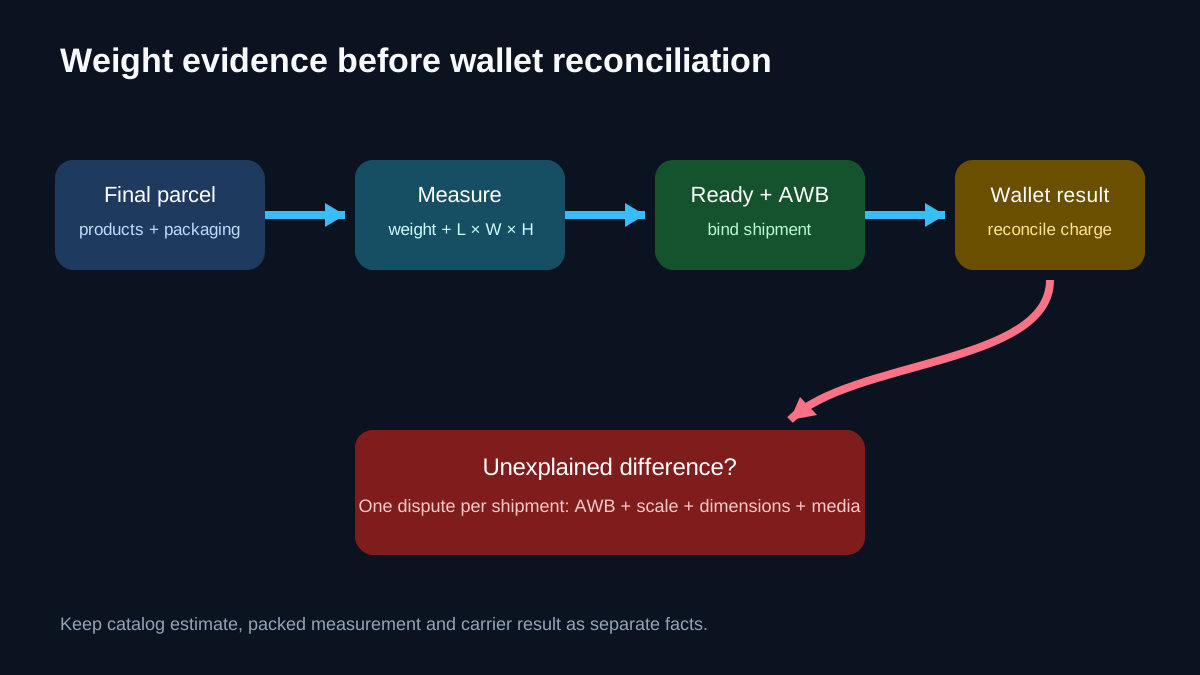
- Create and bind the shipment. After Ready, bind the resulting AWB, shipment and wallet transaction to the measurement record.
- Reconcile. Compare declared, carrier and charged values. Route differences beyond policy tolerance to review.
Reconciliation after Ready
Zid's shipment and transaction documentation describes the shipment tracking page and a transaction log containing shipping fees, weight-difference charges, payment status and wallet references. Polling every order continuously is unnecessary. Use supported order webhooks to trigger targeted work, then read authoritative shipment and transaction state.
A safe sequence is:
- receive and authenticate the relevant order-status webhook;
- deduplicate by event identity and order transition;
- enqueue a reconciliation job;
- fetch the current order and shipment state;
- match AWB, package count, currency and wallet reference;
- record the provider's result without deleting the packing measurement;
- open a review task when a weight-difference transaction appears.
Webhooks are delivery signals, not the final accounting authority. A retry may arrive, events can be delayed, and a provider may update a transaction after the status event. Schedule a bounded daily reconciliation for recent shipments.
Decision table
| Condition | Action | Evidence to retain |
|---|---|---|
| Packed measurement agrees with catalog estimate | Proceed to Ready | Measurement, rate rule and media hashes |
| Volumetric weight exceeds actual weight | Price and reserve using volumetric value | Dimensions, factor source and calculation |
| Carrier reports a higher value | Reconcile the wallet transaction | Carrier result, wallet reference and original evidence |
| Difference is explainable by rate or rounding | Close with a reason code | Contract version and calculation trace |
| Difference is not explainable | Prepare one dispute for that shipment | Order/AWB, scale photo, three dimensions and explanation |
| Evidence is incomplete | Escalate internally; do not fabricate it | Missing-evidence reason and operator record |
| Delivery is near the documented deadline | Prioritize review immediately | delivered_at and deadline timestamp |
Dispute workflow
The current Zid guide asks for the order number or AWB, actual weight, all three dimensions, a clear scale photo, dimension photos or a video, and an explanation. It also says each shipment needs a separate dispute and that acceptance does not guarantee a refund.
Build a case state machine:
detected → evidence_ready → submitted → under_review
         → needs_information → accepted | rejected | expired
Store the submitted bundle hash and timestamp. If support asks for more information, append a new evidence event. Do not replace the original photos, because the ability to show what was submitted matters.
Architecture example
Use five components:
- catalog/PIM: estimate weights and dimensions;
- packing station: capture final measurements and media;
- rate-policy service: version factors, allowances and rounding rules;
- shipment ledger: bind order, packages, AWB, provider measurement and wallet transaction;
- exception queue: manage dispute deadlines and outcomes.
A shipping integration should use scoped authorization and the supported two-way API/webhook flow described by the Zid shipping integration guide. Keep merchant credentials out of photos, logs and case descriptions.
Best practices
- Measure the final carton, not loose products.
- Store units explicitly and decimals as strings or fixed-precision values.
- Version every factor and rate rule by carrier service and date.
- Hash evidence files and keep originals read-only.
- Calibrate scales and record the calibration identity.
- Link every wallet deduction to a shipment and AWB.
- Reconcile recent shipments even when no webhook arrives.
- Start the dispute timer from the documented delivery event.
- Redact customer personal data from unnecessary support artifacts.
- Track root causes: catalog, packaging, factor, carrier measurement or integration.
Anti-patterns
- Hard-coding 4,000 for every domestic carrier forever.
- Treating product weight as final packed weight.
- Taking photos only after a charge appears.
- Mutating the original measurement to match the carrier.
- Combining several shipments into one dispute.
- Retrying a status write blindly after an unknown outcome.
- Assuming a submitted dispute guarantees a refund.
- Logging access tokens, addresses or full customer records with evidence.
Limits
Zid's help pages describe the current dashboard and support process, but carrier contracts, factors, rounding and rate cards can vary. The exact API visibility of a carrier measurement or wallet charge depends on the product and integration available to the merchant. Where an API field is unavailable, the system should flag a manual reconciliation step instead of scraping protected pages or inventing data.
Executive checklist
- Capture final packed weight and dimensions before Ready.
- Resolve the carrier-service factor and rate version.
- Store immutable media and calculation evidence.
- Bind the measurement to AWB, shipment and wallet reference.
- Reconcile weight-difference transactions after Ready.
- File one complete dispute per shipment within the documented window.
- Use results to fix catalog, packaging and rate policies.
For adjacent workflows, see Zid reverse orders: reconcile refunds, returns and stock, Salla shipment pickup time: make the handoff auditable, and Salla order stock relocation. Explore the wider engineering topics hub.
References
- Zid — How to calculate and dispute additional weight charges
- Zid — Shipping method details and customer rates
- Zid — Shipment tracking and transactions
- Zid Docs — Create Order schema
- Zid Docs — Webhook events
- Zid Partners — Integrating shipping systems with Zid
- Jeuwre — Measuring a parcel on a scale, CC BY-SA 4.0, Wikimedia Commons
Prepared by: Noor Yasser
Official references
These references document the tools discussed. Examples and design decisions are illustrative and should be adapted to the project and its versions.
- Zid — How to Calculate and Dispute Additional Weight Charges
- Zid — Shipping Method Details and Customer Rates
- Zid — Shipment Tracking and Transactions
- Zid Docs — Create Order
- Zid Docs — Webhooks
- Zid Partners — Integrating Shipping Systems with Zid
- Wikimedia Commons — Measuring weight with a kitchen scale, Jeuwre, CC BY-SA 4.0
Prepared by: Noor Yasser
Working through a similar engineering challenge?
I help teams turn architecture decisions into a clear scope and dependable, reviewable implementation.