Saudi Arabia's Tap to Pay on iPhone announcement matters because it can turn a compatible iPhone into an attended contactless acceptance device, but it does not turn a commerce app into a payment processor. The safe architecture keeps five boundaries explicit: the merchant app creates a business payment intent, Apple's reader framework handles the tap, an approved payment service provider (PSP) and acquirer process the transaction, the backend owns state and reconciliation, and the commerce platform advances an order only from verified payment evidence.
This is a practical explainer, not launch news. On September 17, 2026, the Saudi Central Bank announced that Tap to Pay on iPhone would be available in Saudi Arabia “soon,” with support expected for mada cards, other contactless cards and digital wallets on compatible iPhones. The announcement did not publish a launch date, a final PSP list or an integration contract. Teams should confirm current regional and provider availability before committing a merchant rollout.
Answer first
Build Tap to Pay as one channel inside a server-owned payment state machine:
- create an immutable payment intent from the authoritative order total;
- bind one logical attempt to the merchant, store, operator, device and PSP;
- let the supported PSP configuration and Apple's ProximityReader flow collect the contactless presentation;
- send the provider result to the backend, but treat a timeout as unknown, not failed;
- verify final status through signed webhooks or an authenticated provider read-back;
- move the order to paid only from verified evidence;
- reconcile authorization, capture, settlement, refund and chargeback records independently.
The iPhone screen is a payment acceptance surface. It must not become the source of truth for money or order state.
What the official sources establish
SAMA's September 17 announcement says compatible iPhones will be able to accept contactless mada cards, other contactless cards and digital wallets through NFC. It places the capability within Saudi Arabia's payment infrastructure and notes that SAMA introduced Software Point of Sale (SoftPOS) in 2021.
The mada overview describes mada Atheer as NFC-based contactless payment and documents an existing phone-based POS service on Android devices. That is context for Saudi SoftPOS evolution; it is not proof that every Android SoftPOS integration or merchant contract automatically transfers to Apple's product.
Apple's developer overview says an app developer must work with a supported PSP in the target region, request the Tap to Pay on iPhone entitlement, integrate ProximityReader or the PSP's API, follow the Human Interface Guidelines and submit the app for review. Apple's ProximityReader documentation says the PSP provides the certified terminal workflow and processes the financial transaction.
Apple states that Tap to Pay transactions are encrypted and processed using the Secure Element and that Apple does not know what is purchased or who buys it. That is a documented vendor security claim, not a substitute for reviewing the PSP's architecture, the merchant's backend, logs, permissions and settlement controls.
The PCI Security Standards Council's Mobile Payments on COTS standard covers secure acceptance on commercial off-the-shelf devices and builds on CPoC and SPoC. Engineering teams should obtain the applicable compliance and certification evidence from the PSP; they should not describe an uncertified custom NFC flow as equivalent.
SAMA's rules for payment technical service providers distinguish technical linking and support from regulated activities such as contracting with merchants, merchant verification and KYC/AML responsibilities. The exact legal classification depends on the service and contract. This article is an engineering design, not legal advice.
Separate the five ownership boundaries
| Boundary | Owns | Must not own |
|---|---|---|
| Merchant app | amount display, operator flow, reader session, receipt handoff | authoritative paid state, raw card data, settlement truth |
| Apple reader layer | contactless presentation and approved device experience | merchant onboarding, order lifecycle, refunds |
| PSP/acquirer | merchant configuration, authorization processing, provider references, settlement evidence | product inventory or fulfillment decisions |
| Commerce backend | intent, idempotency, order linkage, verified status, ledger and reconciliation | card-reading implementation or simulated approvals |
| Salla, Zid or ERP projection | downstream order and fulfillment state | replacing the PSP as the financial source of truth |
A PSP SDK may combine several technical steps, but the conceptual boundaries remain useful during failures and audits. If the SDK reports “success” and the backend never records a verified provider reference, the sale is not safely complete.
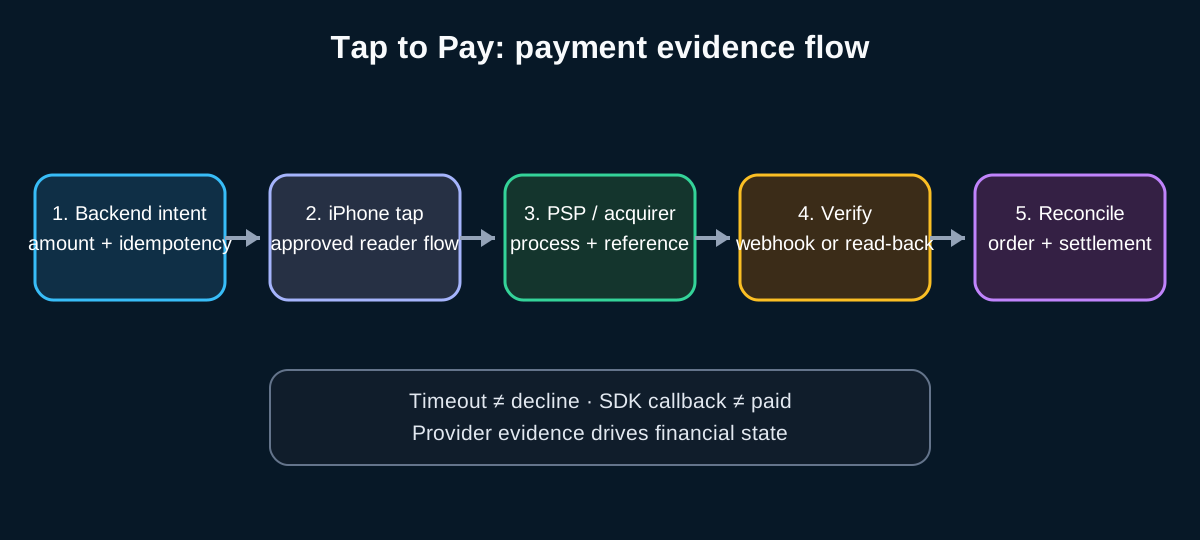
Use a state machine, not one boolean
A generic internal model can use these states:
created: the backend accepted the amount and currency.reader_ready: the device and PSP session are prepared.presented: a card or wallet was presented.processing: the PSP has not returned a terminal outcome.authorized,declinedorunknown: the immediate outcome.captured: funds are captured when the provider exposes a separate capture step.settled: the PSP or acquirer included the transaction in settlement.partially_refundedorrefunded: a verified refund changed the net value.disputed: a later dispute or chargeback entered the financial lifecycle.
Do not force every PSP into separate authorization and capture if its contract does not expose both. Store provider-native status plus your normalized status and the mapping version. The mapping is a versioned business contract, not a hard-coded switch hidden in a mobile app.
Create a durable payment intent
The backend should calculate the final amount in integer minor units, never a floating-point number. Include taxes, discounts, tips and rounding before the reader session begins.
A minimal internal record:
{
  "payment_intent_id": "pay_01J...",
  "order_id": "ord_98142",
  "merchant_id": "m_204",
  "store_id": "store_riyadh_07",
  "amount_minor": 18750,
  "currency": "SAR",
  "channel": "tap_to_pay_iphone",
  "provider": "approved_psp",
  "status": "created",
  "policy_version": "in_person_payments_v3"
}
Issue a short-lived client token or session reference that reveals only what the device needs. The device may display the amount, but it cannot change the signed or server-resolved amount. If the cart changes, invalidate the old intent and create a new one; do not silently reuse a reader session with a different total.
Idempotency for attempts and retries
Separate the logical payment intent from each attempt. A declined card can lead to another attempt. A timeout should first lead to status recovery, not an automatic second charge.
Store:
payment_intent_idfor the business obligation;attempt_idfor one PSP transaction;- a stable idempotency key for safe retries of that attempt;
- the provider transaction reference when received;
- device, operator and PSP configuration identifiers;
- request and response timestamps;
- the last verified provider status and its source.
If the app loses connectivity after the customer taps, show “checking payment” rather than “failed.” Query the backend. The backend should read the provider status or wait for a verified event. Create a new attempt only after the previous one is terminal or an authorized operator resolves the ambiguity.
Webhooks and read-back confirmation
Treat webhooks as authenticated observations, not commands to trust blindly:
- verify the provider signature and timestamp;
- store the raw event in a durable inbox before processing;
- deduplicate on the provider event ID;
- process idempotently inside a transaction;
- compare merchant, amount, currency and transaction references with the local intent;
- for high-impact or ambiguous transitions, fetch current status from the provider;
- append a ledger entry and then update the order projection.
Webhooks can arrive twice, out of order or after the app has closed. A periodic reconciliation job should compare nonterminal attempts and daily settlement data with the backend ledger. The mobile process is not the recovery mechanism.
Online, offline and unknown outcomes
Apple's platform security guide says Tap to Pay can be configured for Store and Forward in limited-connectivity use cases. Availability and risk rules depend on the PSP and configuration. Do not implement a local “offline approved” flag yourself.
Use a decision table:
| Condition | Device message | Backend action |
|---|---|---|
| PSP returns verified approval | Payment accepted | Record reference; wait for required capture/settlement stages |
| PSP returns verified decline | Payment declined | Close the attempt; allow a new method or attempt |
| Network breaks after tap | Checking payment | Mark unknown; recover through provider status or webhook |
| Provider permits Store and Forward | Accepted for forwarding, wording agreed with PSP | Keep a separate pending-risk state until provider confirmation |
| App crashes before receipt | Recovering receipt | Read backend state; never re-charge merely to print again |
| Duplicate event arrives | No customer-visible change | Deduplicate and retain audit evidence |
“Accepted for forwarding” is not identical to settled funds. Product copy, fulfillment policy and staff training must reflect that distinction.
Device, merchant and operator controls
Tap to Pay is an attended payment channel, so identity has several layers:
- onboard the merchant through the PSP's approved process;
- bind the app session to the correct merchant and store;
- authenticate the staff operator and apply refund/void permissions separately;
- record the device model, OS, app version and PSP configuration reference;
- enforce minimum supported versions from Apple and the PSP;
- expire reader sessions quickly and revoke lost or retired devices;
- use enterprise device management where appropriate, while preserving the PSP's own integrity controls.
The first-use flow may require accepting Tap to Pay terms. Apple documents enterprise options for administrator acceptance in supported scenarios. Do not automate acceptance by impersonating the merchant or bypassing the approved onboarding flow.
Receipts, orders and fulfillment
A receipt should reference the backend payment record, not display or store sensitive card data. Include merchant identity, store, time, amount, currency, payment channel, masked provider descriptor when permitted and a support reference.
Keep three ledgers separate:
- Payment ledger: provider references, states, net amounts, fees, refunds and settlement.
- Order ledger: products, tax, discounts, fulfillment and cancellation.
- Inventory ledger: reservations, releases and physical stock movement.
When a payment becomes verified, emit an internal payment.confirmed event. The Salla, Zid or ERP connector consumes it idempotently and advances the order according to its own contract. If platform update fails, do not reverse a valid payment automatically; queue reconciliation and give operations a visible exception.
Refunds and cancellations
Refunds must originate from an authorized backend command with:
- original provider transaction reference;
- requested amount in minor units;
- reason and operator;
- idempotency key;
- remaining refundable amount;
- provider response and later verification.
Handle partial refunds, duplicated commands and unknown responses. Read back the provider state before retrying an ambiguous refund. An order cancellation is not proof of refund, and a refund request is not proof that funds reached the customer.
Payment and loyalty are different contracts
Apple documents that Tap to Pay on iPhone can also read eligible NFC loyalty passes independently or alongside payment. Keep loyalty identity and payment authorization separated in your model:
- do not use a loyalty pass identifier as a payment credential;
- apply points only after verified payment;
- reverse points through a ledger when a refund becomes verified;
- obtain clear consent before linking a customer profile to an in-person transaction;
- allow payment without forcing enrollment.
This avoids turning a convenient tap into an undeclared identity or marketing capture flow.
Failure and security tests
Before rollout, exercise at least:
| Test | Required evidence |
|---|---|
| Same attempt retried after client timeout | One provider transaction or a recovered terminal state |
| Duplicate and reordered webhooks | One ledger transition; later stale event cannot regress state |
| App terminated after tap | Backend recovers status; reopening does not create a second charge |
| Amount changed after reader preparation | Old intent is rejected; a new signed amount is required |
| Wrong merchant or store configuration | Session fails closed; no cross-merchant transaction |
| Refund timeout | Read-back prevents duplicate refund |
| Device revoked or app outdated | Reader session cannot begin |
| Logs and analytics export | No PAN, track data, cryptogram or sensitive SDK payload is retained |
| Settlement mismatch | Exception is visible, assigned and reconcilable |
| Platform API unavailable | Payment remains valid; order projection retries safely |
Test provider sandbox and production certification paths exactly as the PSP documents. A simulator cannot prove device eligibility, contactless behavior, merchant configuration or settlement.
Best practices
- Keep the PSP/acquirer as the authority for financial status.
- Keep amount calculation and paid-state transitions on the backend.
- Represent unknown outcomes explicitly.
- Use durable inbox/outbox patterns for provider events and platform updates.
- Reconcile nonterminal attempts and settlement every day.
- Pin status mappings and provider contracts by version.
- Give operators separate sale, refund and administrative permissions.
- Design Arabic and English customer messages for every terminal and ambiguous state.
- Measure authorization latency, unknown-outcome recovery time, duplicate-event rate and reconciliation backlog.
Anti-patterns and limits
Avoid marking an order paid from an SDK callback alone; regenerating an idempotency key on every retry; treating a timeout as a decline; storing card data in logs; letting a mobile app calculate discounts; coupling payment success directly to one Salla or Zid API call; or assuming “no additional terminal” means no PSP, acquiring, certification or compliance work.
SAMA's announcement confirms direction and expected card/wallet support, not a universal production date. Apple's global documentation describes platform capabilities, not a guarantee that a specific Saudi PSP, device, iOS release or merchant category is supported. Provider contracts, mada requirements and SAMA obligations remain controlling for the actual deployment.
Executive checklist
- [ ] Current Saudi availability and supported PSP are confirmed.
- [ ] Apple entitlement, app review and PSP certification paths are agreed.
- [ ] Merchant, store, operator and device identities are bound.
- [ ] Amounts use integer minor units and server authority.
- [ ] Payment intents and attempts have stable idempotency.
- [ ] Unknown outcomes recover before a new attempt is created.
- [ ] Signed webhooks enter a durable, deduplicated inbox.
- [ ] Provider read-back and settlement reconciliation are implemented.
- [ ] Order, payment and inventory ledgers remain separate.
- [ ] Refunds are idempotent and verified.
- [ ] Logs exclude sensitive payment data.
- [ ] Arabic and English receipt and failure flows are tested.
For adjacent commerce patterns, see Salla customer groups as checkout policy, Salla conditional webhooks with reconciliation, and Salla and Zid order status state machines. The e-commerce engineering hub groups related payment, order, inventory and integration guides.
References
- Saudi Central Bank: Tap to Pay on iPhone Launching Soon in Saudi Arabia
- SAMA: mada services and NFC contactless acceptance
- SAMA Rulebook: Rules for Dealing with E-Commerce Payment Service and Support Providers
- Apple Developer: Tap to Pay on iPhone
- Apple Developer: ProximityReader
- Apple Developer: Adding support for Tap to Pay on iPhone
- Apple Platform Security: Tap to Pay on iPhone security
- PCI SSC: Mobile Payments on COTS
- Havarhen, “iZettle chip and PIN payment terminal,” CC BY-SA 3.0, Wikimedia Commons
Prepared by: Noor Yasser
Official references
These references document the tools discussed. Examples and design decisions are illustrative and should be adapted to the project and its versions.
- Saudi Central Bank — Tap to Pay on iPhone Launching Soon in Saudi Arabia
- Saudi Central Bank — mada services and NFC contactless acceptance
- SAMA Rulebook — Rules for Dealing with E-Commerce Payment Service and Support Providers
- Apple Developer — Tap to Pay on iPhone
- Apple Developer — ProximityReader
- Apple Developer — Adding support for Tap to Pay on iPhone
- Apple Platform Security — Tap to Pay on iPhone security
- PCI Security Standards Council — Mobile Payments on COTS
- Wikimedia Commons — IZettle chip and PIN payment terminal
Prepared by: Noor Yasser
Working through a similar engineering challenge?
I help teams turn architecture decisions into a clear scope and dependable, reviewable implementation.