PostgreSQL autovacuum is the background maintenance system that reclaims dead tuple space for reuse, refreshes planner statistics, maintains the visibility map and prevents transaction ID wraparound. Production tuning should make vacuum start early enough on each high-churn table, then give workers enough throughput to finish before dead tuples accumulate again. The safest method is measurement-first, per-table tuning—not disabling autovacuum or copying one cluster-wide value.
This guide uses the current PostgreSQL 18 documentation, verified on 22 October 2026. Defaults and documented behavior below are PostgreSQL facts; thresholds, alerts and rollout steps labelled as recommendations are an engineering starting point and must be tested against your workload, storage and supported PostgreSQL version.
Why dead tuples become a reliability problem
PostgreSQL uses MVCC, so UPDATE and DELETE normally leave old row versions until no transaction can see them. Standard VACUUM removes those dead versions from tables and indexes and marks their space reusable. It usually does not return space to the operating system, but frequent vacuuming keeps the relation near a steady-state size and reduces the need for disruptive rewrites.
The routine vacuuming documentation lists four responsibilities: reuse space from changed rows, update planner statistics, update the visibility map for index-only scans, and protect against transaction and multixact ID wraparound. A lagging autovacuum can therefore appear as several symptoms: table and index growth, slower scans, stale plans, fewer index-only scans, higher write amplification and an emergency anti-wraparound vacuum.
Do not equate dead-tuple estimates with bytes of recoverable disk. n_dead_tup is an estimate, standard VACUUM makes space reusable inside the relation, and index structure has its own behavior. Measure relation size and workload latency alongside tuple statistics. A table that grew after a one-time purge may need a controlled rewrite; a table with continuous churn usually needs earlier routine vacuuming.
Understand the trigger before changing it
For updates and deletes, autovacuum becomes eligible when changed tuples exceed a base threshold plus a fraction of the table. In simplified form:
vacuum trigger = autovacuum_vacuum_threshold
               + autovacuum_vacuum_scale_factor × estimated table rows
PostgreSQL 18 documents defaults of 50 tuples and 0.2 respectively, with a default maximum trigger of 100,000,000 tuples. At the defaults, a table estimated at 100 million rows can wait for roughly 20 million changes. That may be unsuitable for a hot table even though the same defaults are harmless for a small lookup table. PostgreSQL also has insert-based vacuum thresholds because insert-only tables still need freezing and visibility-map maintenance.
This is a trigger, not a completion guarantee. Eligible work can still wait for a worker, then take longer than the mutation rate permits. The vacuum configuration reference says the default maximum concurrent autovacuum workers is three, while worker slots and maximum workers are separate controls in PostgreSQL 18. More workers increase concurrency but can also raise aggregate I/O and memory demand.
Prefer table storage parameters for exceptional tables. Lower a hot table's scale factor and set a deliberate threshold without making every small table wake too often:
ALTER TABLE public.orders SET (
  autovacuum_vacuum_scale_factor = 0.02,
  autovacuum_vacuum_threshold = 5000,
  autovacuum_analyze_scale_factor = 0.01,
  autovacuum_analyze_threshold = 2500
);
These values are examples, not universal targets. Estimate how many rows can change during the time required to vacuum the table, then choose a trigger that leaves completion headroom. Revisit the settings as row count, update rate, indexes and storage change.
Build a baseline from PostgreSQL statistics
Start with a ranked inventory rather than a configuration change. The cumulative statistics system exposes estimated live and dead tuples, vacuum counts and timestamps. Statistics can lag and may be cached for the current transaction, so sample them consistently and compare time windows rather than treating one query as exact truth.
SELECT schemaname, relname,
       n_live_tup, n_dead_tup,
       last_autovacuum, autovacuum_count,
       last_autoanalyze, autoanalyze_count
FROM pg_stat_user_tables
ORDER BY n_dead_tup DESC
LIMIT 25;
Join the inventory with pg_total_relation_size, change rate and user-facing latency. Track the ratio of dead to live tuples, the time since successful autovacuum, bytes per relation, WAL volume and storage latency. Look for sustained trends: a rising dead-tuple slope after every cycle implies workers are starting too late, moving too slowly or being prevented from removing versions.
While a vacuum is active, pg_stat_progress_vacuum reports its phase and block progress. PostgreSQL's progress reporting also exposes delay time when cost-delay timing is enabled. Use this to separate “not scheduled,” “waiting for capacity,” “scanning slowly” and “blocked from cleanup.” The absence of a row only means no supported VACUUM is currently reporting progress; it does not prove maintenance is healthy.
Check long-running transactions and idle-in-transaction sessions because an old snapshot can keep tuple versions visible. Inspect replication slots and replicas as well: retention can be driven by consumers that are not advancing. Fix the retention cause before repeatedly vacuuming the same table.
Protect against transaction ID wraparound
Wraparound prevention is a correctness boundary, not a capacity preference. PostgreSQL tracks the oldest unfrozen transaction ID for each relation in pg_class.relfrozenxid. When its age approaches autovacuum_freeze_max_age, the system forces an anti-wraparound vacuum; PostgreSQL documents a default of 200 million transactions and states that wraparound protection launches workers even if ordinary autovacuum is disabled.
Monitor age(datfrozenxid) per database and age(relfrozenxid) for the oldest relations. Alert on remaining headroom and consumption velocity, not just a static age. A busy cluster can burn through millions of transaction IDs much faster during an incident or batch workload.
Do not cancel anti-wraparound workers to reduce load without understanding the remaining margin. If PostgreSQL cannot advance freezing, it will eventually protect data by refusing writes. Reserve I/O and operational attention before the system reaches that emergency. Large insert-only and append-heavy tables still need freezing even when n_dead_tup is low.
Tune throughput without creating an I/O storm
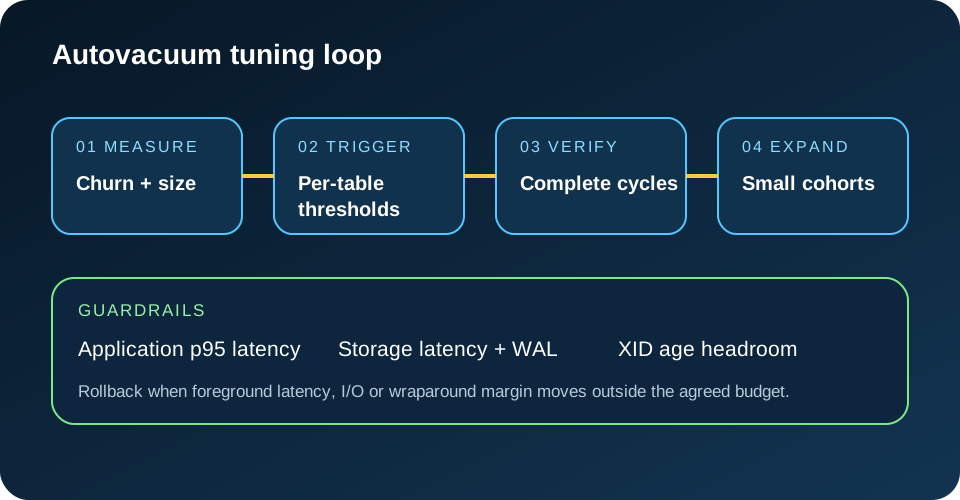
Use a controlled sequence. First lower the trigger on the few tables whose dead tuples grow between cycles. Then observe whether vacuum finishes within the required window. Only after that consider global worker count or cost-based delay.
Cost-based vacuum delay intentionally sleeps after accumulated work crosses a limit. Raising throughput can shorten a vacuum but compete with foreground reads and writes. Increasing workers can improve parallel progress across tables while multiplying I/O. Changes therefore need storage-latency, CPU, WAL and query-latency guardrails.
A practical rollout is:
- capture a seven-day baseline for top churn tables and transaction-age headroom;
- change one table or a small cohort with ALTER TABLE storage parameters;
- observe at least several complete vacuum cycles and peak traffic;
- compare completion time, dead-tuple slope, table and index growth, storage latency and p95 application latency;
- expand only if guardrails stay healthy, and keep the previous parameters ready for rollback.
Partitioning can reduce maintenance scope when the data model already has a lifecycle boundary, but it is not a repair for poor autovacuum settings. Each partition becomes its own relation and must be monitored. Dropping an expired partition can be efficient; creating thousands of tiny partitions introduces planning and operational cost.
Choose the right maintenance action
Use routine autovacuum for ongoing churn. Run manual VACUUM when you need a targeted catch-up, a controlled maintenance window or verification with explicit options. Manual work should supplement the daemon, not silently create two competing schedules.
Use VACUUM (ANALYZE) when both dead-space reuse and current planner statistics matter. Use ANALYZE alone when data distribution changed but dead tuples are not the problem. Use REINDEX or its concurrent form only after evidence points to an index-specific issue; table vacuuming and index reconstruction solve different problems.
VACUUM FULL rewrites the table, needs extra disk space and takes an ACCESS EXCLUSIVE lock. PostgreSQL's documentation recommends frequent standard VACUUM instead of relying on VACUUM FULL. Reserve a rewrite for exceptional reclamation where returning space to the operating system justifies the lock, time, extra space and rollback plan.
Never disable autovacuum cluster-wide as a performance fix. Do not set an extremely low scale factor everywhere without calculating wake-up frequency. Do not tune from n_dead_tup alone, kill workers reflexively, ignore idle transactions or claim success because one manual VACUUM completed.
Production checklist
Inventory the largest and highest-churn relations. Record current per-table overrides before changing them. Set earlier triggers for tables whose mutation volume outgrows the default formula. Confirm enough worker capacity and I/O headroom to finish. Monitor active progress, historical cycles, relation size, foreground latency, old snapshots, replication retention and transaction-age headroom.
The desired state is not “zero dead tuples.” It is a bounded maintenance loop: dead versions accumulate within a known budget, vacuum starts with enough headroom, it completes faster than new debt is created, planner and visibility data remain useful, and wraparound age stays far from the emergency boundary. That is the point at which autovacuum becomes a reliability control rather than a background process operators notice only during an incident.
Official references
These references document the tools discussed. Examples and design decisions are illustrative and should be adapted to the project and its versions.
Prepared by: Noor Yasser
Working through a similar engineering challenge?
I help teams turn architecture decisions into a clear scope and dependable, reviewable implementation.