NGINX Open Source 1.30.6 stable and 1.31.7 mainline, released on October 14, 2026, fix five security issues across URI rewriting, script evaluation, HTTP/3 request bodies, TLS session tickets and asynchronous file I/O. The operational answer is not to patch only the visibly exposed feature: inventory the binary and build flags, inspect the effective configuration, upgrade every serving instance to a fixed upstream or vendor-backed build, canary under real protocol traffic, and verify the fleet from outside the load balancer.
This is a defensive patch guide based on NGINX's official security page, release news and Community Blog, checked on October 26, 2026. NGINX classifies all five issues as medium severity. That vendor severity is a documented fact; priority inside a specific environment is an engineering decision shaped by Internet exposure, enabled modules, configuration and the consequences of a worker crash, request injection or session forgery. The official pages cited here do not claim broad exploitation in the wild, so this guide does not treat scanning attempts or theoretical reachability as confirmed compromise.
The answer first
For upstream NGINX Open Source, move stable deployments to 1.30.6 or later and mainline deployments to 1.31.7 or later. Mainline 1.31.8, released October 21, is also beyond the fixed boundary. If a distribution or appliance backports fixes without changing the upstream-looking version, use its security advisory and package revision as the authority rather than rejecting a fixed vendor build on the version string alone.
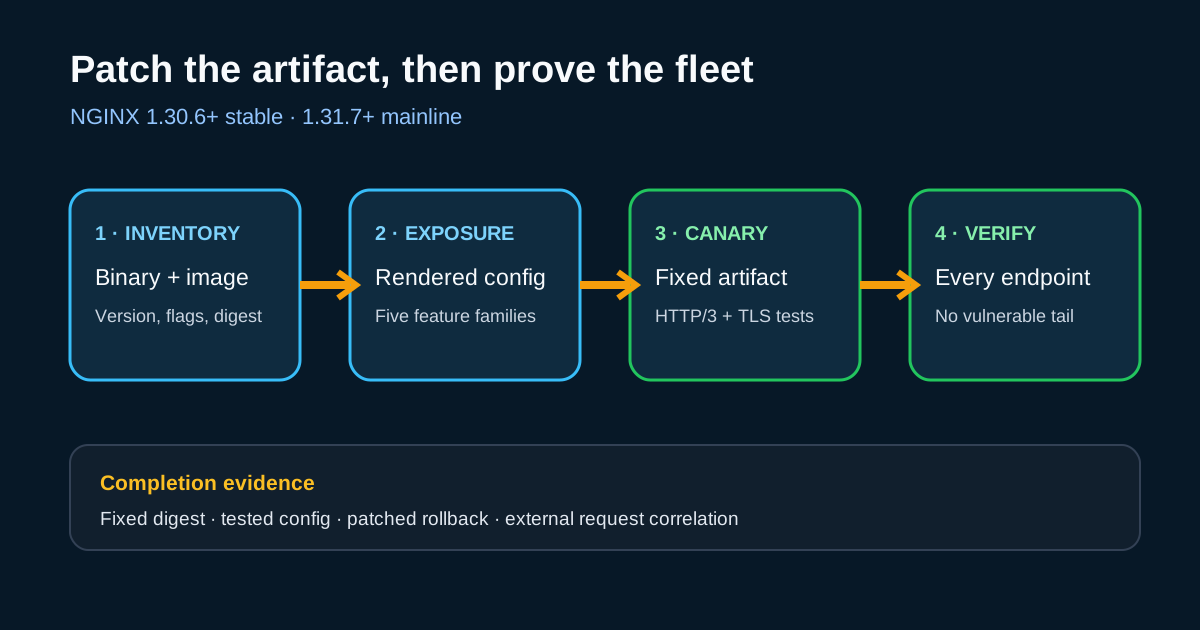
A safe response has five gates: prove which binary actually serves traffic; map feature exposure from rendered configuration and build flags; build or install a fixed artifact; canary with the protocols the service offers; and record external evidence that every endpoint now uses the intended artifact.
What the October 14 release fixed
| Issue | Official vulnerable range | Fixed upstream boundary | Exposure clue to investigate |
|---|---|---|---|
| CVE-2026-15176, buffer overflow using alias with rewrite | 0.1.29–1.31.6 | 1.30.6+ or 1.31.7+ | locations combining alias and rewrite logic |
| CVE-2026-93479, buffer overflow in script evaluation | 1.30.0–1.30.5 and 1.31.2–1.31.6 | 1.30.6+ or 1.31.7+ | string expressions containing variables |
| CVE-2026-95101, request body injection in HTTP/3 | 1.25.0–1.31.6 | 1.30.6+ or 1.31.7+ | QUIC listeners and proxied request bodies |
| CVE-2026-97629, session forgery with TLS session tickets | 1.23.2–1.31.6 | 1.30.6+ or 1.31.7+ | TLS session tickets and shared or rotated ticket keys |
| CVE-2026-97205, use-after-free with asynchronous file I/O | 0.8.11–1.31.6 | 1.30.6+ or 1.31.7+ | AIO together with SSI processing |
The table states NGINX's published ranges and issue names. The final column is an operator discovery checklist, not proof that a configuration is exploitable. Do not postpone the supported update because a quick search finds no match: includes, templates, generated configuration, ingress controllers and vendor defaults can make the effective configuration different from the fragment being reviewed.
Inventory the artifact that serves traffic
Start with the process and image actually receiving requests, not the package declaration in infrastructure code.
nginx -v
nginx -V 2>&1
nginx -T 2>&1 > /tmp/nginx-effective.conf
sha256sum "$(command -v nginx)"
The version command identifies the upstream release label. Capital-V shows compiler arguments and compiled modules. Capital-T tests and prints the full configuration including includes, which is the right material for a controlled exposure review. Protect that output: it can contain internal hostnames, certificate paths and other sensitive operational data.
In containers, capture the immutable image digest as well as the binary digest. In Kubernetes, query every workload and DaemonSet that can terminate or proxy HTTP, not only the deployment named nginx. Check ingress controllers, sidecars, API gateways, caching tiers, base images and maintenance hosts. A fleet is patched only when the old artifact cannot receive traffic after rescheduling or rollback.
Useful evidence includes endpoint, workload, image digest, NGINX version, binary digest, package revision, effective-config digest and observation time. Do not infer a vendor package's status only from nginx -v; record the vendor advisory and exact package revision proving the backport.
Map exposure without treating it as a patch substitute
Review the effective configuration through a read-only workflow:
grep -nE '(^|[[:space:]])(alias|rewrite|listen.*quic|ssl_session_ticket_key|aio|ssi)[[:space:]]' /tmp/nginx-effective.confFor CVE-2026-15176, prioritize locations where URI rewriting and alias path resolution interact. For CVE-2026-93479, inspect variable-bearing expressions generated by templates. For CVE-2026-95101, identify QUIC listeners, public HTTP/3 reachability and proxied request bodies. For CVE-2026-97629, inventory ticket configuration, shared key distribution and authentication decisions depending on the TLS session. For CVE-2026-97205, find AIO and SSI use, including inherited directives and generated includes.
This review sets rollout order and incident scope; it does not make an old binary safe. Configuration workarounds can regress during reload or template changes, while the fixed build removes the known flaw at its source.
Choose the fixed artifact
| Delivery model | Patch evidence |
|---|---|
| Upstream packages or source | NGINX 1.30.6 stable, 1.31.7 mainline or later |
| Linux distribution | vendor advisory plus exact fixed package revision |
| Container image | registry digest built from a fixed package, with SBOM or provenance |
| Managed appliance | vendor bulletin and installed firmware or build identifier |
| Kubernetes controller | controller release notes plus embedded NGINX version |
Do not copy a binary into an old container at runtime. Rebuild the image, pin the new digest, scan and attest it, then deploy through the normal release path. This keeps rollback and fleet reconciliation meaningful. If compiling from source, verify the download and signature, reproduce required modules and flags, and run the same functional and security checks. A binary that omits an expected module can fix the CVEs yet still break production.
Canary the upgrade
Before traffic, run syntax and configuration checks:
nginx -t
nginx -T > /secure-review/nginx-effective-after.conf
nginx -V 2>&1
Compare the before-and-after configuration semantically. A package upgrade can change defaults, module availability or TLS behavior even when local files are unchanged.
Route a bounded slice of traffic to the fixed artifact. Exercise ordinary HTTP/1.1 and HTTP/2 requests, uploads, redirects and aliased files; HTTP/3 and QUIC negotiation with request bodies when enabled; TLS full and resumed sessions; SSI and static-file reads when configured; upstream timeouts, headers and body streaming; and graceful reload, worker drain and rollback to another fixed artifact.
Monitor customer errors, upstream resets, worker exits, reload failures, latency, handshake failures and protocol-specific traffic. A clean nginx -t proves configuration syntax, not correct request routing, TLS resumption or HTTP/3 behavior.
Roll out without leaving a vulnerable tail
For virtual machines, replace packages by small failure domain and verify the running binary. For containers, roll to a pinned digest and prevent old ReplicaSets from receiving traffic. For node-local proxies, reconcile every node. For autoscaling groups, update the launch image before terminating the final old instance; otherwise scaling can recreate the vulnerable build.
| Gate | Evidence |
|---|---|
| Artifact | version, package or image digest and provenance |
| Configuration | tested effective-config digest |
| Canary | protocol tests and monitoring window |
| Fleet | every serving instance reports the fixed artifact |
| External | each public endpoint observed through the load balancer |
| Recovery | rollback target is also fixed |
A deployment is not complete when the new pods are Ready. It is complete when the old digest is absent from schedulable templates, running workloads, standby pools and rollback manifests.
Verify from outside the edge
External verification should prove behavior and artifact ownership without exposing a public diagnostic endpoint. Correlate a synthetic request ID with load-balancer and NGINX logs, then map the serving instance to its recorded binary or image digest.
Test every advertised protocol and hostname. Where HTTP/3 is enabled, confirm that the response actually negotiated HTTP/3 rather than silently falling back. Exercise a harmless body through the same proxy path used by uploads. For TLS resumption, compare a full handshake with a resumed session and confirm the intended authentication policy. Keep fleet attestations internal; exact version headers add reconnaissance value and are weaker than signed inventory evidence.
Incident review: attempt is not compromise
A vulnerable, exposed system deserves log and integrity review, but ordinary scans are not confirmed exploitation. Preserve load-balancer, WAF and NGINX logs; worker crashes, core dumps and restart history; configuration and image digests; ticket-key distribution records; upstream logs for body discrepancies; and deployment, scaling and rollback events.
A crash near a crafted request is evidence to investigate, not automatic proof of code execution. An unusual upstream body does not alone prove HTTP/3 injection. Correlate request ID, protocol, edge instance, upstream observation and process telemetry. If compromise indicators exist, rotate relevant secrets, replace instances from known-good images, scope downstream access and follow the incident-response plan. Patching stops known paths; it does not erase evidence or reverse a prior intrusion.
Best practices
- Patch to a fixed supported release even when the affected feature appears disabled.
- Treat rendered configuration and the live build as evidence, not repository intent.
- Pin images by digest and retain SBOM or provenance.
- Test HTTP/3 and TLS resumption explicitly when offered.
- Keep rollback artifacts patched and reconcile standby instances.
- Separate vendor facts from local risk analysis and incident conclusions.
Anti-patterns
- Checking only the version on an administrator laptop.
- Grepping one configuration file while ignoring includes and generated config.
- Treating a WAF rule or disabled feature as the permanent fix.
- Mutating a running container instead of deploying an immutable image.
- Declaring success when the first canary becomes Ready.
- Assuming a scan proves compromise, or no crash proves safety.
- Rejecting a distribution backport because the upstream label is unchanged.
Executive checklist
- Freeze endpoint and workload inventory.
- Capture version, flags, effective configuration and artifact digests.
- Map the five feature families and prioritize exposed edges.
- Select NGINX 1.30.6+, 1.31.7+ or a vendor-confirmed fixed build.
- Build and attest an immutable replacement.
- Run syntax, protocol, TLS and application tests.
- Canary, monitor and expand by failure domain.
- Remove the old artifact from workloads, templates and rollback paths.
- Verify every public endpoint and reconcile the fleet.
- Review evidence without conflating attempts with compromise.
Related reading: Apache Tomcat October 2026 security update, Node.js October 2026 security release, Kubernetes NetworkPolicy default-deny rollout, and the Cloud, DevOps & Kubernetes hub.
Primary references
- NGINX security advisories
- NGINX news: 1.30.6 stable and 1.31.7 mainline
- NGINX Community Blog: NGINX 1.31.7
- NGINX command-line parameters
- NGINX controlling processes
- NGINX HTTP/3 module
- Wikimedia Commons — Racks Amravati Data Center
- Creative Commons Attribution-ShareAlike 4.0
Official references
These references document the tools discussed. Examples and design decisions are illustrative and should be adapted to the project and its versions.
Prepared by: Noor Yasser
Working through a similar engineering challenge?
I help teams turn architecture decisions into a clear scope and dependable, reviewable implementation.