Kyverno 1.19.2 is the security baseline for the 1.19 release line. The maintainers say this release addresses 24 published GitHub Security Advisories: 9 Critical, 14 High and 1 Moderate. Several issues cross a Kubernetes namespace boundary by making a privileged Kyverno controller act on data supplied by a namespace-scoped policy author; others affect image verification, generated policies, wildcard or variable processing, and project automation.
Upgrade urgency is high when untrusted or semi-trusted tenants can create Kyverno policy objects. That condition is not proof of compromise, and the official material reviewed on November 6, 2026 does not establish active exploitation in customer clusters. Two advisories document successful reproductions against live test clusters; that is evidence that the paths were reachable, not evidence that your cluster was breached.
The vendor facts below come from the Kyverno release and project advisories. The inventory, containment, rollout and evidence plan is engineering guidance.
Answer first
Use this decision table before changing production:
| Observed state | Risk interpretation | Immediate action |
|---|---|---|
| Kyverno 1.19.1 or earlier and namespace users can create Policy or NamespacedMutatingPolicy objects | Critical privilege-escalation paths may be reachable | Restrict policy authorship, preserve evidence and upgrade to 1.19.2 |
| Kyverno before 1.19.2 with image verification, generated admission policies, generate rules or cleanup policies | Other high- or critical-severity advisory families may apply | Map enabled features and upgrade all controllers, not only admission |
| Kyverno 1.19.2 but old pods or rollback artifacts remain | The declared version is fixed, but the live fleet can still be mixed | Prove every image digest and remove vulnerable rollback targets |
| Kyverno is absent | These Kyverno advisories do not apply | Confirm the inventory; do not infer safety from a missing Helm release name |
The official v1.19.2 release was published on October 20, 2026 and directs users to upgrade for the listed fixes. The matching Helm chart is 3.9.2. Kyverno's upgrade documentation warns that an upgrade is not just an image-tag bump because supporting resources and CRDs can change.
What the security release fixes
The 24 advisories are best treated as security-boundary families rather than a flat CVE list:
| Family | What can cross the boundary | Example consequence |
|---|---|---|
| API path and namespace confinement | A namespaced policy influences a request executed by a privileged controller | Cross-namespace access or cluster-admin escalation |
| NamespacedMutatingPolicy target confinement | A tenant selects a target outside its namespace | Overwrite an existing resource in another namespace or at cluster scope |
| Image verification and attestation | Forged or incompletely verified state reaches an allow decision | Workload admission without the intended signature or attestation guarantee |
| Generated policy and PolicyException enforcement | Generator output does not preserve every exception gate | Broader policy bypass than the operator configured |
| Generate, clone and internal-label protections | Controller authorization or ownership assumptions are confused | Unauthorized generated resources or cross-namespace effects |
| Evaluation bounds and panic hardening | Crafted wildcard, variable or CEL work consumes excessive resources | Admission latency or denial of service |
| Project workflow hardening | Pull-request-controlled data reaches a privileged cherry-pick workflow | Credential exposure in the project CI context, not a runtime-cluster flaw |
This grouping matters. A cluster that never delegates policy creation may have a different exposure path than a multi-tenant platform, but it still needs the release because image verification, generation and availability issues have different prerequisites.
Two critical namespace-boundary examples
### Policy apiCall validates one path and executes another
The project advisory GHSA-3xfv-vq8x-qhg4 affects Kyverno up to 1.19.1 and is patched in 1.19.2. It says a namespace-scoped user with permission to create a namespaced Policy can hide traversal segments behind a URL fragment or query separator. Validation cleans one representation of the path, while the Kubernetes client executes the raw representation after discarding the fragment or query.
The resulting request runs with the admission controller's ServiceAccount. The advisory explains that this account can create cluster-scoped admission configuration and PolicyException objects, producing an effective cluster-admin path. The researchers verified the issue on a default Helm installation of Kyverno 1.19.1 in kind.
A related advisory, GHSA-39w8-hv5g-f73w, documents a malformed percent-escape variant in 1.19.1. The engineering lesson is broader than URL parsing: security checks and execution must operate on the same canonical representation.
### NamespacedMutatingPolicy can choose a foreign target
GHSA-jcw5-3wcg-fqx5 affects versions from 1.18.0 and is patched in 1.19.2. It describes a NamespacedMutatingPolicy with mutate-existing enabled that can fabricate a target object through a CEL expression. Without a per-target namespace and scope check, the background controller can write the result using its privileged ServiceAccount.
The important precondition is permission to create the namespaced policy resource. The impact can include overwriting existing Roles, RoleBindings, NetworkPolicies or ConfigMaps outside the attacker's namespace, depending on the controller's effective permissions. Test that precondition with your real RBAC model; do not assume that “namespace admin” means the same thing in every platform.
Inventory before containment
Create one evidence row per cluster:
{
  "cluster": "prod-eu-1",
  "install_method": "helm",
  "chart": "kyverno-3.9.1",
  "app_version": "1.19.1",
  "controllers": ["admission", "background", "cleanup", "reports"],
  "policy_authors": ["platform-team", "tenant-admins"],
  "namespaced_policy_types": ["Policy", "NamespacedMutatingPolicy"],
  "image_verification": true,
  "artifact_digests": ["sha256:..."],
  "rollback_revision": "42"
}
This is an inventory schema, not a Kyverno configuration file.
Collect evidence from the live cluster:
helm list -A | grep -i kyverno
kubectl api-resources | grep -i kyverno
kubectl -n kyverno get deploy,pod -o wide
kubectl -n kyverno get deploy -o jsonpath='{range .items[*]}{.metadata.name}{"\n"}{range .spec.template.spec.containers[*]}  {.name}{" "}{.image}{"\n"}{end}{end}'
kubectl get clusterrole,clusterrolebinding | grep -i kyverno
Then ask Kubernetes authorization directly for representative identities and the exact resource names returned by api-resources:
kubectl auth can-i create policies.kyverno.io --as=alice -n tenant-a
kubectl auth can-i create namespacedmutatingpolicies.policies.kyverno.io --as=alice -n tenant-a
Also inventory GitOps manifests, Helm values, CRD ownership, disaster-recovery clusters and autoscaling or rollback artifacts. A repository value saying 1.19.2 does not prove that every running controller uses it.
Contain without destroying evidence
If you cannot upgrade immediately:
- Remove or narrowly restrict untrusted create and update permissions for namespaced Kyverno policy types. Use the exact API resources installed in your cluster.
- Freeze new policy changes and review recently created or modified Policy, NamespacedMutatingPolicy, CleanupPolicy, PolicyException and image-verification objects.
- Preserve Kubernetes audit logs, Kyverno controller logs, admission decisions, GitOps history and controller image digests before rolling pods.
- Review API calls made by Kyverno controller ServiceAccounts for unexpected cross-namespace or cluster-scoped writes.
- Keep admission availability in mind. Do not delete webhooks or controllers blindly; an unplanned fail-open or fail-closed state can create a second incident.
These are risk-reduction measures, not a substitute for 1.19.2. If suspicious activity is found, follow your incident process and rotate affected credentials after preserving the evidence needed for scoping.
Upgrade Kyverno as a system
For Helm-managed installations, pin chart 3.9.2 or a later supported chart that carries Kyverno 1.19.2 or later. Export the current values and read the release notes before applying the change. Kyverno 1.19 introduces a dedicated kyverno-api chart dependency for CRDs, so teams that set crds.install=false or manage CRDs separately must update that workflow deliberately.
Run the change through a representative non-production cluster first:
- Back up Helm values, policy objects and CRD management configuration.
- Update the chart and CRDs using the supported installation method.
- Wait for every Kyverno deployment to complete its rollout; record the new image digests.
- Exercise positive and negative admission cases for validation, mutation, generation, image verification, exceptions and cleanup features you actually use.
- Test a tenant identity that should create a namespaced policy and one that should be denied. Verify that a namespaced policy cannot read or mutate another namespace.
- Promote by cluster cohort, monitor admission latency, rejection rate, controller errors and policy reports, and keep a fixed rollback decision window.
- Do not roll back to 1.19.1 or an earlier vulnerable artifact. If a functional regression blocks promotion, contain policy authorship and escalate to the vendor while preserving the fixed security boundary.
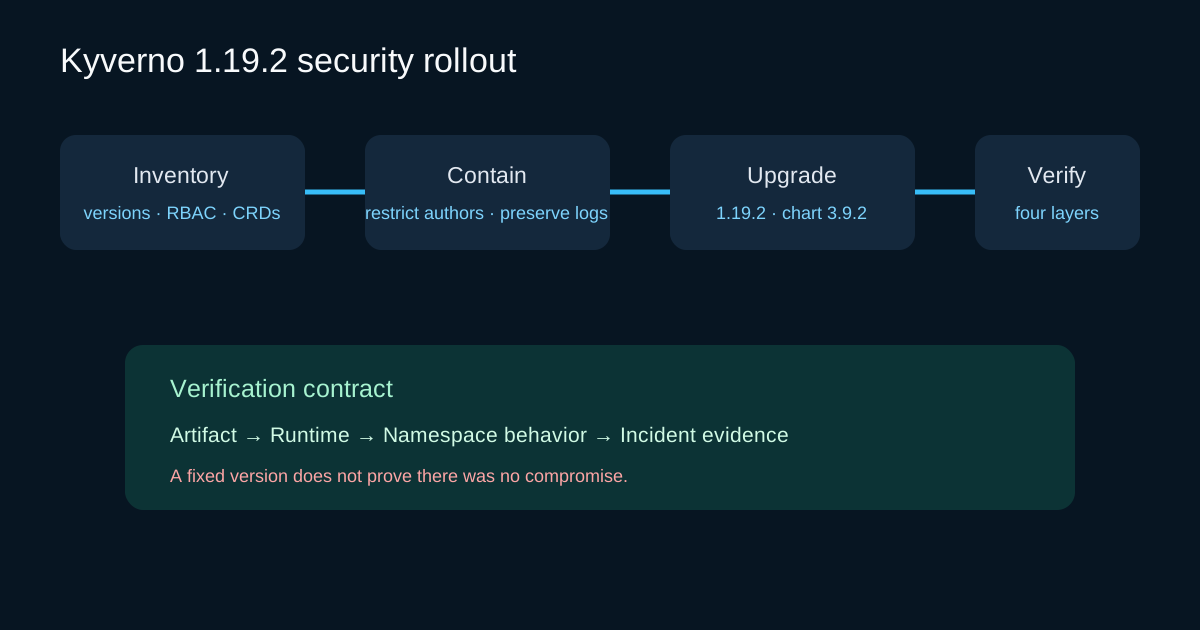
Verification contract
Call the deployment fixed only when all four layers pass:
- Artifact: every controller image resolves to the approved digest, and the Helm release or manifest matches the reviewed 1.19.2 configuration.
- Runtime: no old pod, node-local cache, dormant cluster, job or rollback revision can restart a vulnerable controller.
- Behavior: namespace-confined policy tests stay confined; image verification, exceptions, generation and cleanup still enforce intended policy.
- Evidence: audit and controller logs show no unexplained privileged calls during the review window.
Do not run public proof-of-concept payloads against production. Build a minimal negative test that proves a tenant cannot target another namespace, and execute it in an isolated cluster with representative RBAC.
Best practices, anti-patterns and limits
Best practices:
- Treat policy authoring as privileged code review, even for namespaced policy objects.
- Minimize each controller ServiceAccount and monitor changes to its aggregated roles.
- Pin images by digest and include every controller in the software inventory.
- Keep admission security tests beside policy-as-code changes.
- Separate a successful patch from a completed compromise assessment.
Avoid these anti-patterns:
- “We do not use ClusterPolicy, so a namespaced author cannot affect the cluster.”
- Upgrading only the admission controller while background or cleanup controllers remain old.
- Changing only an image tag without the chart, CRDs and supporting resources.
- Declaring compromise because a vulnerable version existed, or declaring safety because no alert fired.
- Disabling Kyverno globally without understanding webhook failure policy and admission dependencies.
Kyverno 1.19.2 closes the advisories listed in its release notes; it is not a universal proof that every custom policy, RBAC binding or external webhook is safe. Mixed controller versions, overprivileged ServiceAccounts and unreviewed policy logic remain operational risks.
Executive checklist
- Confirm whether Kyverno is installed and record every controller version and digest.
- Identify who can create or update namespaced Kyverno policy resources.
- Restrict risky authorship while preserving audit and controller evidence.
- Upgrade the complete installation to 1.19.2/chart 3.9.2 or a later supported fixed release.
- Test namespace confinement and each enabled policy family in a canary cluster.
- Remove vulnerable rollback artifacts and verify every live controller.
- Investigate evidence separately from patch status; do not infer active exploitation.
For adjacent hardening, see the Kubernetes certificate-rotation guide, the Next.js 16.4.1 security rollout and the ClickHouse critical RCE patch guide. Noor Yasser's cloud and performance engineering service covers production rollout design and observability.
References
- Kyverno v1.19.2 release notes
- Kyverno security advisories
- GHSA-3xfv-vq8x-qhg4: Policy apiCall privilege escalation
- GHSA-39w8-hv5g-f73w: malformed percent-escape bypass
- GHSA-jcw5-3wcg-fqx5: cross-namespace mutate-existing
- Kyverno upgrade documentation
- Cover photo and license record — Carl Lender, Wikimedia Commons.jpg)
Prepared by: Noor Yasser
Official references
These references document the tools discussed. Examples and design decisions are illustrative and should be adapted to the project and its versions.
Prepared by: Noor Yasser
Working through a similar engineering challenge?
I help teams turn architecture decisions into a clear scope and dependable, reviewable implementation.