
OpenAI released GPT-6.1 Sol on 29 September 2026 as an upgrade to GPT-6 Sol for coding, professional work and agentic workflows. The important developer story is not a single leaderboard position. It is the attempt to move near-Astra capability into the Sol price tier while cutting cached-input cost and adding Multi-agent support in beta.
OpenAI says the model approaches GPT-6 Astra on several internal or partner evaluations, with standard API pricing of $2 per million input tokens, $0.10 per million cached input tokens and $10 per million output tokens for prompts up to the pricing threshold described in the API changelog. Those are vendor-published results and prices, not a guarantee for a particular product. The right response is a measured migration, not a model-name replacement.
What actually changed
The official announcement describes GPT-6.1 Sol as a more capable Sol across agentic coding, computer use, professional documents, workflow automation, scientific tasks and factuality. OpenAI reports a 6.4-point improvement over GPT-6 Sol's best DeepSWE result, a seven-point improvement on the cited OSWorld setting, and lower factual-error incidence on its difficult internal evaluation at low reasoning effort.
The API changelog confirms the model ID as \u0060gpt-6.1-sol\u0060, support in Responses and Chat Completions, and Multi-agent in beta. OpenAI's model guidance still recommends the Responses API for reasoning with tools. Treat each capability separately: a coding gain does not prove better retrieval, Arabic writing, structured extraction or your own tools.
The economics are more than token prices
The headline standard prices match GPT-6 Sol for uncached input and output, while cached input falls from $0.20 to $0.10 per million tokens according to OpenAI. That matters for agents that repeatedly reuse a stable system prompt, policies, tool schemas or repository context. It matters much less when every request changes its prefix or when outputs dominate the bill.
Calculate cost per completed task, not cost per token. Include failed attempts, reasoning and output tokens, tool calls, cache writes, cache reads, retries and human review. The changelog qualifies its standard prices for prompts up to 272K input tokens, so long-context applications must check the current pricing table rather than extrapolating the headline.
Route workloads before choosing a default
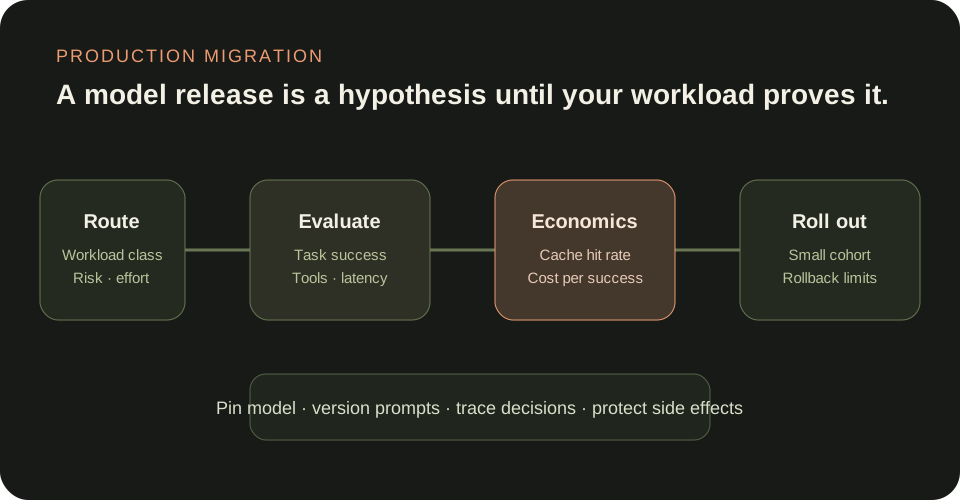
A useful migration begins by classifying production traffic. Keep a small, explicit routing table: repetitive classification and extraction, long-context review, multi-step coding, browser or computer use, and high-risk actions should not automatically share one model and effort setting.
Use GPT-6.1 Sol where stronger reasoning could remove retries or human correction. Keep a cheaper model for stable, narrow work that already meets its quality target. Reserve Astra for tasks where the additional capability changes the completion rate enough to justify its price. A single default hides these trade-offs and makes regressions difficult to diagnose.
Build a representative evaluation set
Start with anonymized production tasks and known failure cases. For a coding agent, measure whether the patch is correct, scoped, tested and mergeable. For a support or commerce agent, measure tool selection, argument validity, policy compliance, grounded answers and successful task completion. Include Arabic and English cases if the product serves both.
Run the same prompts, tools, reasoning effort and stopping rules against the current model and GPT-6.1 Sol. Record task success, latency distribution, total cost, tool-call count, retries and reviewer preference. OpenAI's benchmark claims help form hypotheses; your evaluation decides whether the migration works.
Test the API contract, not only answer quality
The model can support a feature while your current endpoint or parameters cannot. OpenAI's GPT-6 guidance says GPT-6 tool calling should use Responses and notes compatibility constraints around reasoning effort and sampling parameters. Validate streaming events, structured outputs, tool-call ordering, cancellations, timeouts and error handling with the exact SDK version used in production.
If you test Multi-agent beta, define what may be delegated, the maximum depth and parallelism, a shared cost budget and how subagent results are verified. Beta capability is not an architecture. Your application still owns authorization, tenant isolation, idempotency and the decision to commit an external side effect.
Measure cache behavior explicitly
A cheaper cached-input rate creates value only when requests actually hit the cache. Keep stable instructions and tool schemas in a reusable prefix, move volatile user data later, and monitor cached versus uncached tokens. A prompt refactor that improves readability but changes the prefix on every call can erase the expected saving.
Compare at least three numbers: cache hit rate, cost per successful task and latency to the first useful result. Also test whether changing reasoning effort or tool availability preserves the intended cache path in your implementation. Do not budget from the best-case discount alone.
Roll out with a reversible contract
Start with shadow evaluations or an internal cohort, then send a small percentage of eligible traffic to GPT-6.1 Sol. Pin the model ID rather than relying on an alias whose target may change. Define rollback thresholds for task failure, invalid tool calls, latency, cost and safety incidents before expanding exposure.
Log the selected model, effort, prompt version, tool version and evaluation cohort with each trace. Avoid logging sensitive prompts or credentials. If the new model changes output length or tool behavior, update budgets and timeouts deliberately instead of masking the effect with retries.
What should a team do now?
Teams already using GPT-6 Sol should evaluate GPT-6.1 Sol first on difficult tasks with expensive retries or large reusable prefixes. Teams using Astra should test whether 6.1 Sol reaches the required completion rate at lower task cost. Teams on older models should treat this as a broader Responses API and evaluation migration, not merely a string change.
The practical conclusion is simple: GPT-6.1 Sol looks important because it changes the capability-cost boundary, especially for coding agents and cached context. The production decision still depends on representative tests, complete task economics and a controlled rollback path.
Official references
These references document the tools discussed. Examples and design decisions are illustrative and should be adapted to the project and its versions.
Prepared by: Noor Yasser
Working through a similar engineering challenge?
I help teams turn architecture decisions into a clear scope and dependable, reviewable implementation.