
Zid exposes storefront events for purchase, product view, add to cart, remove from cart, start checkout, view item list and select item. Its StoreFront Events documentation also describes customer state and richer cart and item payloads. That is enough to observe a useful commerce journey, but receiving callbacks is not the same as owning trustworthy analytics.
The hard problem begins after the first callback. Browser events can be repeated, lost during navigation, arrive with different identity states and drift as a storefront or platform evolves. A purchase event can describe what the browser saw without proving what the merchant later captured, refunded or cancelled. If every destination receives a different interpretation, dashboards become persuasive but irreconcilable.
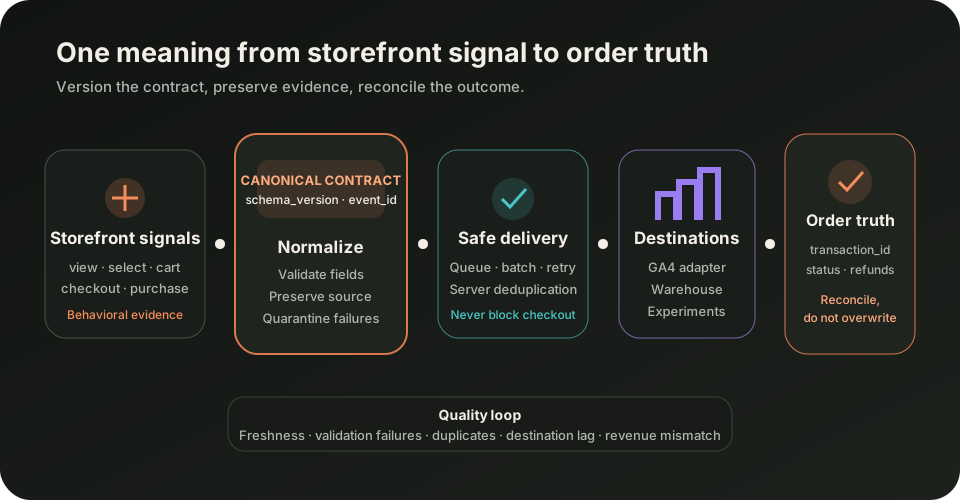
The right boundary is a small, versioned event contract between Zid and every analytics destination. The storefront adapter translates platform events once. Downstream systems consume the same stable meaning.
Start with the decisions, not the dashboard
Write the questions the measurement system must answer before adding tags. Which list or campaign introduced a product? Where do shoppers leave between cart and checkout? Does a checkout error reduce paid orders? Which acquisition source produces revenue that survives cancellation and refund? Which storefront release changed conversion without degrading performance?
Each question implies an event, dimensions and a source of truth. Product discovery needs list, position and product identity. Funnel analysis needs a stable anonymous session plus a later authenticated identity. Revenue needs a transaction identifier that can be reconciled with the order system. Release analysis needs deployment or experiment context. Do not collect a field merely because it exists in the source payload.
Treat the browser stream as behavioral evidence. Treat the commerce backend as the authority for the final order lifecycle. This distinction prevents a client-side purchase signal from silently becoming accounting truth.
Inventory Zid's event surface
The official Zid page documents purchase, product-view, add-to-cart, remove-from-cart and start-checkout events, plus view-item-list and select-item events. Purchase includes a transaction identifier, value, currency and items. The checkout event receives cart context, while list and selection events preserve the discovery step before a product page opens.
Those events map well to the standard commerce vocabulary in Google's GA4 ecommerce guide: view_item_list, select_item, view_item, add_to_cart, remove_from_cart, begin_checkout and purchase. Use that mapping at the destination adapter, not as your internal domain model. A warehouse, product analytics tool and experiment service should not force each other to inherit GA4-specific limits.
Also record what the platform does not guarantee. A browser callback is not an exactly-once message. Event ordering can change across tabs. A customer may be anonymous when viewing a product and authenticated by checkout. A script can be blocked or the page can close before a request finishes. These are design inputs, not edge cases.
Define one canonical event envelope
Normalize every callback into an internal envelope before forwarding it. Keep the envelope small, explicit and independently versioned from the application release.
{
  "event_name": "checkout_started",
  "schema_version": 1,
  "event_id": "01K6...",
  "occurred_at": "2026-10-02T10:58:14.221Z",
  "store_id": "store_...",
  "session_id": "anon_...",
  "customer_id": null,
  "source_event": "start_checkout",
  "source": {"channel":"organic", "campaign":null},
  "cart": {"id":"cart_...", "currency":"SAR", "value":219.00},
  "items": [{"product_id":"p_...", "variant_id":"v_...", "quantity":1}],
  "context": {"page":"/products/...", "release":"storefront-2026.10.02"}
}
Generate event_id in your adapter and preserve it through retries. Keep source_event for debugging while consumers rely on event_name. Put money beside an explicit currency, quantities beside stable product and variant identifiers, and list context beside product discovery events. Validate required fields at the edge and quarantine invalid records rather than filling them with convincing defaults.
Schema evolution must be additive by default. A new optional field can appear inside version 1; a changed meaning, unit or required field deserves version 2. Publish fixtures for every event and run them against destination adapters in CI. If Zid changes a field name or shape, only the source adapter should change.
Make delivery idempotent and page-safe
The storefront must remain fast when analytics is slow. Capture the event synchronously, validate only inexpensive invariants, append it to a memory or durable browser queue when appropriate, and flush in small batches. Never hold checkout navigation open while waiting for an analytics vendor.
Use event_id as the idempotency key at the collector. A retry returns success for an already accepted identifier without inserting a second event. At the warehouse boundary, enforce a unique key or deterministic merge. Add a short-lived client-side sent set only as an optimization; the server remains responsible for deduplication.
For end-of-page delivery, MDN recommends reacting to visibility changes and using navigator.sendBeacon() for small analytics payloads. The Beacon API is asynchronous and does not block the next navigation. It still does not create an exactly-once guarantee, so keep identifiers and server-side deduplication. Avoid unload and beforeunload as primary delivery hooks because browsers can skip them, especially on mobile.
Set hard budgets: script bytes, initialization time, batch size, collector timeout and queue depth. Drop verbose diagnostics before dropping purchase or checkout events, and expose a metric when the queue overflows. Zid advises testing injected app scripts in a development store and optimizing them for performance; make that an actual release gate.
Stitch identity without rewriting history
Create an anonymous session identifier before authentication. When customer state becomes available, emit an identity-linked event that associates the anonymous session with the internal pseudonymous customer key. Do not rewrite historical raw events in place. Resolve identity in a modeled table or query layer so the original evidence remains auditable.
Keep authentication state separate from consent. A logged-in customer is not automatically permission to send personal data to every analytics destination. Minimize payloads at collection time: product identifiers, quantities, money, session and pseudonymous customer keys are usually enough. Do not forward names, phone numbers, addresses or free-form notes into analytics unless a documented purpose, retention rule and lawful basis require them.
Define attribution as code, not dashboard folklore. Capture entry source and campaign once, preserve internal list and position context through select and add-to-cart, and decide whether reports use first touch, last non-direct touch or a different model. Internal navigation must not overwrite acquisition. Store the rule version with derived attribution so a future model change can be compared rather than silently rewriting history.
Reconcile purchase with order truth
The purchase callback is valuable because it is close to the customer experience, but it can be duplicated, blocked or emitted before later order changes. Ingest it as purchase_observed, keyed by transaction_id. Separately import authoritative order status from the merchant's server-side integration or operational export. Build a reconciliation job that compares transaction identity, currency, gross value and item quantities.
Promote an observed purchase to order_confirmed only when the authoritative source matches. Model later paid, cancelled, partially refunded and fully refunded states as new facts, not edits to the original event. This gives product teams a fast conversion signal while finance and merchant reporting retain operational truth.
Track three quality ratios: observed purchases without an order, orders without an observed purchase, and value mismatches. Segment them by browser, storefront release and acquisition source. A sudden rise can reveal a blocked script, navigation regression, schema drift or a faulty currency conversion before stakeholders argue over two dashboards.
Map destinations after the contract
Create a pure adapter from the canonical vocabulary to each destination. For GA4, translate product_list_viewed to view_item_list, product_selected to select_item, product_viewed to view_item, cart_item_added to add_to_cart, cart_item_removed to remove_from_cart, checkout_started to begin_checkout and the reconciled transaction signal to purchase according to the reporting policy.
The GA4 ecommerce documentation defines the items array and recommended event names. Follow it at the GA4 boundary, including currency when value is sent, but retain richer internal context in the warehouse. Destination delivery should have independent retry, error and sampling policies. A vendor outage must not delete the canonical event.
Connect performance to the same release and session context. The web.dev guide on combining Web Vitals with GA4 and BigQuery shows why field performance becomes more useful when it can be queried alongside business dimensions. Do not claim that a slow page caused abandonment from correlation alone; use the joined data to find a hypothesis, then verify it with controlled changes or deeper investigation.
Test the measurement system as a product
Build contract tests from documented payloads and sanitized development-store captures. Assert field types, currency rules, item identity, quantity signs and required transaction fields. Add mutation cases: missing item list, repeated callback, late authentication, two tabs, offline-to-online recovery, blocked storage, rapid navigation and a collector timeout.
Run a shadow period in which the new pipeline writes beside the existing analytics without powering executive reports. Compare funnel transitions and revenue totals daily. Investigate differences instead of forcing equality: the old system may be wrong, the new contract may be incomplete, or the two may define a stage differently.
Monitor freshness, acceptance rate, validation failures, duplicate rate, destination lag and reconciliation gaps. Alert on changes relative to the event's own baseline, not one global threshold. A low-volume store and a campaign spike need different sensitivity.
A practical rollout sequence
First, document the decision questions and event dictionary. Second, implement the Zid source adapter and canonical validator behind a release flag. Third, persist raw accepted events and idempotency keys before adding destinations. Fourth, ship GA4 and warehouse adapters in shadow mode. Fifth, reconcile purchase observations with orders and publish data-quality metrics. Finally, migrate dashboards only after the business definitions and discrepancies are reviewed.
Version the event contract, attribution rule and storefront release independently. Make rollback remove destination delivery without destroying accepted raw events. Keep a small runbook for queue growth, destination rejection, schema drift and purchase mismatch.
The engineering decision
Zid's storefront events provide the observation points. Trust comes from the system around them: one canonical contract, explicit identity and attribution rules, idempotent delivery, page-performance budgets and reconciliation against order truth.
Send every destination the same meaning rather than the same raw callback. Preserve evidence before transformation. Treat purchases as a lifecycle, not a page event. Then the analytics layer can support product decisions, merchant operations and experiments without becoming a second, contradictory commerce system.
Official references
These references document the tools discussed. Examples and design decisions are illustrative and should be adapted to the project and its versions.
Prepared by: Noor Yasser
Working through a similar engineering challenge?
I help teams turn architecture decisions into a clear scope and dependable, reviewable implementation.